Broadcast AV equipment types: the 2026 professional guide
Date added: 11/07/2026

Broadcast AV equipment is defined as the integrated hardware and software used to capture, process, mix, and distribute professional audio and video content across live and recorded productions. The core categories include cameras, video switchers, audio consoles, broadcast monitors, and transmission gear, each governed by standards such as SMPTE 2110 and ATSC 3.0. Signal integrity and timing synchronisation are the two non-negotiable principles that run through every category. Software-defined and hybrid tools are now reshaping what a broadcast chain looks like, but the underlying equipment roles remain constant.
1. What are the main broadcast AV equipment types?
Broadcast AV equipment types fall into five functional categories: acquisition (cameras), switching and mixing (video switchers), audio (consoles and microphones), monitoring (displays and scopes), and distribution (transmission and signal routing). Each category contains both traditional hardware and newer software-defined alternatives. Understanding where each category sits in the signal chain is the fastest way to make confident purchasing or hire decisions.
2. Studio cameras and broadcast camera types
Studio cameras are the primary acquisition tool for fixed broadcast environments. They connect to a camera control unit (CCU) via triax or fibre cable, which carries power, video, and talkback on a single run. The Blackmagic Studio Camera 4K is a well-established example of a studio camera that delivers 4K SDI output with genlock support at a fraction of traditional broadcast camera costs.
PTZ (pan-tilt-zoom) and robotic cameras are the fastest-growing camera type in corporate and broadcast studios. They remove the need for a camera operator on each position, which reduces crew costs significantly. PTZ cameras now support NDI and SMPTE 2110 IP outputs, making them compatible with modern IP-based production workflows.
ENG (electronic news gathering) and EFP (electronic field production) cameras are shoulder-mounted units built for location work. They carry their own batteries, record internally, and output SDI for live feeds. HDR capability, typically HLG or PQ, is now standard on broadcast-grade ENG cameras.
- Studio cameras: Fixed position, CCU-controlled, triax or fibre connection
- PTZ/robotic cameras: Operator-free, IP-native, ideal for corporate and multi-camera studios
- ENG/EFP cameras: Location-ready, SDI output, internal recording, HDR support
- IP cameras (NDI/SMPTE 2110): Network-distributed, software-controlled, growing adoption in hybrid facilities
Pro Tip: Genlock capability is non-negotiable for multi-camera live production. Without it, frame-accurate switching is impossible and you will see visible glitches on cuts.
3. Video switchers and vision mixers
A video switcher, also called a vision mixer, is the device that selects and transitions between multiple video sources in real time. Hardware switchers offer the lowest latency and the highest reliability for live broadcast. The Blackmagic Design ATEM Mini PRO handles up to four HDMI inputs with built-in streaming, making it a practical entry point for smaller productions.
Hardware switchers at the mid-tier, such as the Roland V-40HD Multiformat Vision Mixer, support multiple formats simultaneously and include built-in scalers. This matters when you are mixing sources with different resolutions or frame rates in a single production. The Blackmagic Smart Videohub Cleanswitch 12x12 extends routing capability for larger facilities managing multiple SDI feeds.
Software switchers and GPU-accelerated compositing engines are now a genuine alternative for many productions. GPU-accelerated software engines manage compositing, mixing, and graphics in unified interfaces, reducing physical footprint and power requirements. Modern broadcast software platforms achieve sub-250ms latency for live production, enabling interactive multi-source remote workflows without heavy hardware.
The most significant emerging trend is the separation of processing from control. Future broadcast control separates server-side processing from web-based control surfaces, enabling remote operation of multi-camera productions from anywhere. This is already in use for remote sports coverage and distributed corporate events.
Pro Tip: Always confirm your switcher supports genlock or SPG input. Timing synchronisation prevents frame drops and jitter when cutting between cameras. Genlock and SPG are the most commonly overlooked specifications at the point of purchase.
4. Broadcast audio consoles and microphone systems
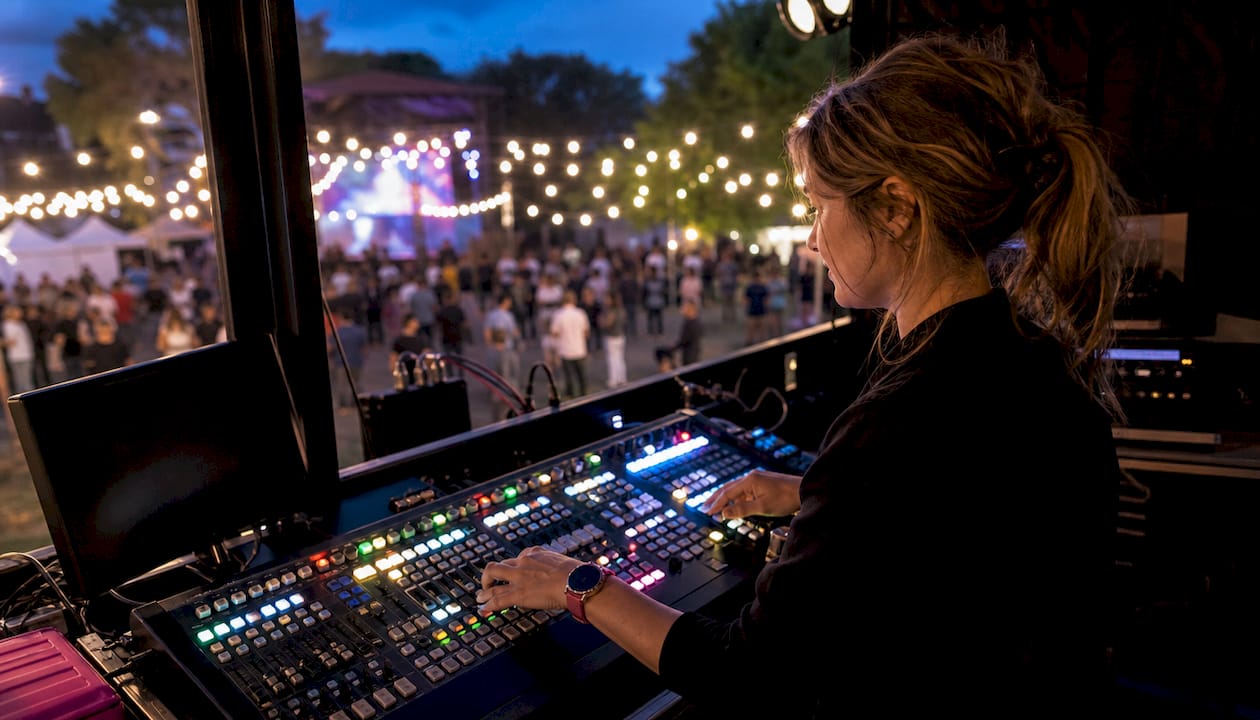
Digital mixing consoles are the standard for broadcast audio. They offer recall, automation, and digital routing that analogue desks cannot match. The Allen & Heath Avantis Digital Mixing Console supports Dante audio networking and delivers the channel count and processing depth required for complex broadcast productions.
Modern audio mixing consoles support Dante audio networking, embedded metadata, and comply with EBU R128 loudness standards for broadcast. EBU R128 compliance is not optional for broadcast delivery. Loudness non-compliance results in content being rejected by broadcasters or automatically corrected in ways that damage audio quality.
Microphone selection depends entirely on the production format:
- Wireless lavalier microphones: Preferred for presenters and talent. Systems such as the Sennheiser EW-D EM Receiver offer digital transmission with low latency and strong RF management.
- Handheld wireless microphones: Standard for interviews and vox pops. The Sennheiser G4 Receiver remains a reliable choice for live broadcast environments.
- Conference and panel microphone systems: The conference mic system format suits multi-speaker corporate broadcasts and panel discussions.
- Shotgun microphones: Used on booms for drama and documentary production, connected via XLR to the console or audio interface.
Audio embedding and de-embedding is a critical but often overlooked skill. Broadcast signals carry audio embedded within the SDI stream. Dedicated embedders and de-embedders allow audio to be extracted, processed separately, and re-inserted without breaking the signal chain.
5. Broadcast monitors and display equipment
Broadcast monitors differ from consumer displays in one fundamental way: they are calibrated for accurate colour reproduction and carry zero processing delay. A consumer television applies image enhancement that adds latency and distorts colour. A broadcast monitor shows the signal as it is, which is what operators need for quality control.
The Blackmagic Video Assist 7 Inch 12G HDR Monitor combines a calibrated display with recording capability, making it useful both as a field monitor and as a confidence monitor in studio environments. SDI connectivity is the standard for broadcast monitors, though HDMI inputs are common on monitors designed for hybrid production.
| Monitor type | Primary use | Key specification |
|---|---|---|
| SDI broadcast monitor | Studio quality control | Colour accuracy, zero processing delay |
| Multiviewer display | Multi-source confidence monitoring | Simultaneous display of multiple feeds |
| Waveform/vectorscope | Signal measurement | Luma and chroma analysis |
| Field monitor | Location production | Lightweight, battery-powered, HDR support |
Multiviewers display multiple sources on a single screen, which is standard practice in broadcast galleries. Waveform monitors and vectorscopes measure luma and chroma levels, providing objective signal data that the human eye cannot reliably judge under varying ambient light conditions.
6. Transmission and signal distribution equipment
Transmission equipment carries the finished broadcast signal from the production facility to the audience. The choice between traditional RF transmission and IP delivery defines the entire infrastructure approach. Entry-level streaming-first broadcast setups cost between £8,000 and £25,000, while traditional studio and transmitter setups exceed £50,000 to £200,000. The cost gap reflects the difference in infrastructure complexity.
Traditional terrestrial transmission uses RF modulators, antennas, and transmitters operating under Ofcom licence in the UK. These systems deliver zero-dependency-on-internet reliability but require significant capital investment and ongoing compliance management. ATSC 3.0 and DVB-T2 are the current digital terrestrial standards for broadcast-grade transmission.
IP-based distribution via SMPTE 2110 is the direction the industry is moving. Transitioning to IP workflows depends on rigorous network management, managed switches, PTP (Precision Time Protocol) configuration, and ample bandwidth. The network infrastructure is as important as the devices connected to it. Many facilities underestimate this and encounter sync failures that are difficult to diagnose without specialist knowledge.
Production mobile units integrate cameras, production control, audio, transmission, and communication equipment, supporting multi-camera live events outside traditional studios. OB (outside broadcast) vehicles represent the most complete expression of broadcast AV equipment types working as a unified system.
Key takeaways
Broadcast AV equipment types are most effectively selected by matching each category to its role in the signal chain, from acquisition through to distribution.
| Point | Details |
|---|---|
| Camera selection by workflow | Match camera type to environment: studio, PTZ for fixed multi-camera, ENG for location work. |
| Switcher reliability vs. flexibility | Use hardware switchers for mission-critical live output; software switchers suit iterative and remote productions. |
| Audio compliance is mandatory | EBU R128 loudness compliance and Dante networking are standard requirements for broadcast audio delivery. |
| Monitor accuracy over consumer displays | Broadcast monitors provide calibrated colour and zero processing delay, which consumer screens cannot match. |
| IP infrastructure is the hidden cost | SMPTE 2110 workflows require managed switches, PTP, and bandwidth planning before any device is connected. |
Hardware vs. software: what experience actually teaches you
The industry conversation about hardware versus software has been running for a decade, and the answer is still the same: it depends on what you cannot afford to get wrong. Hardware switchers do not crash mid-broadcast. Software engines give you capabilities that would cost ten times as much in dedicated hardware. Both statements are true, and neither cancels the other out.
What I have seen repeatedly is professionals making the mistake of going software-first because the cost looks attractive, then discovering that their network infrastructure is not ready for it. Hardware-centric systems are necessary for zero-tolerance, multi-source live broadcasts requiring high reliability, whereas software-defined tools suit flexible, iterative production and remote collaboration. That is not a preference. That is the operational reality.
For professionals starting out or working at mid-tier production level, the practical advice is to build your signal chain around one reliable hardware switcher and layer software tools on top for graphics, streaming, and remote sources. The Vmix 4K Media Server is a good example of a software platform that integrates cleanly alongside hardware without replacing it entirely.
The future is clearly moving towards remote and cloud production. Web-based control surfaces separated from processing units are already in professional use. But the fundamentals, genlock, signal integrity, loudness compliance, and proper cabling, do not change regardless of whether your switcher is a hardware unit or a GPU running in a data centre.
— Michael
Fireflyav’s broadcast AV equipment for professional productions
Fireflyav supplies broadcast production gear across every category covered in this guide, from studio cameras and vision mixers to digital mixing consoles and professional microphone systems.
Whether you are specifying a full broadcast studio, an OB setup, or AV equipment for live streaming, Fireflyav’s team provides equipment and technical support matched to your production requirements. The Allen & Heath Avantis Digital Mixing Console and Blackmagic Design ATEM Mini PRO are among the broadcast-grade options available to hire or purchase. For a full equipment specification and expert consultation, complete the product enquiry form and a specialist will respond with a tailored recommendation.
FAQ
What are the core broadcast AV equipment types?
The core categories are cameras, video switchers, audio consoles, broadcast monitors, and transmission equipment. Each category has a defined role in the signal chain from acquisition to distribution.
What is the difference between SDI and HDMI in broadcast?
SDI is the professional standard for broadcast signal paths, carrying video over long cable runs with no copy protection limitations. HDMI is used in consumer and hybrid production environments but is avoided in primary broadcast signal paths.
Do I need a hardware switcher or will software work?
Hardware-centric systems are the right choice for zero-tolerance live broadcasts. Software switchers suit remote collaboration and productions where flexibility matters more than absolute reliability.
What does SMPTE 2110 mean for broadcast equipment?
SMPTE 2110 is the standard for transporting video, audio, and data over IP networks. Adopting it requires managed network switches, PTP configuration, and careful bandwidth planning alongside the broadcast devices themselves.
How much does a broadcast setup cost?
Entry-level streaming-first setups cost between £8,000 and £25,000. Traditional studio and transmitter infrastructure exceeds £50,000 to £200,000 depending on compliance requirements and signal distribution scope.