Stop rehearsal chaos: UK event rehearsal schedule and AV checklist
Date added: 2/10/2026

A working event rehearsal schedule names one owner, blocks every phase from table read to dress run with clear start and finish times, and locks in safety and technical milestones well before production week. It coordinates people, kit and risk so the technical run and the final performance don’t collide on the day. We’re an audio visual hire and event production company based in Leeds and Preston working UK-wide, and we support rehearsals for theatre, corporate and hybrid events. Below you’ll find a call sheet template, a timed tech-day example and a step-by-step build workflow.
TL;DR:
- Building a detailed master schedule with clear ownership, fixed dates for key milestones, and version control prevents confusion and ensures smooth coordination.
- Scheduling the correct personnel for each rehearsal phase optimizes time, with full cast and crew involved only during relevant sessions like dress rehearsals.
- Arranging technical and safety meetings at least six weeks in advance allows ample time to address access, power, and staffing issues proactively.
- Incorporating buffers of 15 to 20 minutes after major sessions helps absorb overruns, preventing schedule cascading failures.
- Sharing schedule updates via a single cloud document avoids version confusion and helps external vendors align tech setup with rehearsal needs.
Table of Contents
- What belongs on every rehearsal schedule?
- What are the rehearsal phases and who needs to be there?
- How do you build a rehearsal schedule from draft to production week?
- When do safety and technical meetings need to happen?
- Who owns the schedule and how do you avoid burning out stage management?
- What templates and timed examples can you copy?
- How does an AV supplier fit around a rehearsal schedule?
- How do you plan for schedule changes or delays?
- How do you coordinate with external vendors and suppliers?
- Author perspective: three practical priorities planners often miss
- FAQ
- Sources
What belongs on every rehearsal schedule?
A rehearsal schedule earns its place as a working document only when it carries enough detail that nobody needs to ask a follow-up question. Stage management guidance from the Stage Management Association treats scheduling and note distribution as core duties, not admin on the side, and that standard is worth applying to corporate rehearsals too.
Start with document-level fields: production name, date, venue, schedule owner and version number, plus a distribution list so everyone knows who last saw the current copy. Then build the session itself:
- Session timing: start and finish time, with a one-line objective for the block.
- Participants: named roles, not just “cast” or “crew”, so absences are spotted early.
- Technical columns: kit list, console assignments (an Allen & Heath desk, LED wall feed, video routing), comms channels and power draw.
- Logistics: venue access window, load-in notes, catering breaks, first aid cover, transport and the derig window.
- Version control: who signs off changes and how last-minute edits reach everyone, not just the people in the room.
Arrival and wardrobe call times deserve their own line separate from the session start, because a 7:00pm curtain rarely means a 7:00pm call for the cast. Our audio visual equipment explained page breaks down which kit typically needs its own technician call, which helps when you’re tagging the technical column.
What are the rehearsal phases and who needs to be there?
Rehearsals move through recognisable stages, and scheduling the wrong people into the wrong stage wastes studio time and patience in equal measure.
- Table read: director, creative team and full cast; no technical crew required.
- Blocking: director, cast and stage management; essential only, since movement is still being worked out.
- Working rehearsals: cast and relevant scene partners, with stage management tracking notes.
- Cue-to-cue / technical rehearsal: full technical crew, running crew and essential cast; this is where lighting, sound and video cues get set against the action.
- Dress or full run: everyone, run at performance pace with no stops unless safety demands one.
Blocking has to happen before technicals because cues are built around movement, not the other way round. Where rehearsals are amplified, the HSE’s sound advice guidance recommends allowing recovery time after loud sessions and recording the findings in the risk assessment, which should shift how tightly you pack consecutive loud calls.
How do you build a rehearsal schedule from draft to production week?
Work backwards from the dates that cannot move. Tech day, photo call, dress rehearsal and performance nights are fixed points; everything else gets scheduled around them.
Bring the right people in at the right stage:
- Stage manager: owns the master schedule from the first draft onward.
- Production manager: confirms get-in, fit-up and get-out windows with the venue.
- Technical leads: set the technical rehearsal length and kit dependencies.
- Venue technical contact: confirms access, staffing and any house rules on rehearsal hours.
Once those conversations are done, build the master schedule in blocks: get-in and fit-up, rehearsal blocks by phase, technical rehearsal, dress rehearsal, previews if applicable, performances, then get-out. The HSE’s event management guidance frames every one of these as a phase with its own controls that need testing, not just a line on a calendar, so build in time to actually check that a control works rather than assuming it does. Our event production setup examples page shows how get-in and fit-up timings vary by venue type, which is worth checking before you fix those blocks.
Daily call sheets are then cut from the master schedule, each one tagged with that day’s technical requirements and a named owner responsible for the day running to time.
Pro Tip: Keep the master schedule in one shared cloud document rather than emailing updated spreadsheets; version confusion is one of the most common causes of a missed call.
For most productions, a shared spreadsheet template covers daily call sheets perfectly well. Larger multi-venue or touring productions sometimes justify a dedicated event management tool, but the discipline of one owner and one version matters more than the software.
When do safety and technical meetings need to happen?
Safety milestones need fixed dates on the schedule, not a vague intention to “sort it before tech”.
Venue guidance from Wakefield Council describes production technical meetings commonly arranged several weeks before production, with the production risk assessment completed by that point. Arranging the technical meeting at least six weeks ahead gives time to resolve access, power and staffing issues before they become rehearsal-week emergencies, according to Wakefield Council’s guidance.
Build these into the schedule explicitly:
- Risk assessment completion, signed off before the technical meeting.
- Noise checks, following the recovery-time principle from HSE sound guidance.
- PAT and electrical checks on all rented and house equipment.
- Work-at-height controls for any rigging or set work above floor level.
HSE’s incident and emergency guidance recommends testing show-stop wording and public address communications before the event, and running a tabletop exercise where practical. For touring shows or novel temporary structures, a dedicated structure rehearsal documents lessons for safer erection and deconstruction next time.
Who owns the schedule and how do you avoid burning out stage management?
One person has to own the master schedule, and that’s conventionally the stage manager, working with a separate show-caller running cues during tech and dress. Stage Management Association guidance places schedule-building and note distribution squarely within the stage manager’s core duties.
Rehearsal week length varies by agreement. Arts Professional reported Equity trials of a five-day rehearsal week in parts of the sector, so check the applicable agreement before fixing calls.
- Split DSM, ASM and props prep duties rather than loading one person with all three.
- Build in dedicated note-writing time after each run, not squeezed between calls.
- Confirm venue minimum staffing levels early, and book in resident or additional technicians accordingly.
What templates and timed examples can you copy?
A compact daily call sheet needs production, date, venue and version at the top, then rows for each session with time, objective, participants and kit tag. A corporate presenter rehearsal variant swaps “cast” for “presenter” and adds a slide-deck version column.
A worked tech-day timetable might run like this:
| Time | Activity | Kit tag |
|---|---|---|
| — | Load-in and rig check | PA, lighting desk |
| — | Cue-to-cue, Act 1 | LED wall, video |
| — | Break | None |
| — | Cue-to-cue, Act 2 | Comms, FOH desk |
| 2:00pm to 5:00pm | Full technical run | All departments |
Tag each column by department, PA, FOH desk, lighting desk, video, comms, and name an owner for each so a fault report reaches the right person first time. Before sending any sheet, check the version number, confirm sign-off and recheck the distribution list.
- Save a blank version of the call sheet as the house template for the next production.
- Keep the tech-day timetable as a reusable shape, adjusting only the activity names.
How does an AV supplier fit around a rehearsal schedule?
As an AV hire and event production company working UK-wide, we build our technician call times directly against the rehearsal master schedule rather than treating AV as a separate booking.
Our practical checklist for confirming kit against a schedule:
- Confirm Absen LED wall configuration and content resolution against the venue’s playing space.
- Lock Panasonic projector throw distance and brightness to the lighting state.
- Check Sennheiser radio mic frequencies against other RF in the venue.
- Confirm Allen & Heath console channel counts and DB Technologies speaker placement for coverage.
- Agree Birddog camera positions and Lite Deck staging dimensions before fit-up.
We ask for the final kit list, power requests and onsite access windows by the technical meeting, not on the morning of fit-up.
Pro Tip: Book technicianed hire rather than dry hire when the schedule has tight cue-to-cue turnarounds, since a technician on site can troubleshoot in real time rather than over the phone.
How do you plan for schedule changes or delays?
Rehearsal schedules slip. A cast member is late, a set piece isn’t ready, a technical fault eats an hour that was earmarked for a full run. Planning for that reality rather than hoping it doesn’t happen is what separates a schedule that survives contact with the week from one that collapses by Wednesday.
Build slack into the schedule rather than discovering it’s needed. A 15 to 20 minute buffer after each major session absorbs small overruns without pushing the whole day back. For technical rehearsals specifically, protect one contingency block, often the end of the day or a half-day before dress, that can be used to catch up on anything that didn’t finish.

Agree in advance what gets cut if time runs out. A pre-agreed priority order (safety checks first, then technical cues, then full artistic polish) means the stage manager isn’t negotiating priorities live under pressure. Document the decision in the day’s notes so the reason for a cut session is clear to anyone reviewing the week afterwards.
Communicate delays the moment they’re confirmed, not at the next scheduled break. A short message to the distribution list, new time, reason, next fixed point, keeps everyone working from the same version of reality. Where a delay pushes into a union-governed rest period or minimum staffing window, check the applicable agreement before reshuffling calls, since some changes need sign-off rather than just a notification.
How do you coordinate with external vendors and suppliers?
Rehearsals rarely involve only the cast and in-house crew. Lighting support, staging contractors, AV suppliers and specialist riggers all need their own slot in the schedule, and each one works to a different lead time.
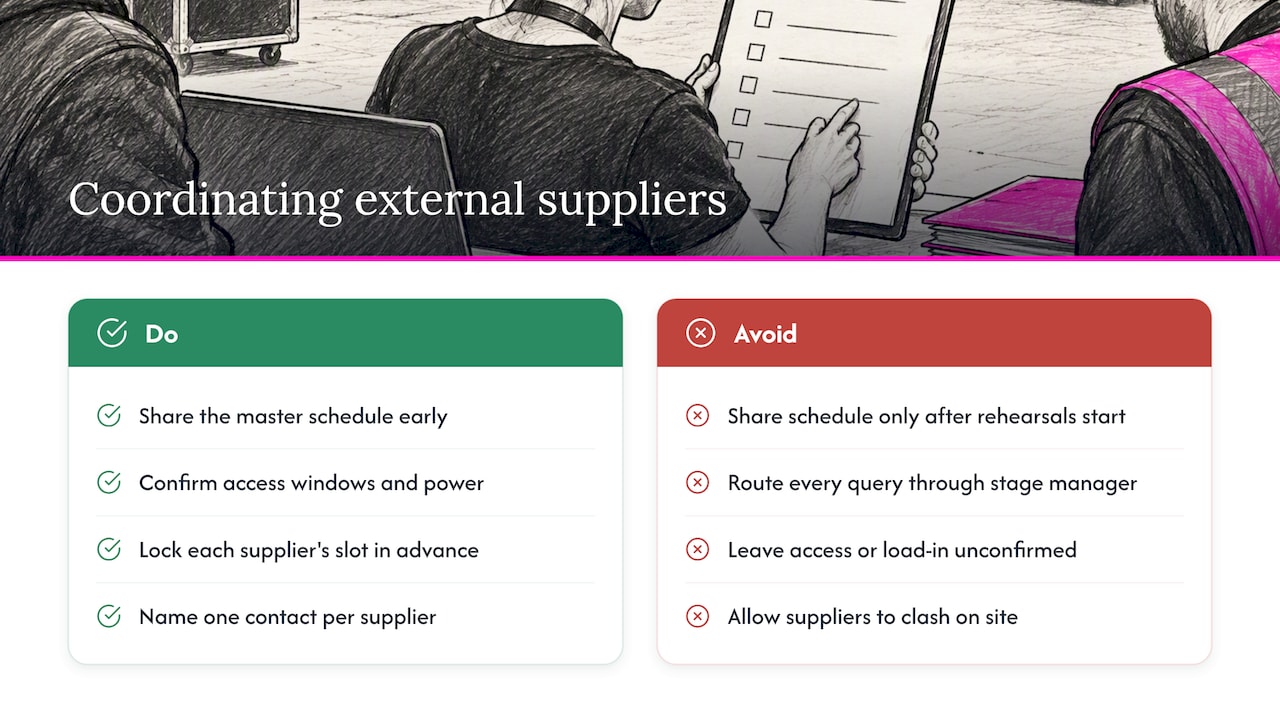
Share the master schedule with every external supplier as soon as get-in and fit-up dates are fixed, not once rehearsals are already under way. Vendors generally need their own confirmation of access windows, power availability and load-in sequencing well ahead of the day, particularly where multiple suppliers are working the same space and need to avoid clashing. A lighting support partner such as Lemon Lens working a shoot day alongside a stage build, for instance, needs its slot locked before either crew turns up.
Name a single point of contact for each supplier on the call sheet rather than routing every query through the stage manager. That keeps technical questions, cable runs, dimmer patches, RF checks, with the people who can actually answer them, while the stage manager keeps ownership of the overall running order.
Tools built for tracking crew arrivals against a schedule, such as Clock Me’s time tracking setup, can confirm supplier crews are on site when the call sheet says they should be, which matters most on get-in day when several contractors are moving through the same access window.
Author perspective: three practical priorities planners often miss
The schedules that fail aren’t usually missing information, they’re missing ownership. Two people both think they’re keeping the master copy, and by Thursday nobody trusts either version. Fix that first.
Second: book the technical meeting early and keep spare time in the fit-up for the thing that doesn’t fit. Third: actually say the show-stop line out loud during tech, with the real microphone, not just write it in the plan.
— Michael
FAQ
What time should a rehearsal dinner be?
There’s no fixed industry standard time for a rehearsal dinner, since it depends on when the rehearsal itself finishes and how far guests are travelling. A common approach is to schedule it for early evening, allowing an hour or so after the rehearsal ends for people to travel and settle before the meal starts.
What are the trends for rehearsal dinners in 2026?
If you’re planning a rehearsal dinner, focus on the fundamentals that always apply: confirm numbers early, agree the venue, and fix the timing against the main rehearsal schedule rather than treating it as a separate event.
How do I write a schedule for an event?
Start from the fixed dates that can’t move (performance night, tech day, dress rehearsal) and work backwards, building master blocks for get-in, rehearsal, technical runs and get-out. Cut daily call sheets from that master schedule, each with a named owner, and distribute a versioned copy to everyone involved rather than emailing separate updates.
What are the stages of rehearsal in theatre?
The standard phases run from table read, through blocking and working rehearsals, into cue-to-cue or technical rehearsal, finishing with a dress or full run. Each phase needs a different group in the room: full cast for the table read, essential cast and stage management for blocking, and the complete technical and running crew once cue-to-cue begins.
How far in advance should the venue technical meeting happen?
Venue guidance commonly points to arranging the production technical meeting at least six weeks before production, with the risk assessment completed by that point. That gives enough time to resolve access, staffing and power questions before they turn into rehearsal-week problems.