PA systems for events: what every planner needs to know
Date added: 11/07/2026
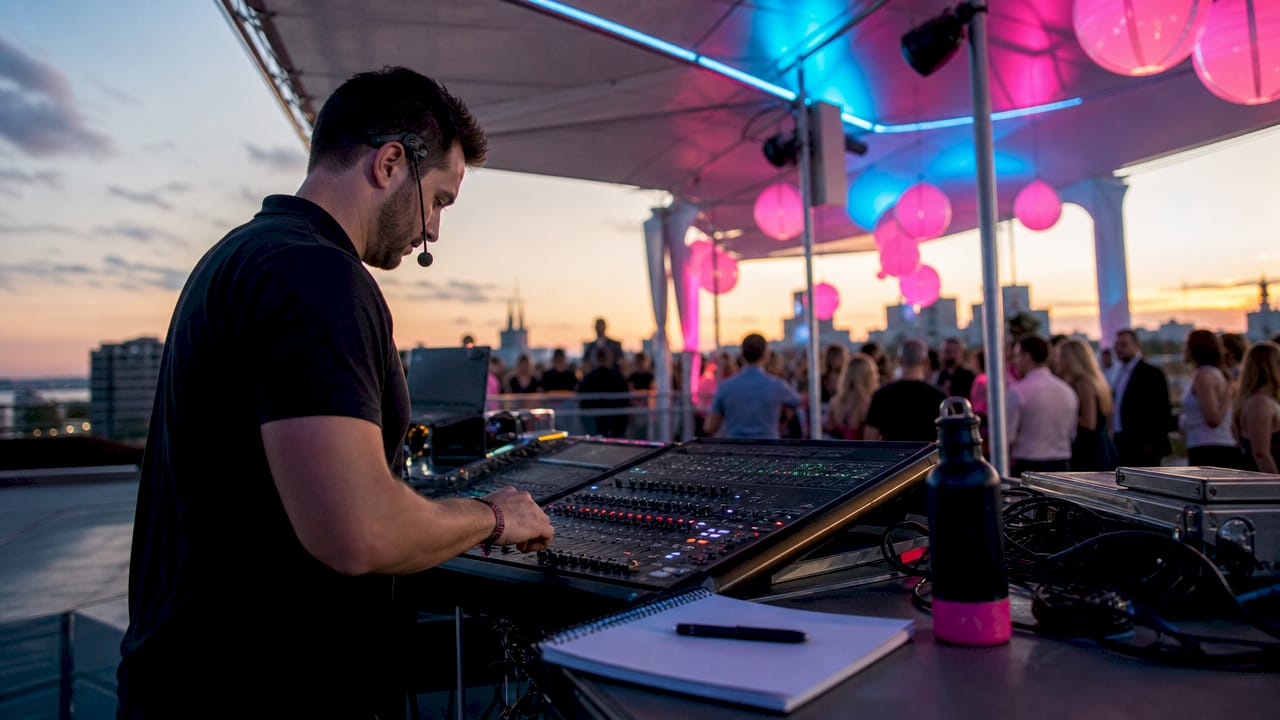
A PA system, short for Public Address system, is an integrated audio setup that amplifies and distributes sound so large audiences can hear clearly at events and conferences. Every working PA system combines four core components: microphones, mixers, amplifiers, and speakers. Together, these components convert a speaker’s voice or a music source into clear, consistent sound across an entire venue. Understanding what a PA system does at events is the first step to choosing the right one and setting it up correctly.
What is a PA system at events and how does it work?
A PA system at events is the complete chain of equipment that takes sound from a source and delivers it to an audience at the right volume and quality. Without it, a speaker addressing 200 delegates in a conference hall would be inaudible beyond the first few rows. The system works by capturing sound through a microphone, routing it through a mixer, boosting it with an amplifier, and broadcasting it through speakers positioned around the venue.
Modern PA systems can also integrate zoning capabilities, allowing selective audio targeting to defined areas. This means a planner running a multi-room conference can send different audio feeds to different spaces without bleed or confusion. Zoning is particularly valuable for exhibitions, trade shows, and large corporate events where separate sessions run simultaneously.
The industry also uses the term “sound reinforcement system” (SR system), which is related but distinct. A PA system prioritises speech intelligibility and clear announcements. An SR system is engineered for high-fidelity music reproduction. Knowing the difference matters when you are booking equipment for your event.
What are the main components of a PA system?
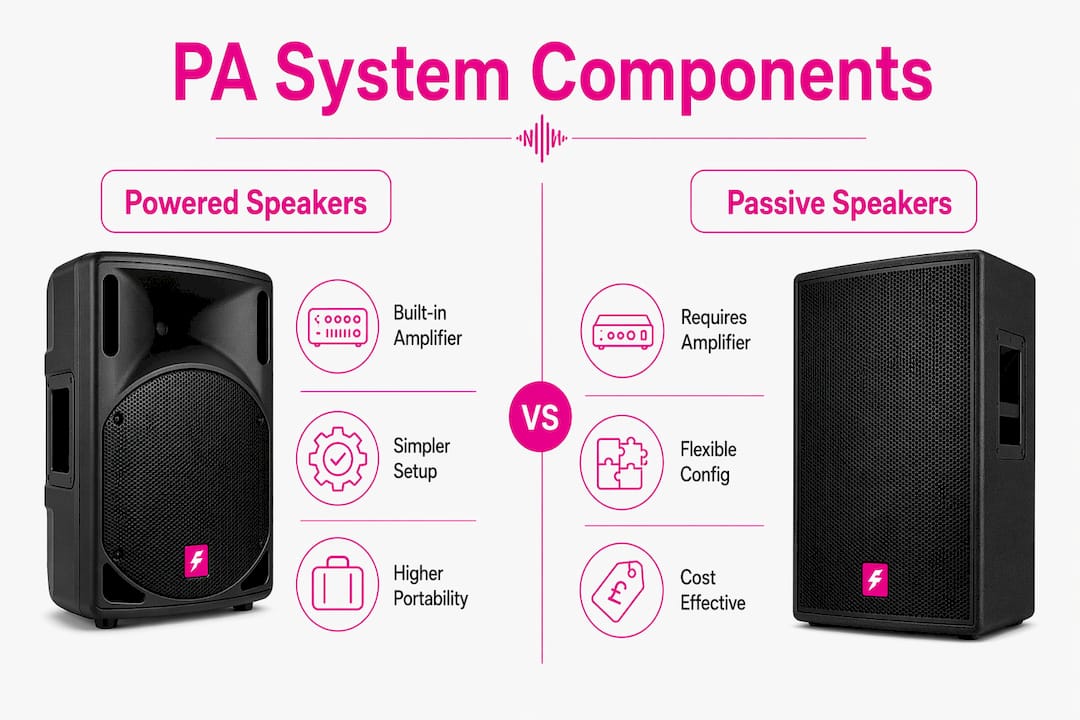
PA systems typically consist of microphones, mixers, amplifiers, and speakers, each playing a specific role in the audio chain. Removing or misconfiguring any one component degrades the entire output.
Here is what each component does:
- Microphones capture sound at the source. Handheld, lapel, and headset microphones each suit different event formats. A panel discussion benefits from individual lapel mics; a keynote speaker often uses a handheld or podium mic.
- Mixers combine multiple audio inputs and let a sound engineer adjust levels, tone, and routing. A mixer is the control centre of any PA setup.
- Amplifiers boost the electrical signal from the mixer to a level powerful enough to drive the speakers. Without sufficient amplification, speakers produce weak, distorted sound.
- Speakers convert the amplified signal back into sound waves. Their placement and coverage angle determine how evenly sound reaches the audience.
One critical distinction for event planners is the difference between passive and powered speakers. Passive speakers require separate amplifiers, whereas powered (active) speakers have built-in amplifiers, simplifying setup and making them ideal for smaller or mobile events. Choosing the right speaker type directly affects portability, sound quality, and how long your crew spends on setup.
Pro Tip: For conferences with a conference mic system, always request a dedicated channel on the mixer for each microphone. This gives your sound engineer precise control over individual speakers and eliminates the risk of one hot mic overwhelming the room.
What are the primary benefits of using a PA system at live events?
PA systems offer five primary benefits: enhanced sound quality, wider audience reach, adaptability to various environments, user-friendly operation, and cost-effectiveness compared to permanent installations. These advantages become critical in large auditoriums or open-air events where natural acoustics fall short.
- Enhanced sound clarity means every attendee hears the same quality of audio, regardless of where they sit. This directly improves engagement and reduces listener fatigue.
- Wider reach allows a single speaker to address thousands of people simultaneously, which is impossible without amplification.
- Adaptability means the same core equipment can work in a hotel ballroom, an outdoor festival site, or a corporate boardroom with the right configuration.
- User-friendly operation has improved significantly. Modern portable PA systems are designed for quick deployment, reducing the technical burden on event staff.
- Cost-effectiveness is a genuine advantage for planners. Hiring a PA system for a one-off event costs a fraction of installing a permanent audio infrastructure.
The benefit that most planners overlook is safety. PA systems play a critical role as infrastructure for emergency communication and coordinating evacuations during incidents at large events. A well-configured PA system is not just a comfort feature. It is a safety asset that regulators and venue managers increasingly expect to see in event risk assessments.
“A PA system that is designed only for entertainment and not for emergency communication is a system that is only half-finished. Every event planner should ask their AV supplier how the system handles an emergency broadcast before the event goes live.”
Understanding the benefits of AV at corporate events goes well beyond sound quality. The right audio setup shapes how your audience perceives the entire event.
How to set up a PA system for an event
Effective PA system setup follows six key steps: plan placement, connect microphones to the mixer, link the mixer to amplifiers and speakers, verify power order, perform sound checks, and finalise equalisation. Skipping any step creates problems that are difficult to fix once an event is live.
- Plan speaker and microphone placement. Walk the venue before setup begins. Identify where the audience will sit, where sound reflections are likely, and where cables can run safely. Speakers should sit at ear level and angle towards the audience, not the ceiling.
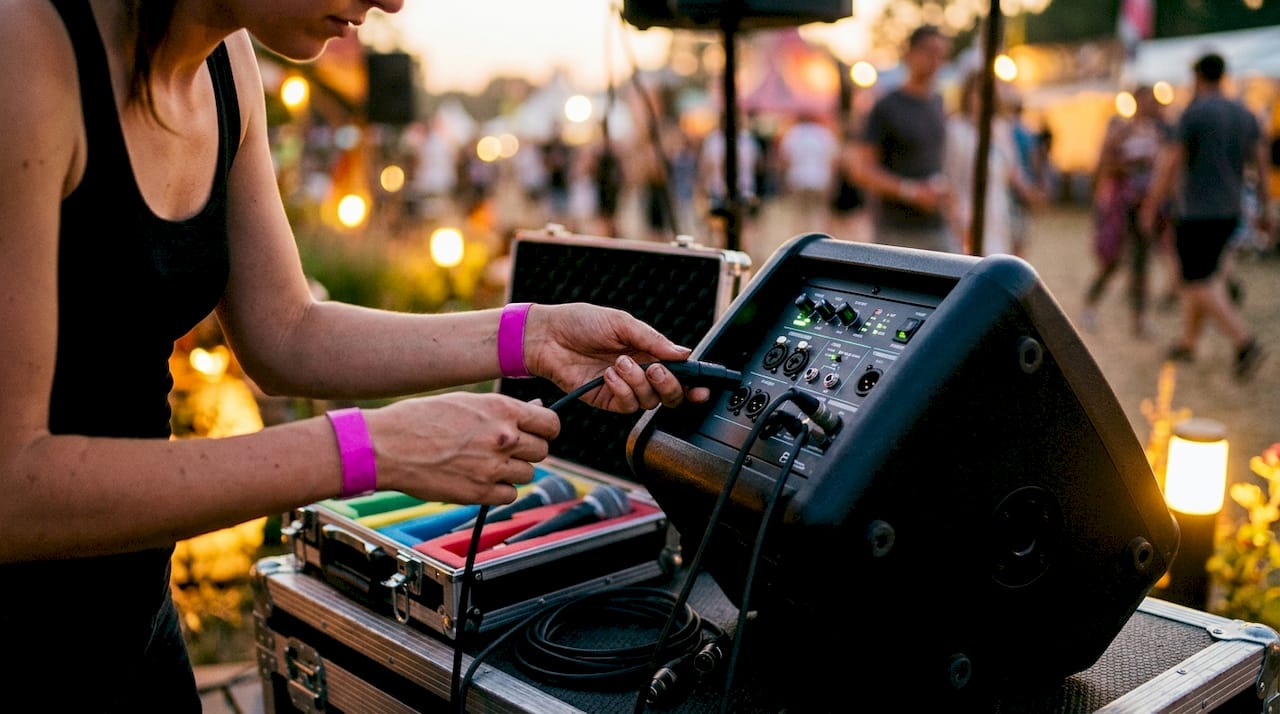
- Connect microphones to the mixer. Use balanced XLR cables to minimise interference. Label each channel on the mixer so your engineer knows which input corresponds to which microphone.
- Link the mixer to amplifiers and speakers. Run the main output from the mixer into the amplifier inputs, then connect the amplifier outputs to the speakers. For powered speakers, the mixer output connects directly.
- Verify power sequencing. Proper power sequencing prevents equipment damage. Power amplifiers turn on last and off first. Connect and verify all components and levels before switching on the amplifiers.
- Conduct sound checks. Test every microphone at the volume levels expected during the event. Walk the room while someone speaks into each mic to identify dead spots or feedback zones.
- Finalise equalisation. Adjust the mixer’s EQ to compensate for the room’s acoustic character. Rooms with hard surfaces need high-frequency cuts; rooms with heavy soft furnishings often need a boost in the mid-range.
Microphones should sit 2–3 inches from the speaker’s mouth for clarity and to avoid feedback. Speakers positioned too close to microphones are the single most common cause of the high-pitched squeal that ruins event openings.
Pro Tip: Always run a full dress rehearsal with the actual presenters, not just a stand-in. Presenters move differently, hold microphones at different angles, and project at different volumes. A rehearsal with the real people eliminates 90% of live surprises.
For a broader view of AV equipment for event planners, understanding how PA systems fit within the wider AV stack helps you make better decisions at the planning stage.
PA systems vs. sound reinforcement systems: which does your event need?
PA systems prioritise speech intelligibility and effective announcements, while sound reinforcement systems are tailored to high-fidelity music reproduction. Choosing the right system aligns with the primary content type of your event.
| Event type | Recommended system | Primary reason |
|---|---|---|
| Corporate conference | PA system | Speech clarity is the priority |
| Award ceremony (speeches and music) | Hybrid PA and SR setup | Both intelligibility and music fidelity required |
| Live music concert | SR system | Full-frequency music reproduction needed |
| Exhibition or trade show | PA system with zoning | Multiple zones, announcements, and background audio |
| eSports event | SR system with PA overlay | High-impact audio plus commentary and announcements |
The scale difference is also significant. A PA system for a 50-person meeting might be a single powered speaker and a wireless microphone. An SR system for a 5,000-capacity music venue involves line arrays, subwoofers, and a dedicated front-of-house engineer. PA systems range vastly in scale, from simple single-microphone setups to complex multi-zone arrays requiring professional operation.
Fireflyav works across both categories, supplying equipment and technical support for corporate conferences, live events, and eSports productions where the audio requirements differ significantly between formats.
What should planners consider when choosing a PA system?
Event planners should consider audience size, venue size, indoor or outdoor settings, and integration needs when choosing a PA system. Getting this assessment right before booking equipment saves time, money, and stress on the day.
- Audience size and venue acoustics determine the power and coverage you need. An outdoor event for 500 people requires far more amplification than an indoor seminar for 80.
- Portability and setup time matter greatly for temporary venues. Powered speakers and compact mixers reduce crew time and the risk of setup errors.
- Multi-zone capability is worth specifying for segmented spaces. A conference centre with breakout rooms needs a system that can route different audio to different areas independently.
- Integration with other AV equipment is increasingly expected. Your PA system should connect cleanly with presentation systems, video conferencing platforms, and any multi-venue screen networks used for signage and communication.
- Budget and scalability should be assessed together. Hiring equipment for individual events is almost always more cost-effective than purchasing, particularly when your event calendar varies in scale.
- Renting versus purchasing comes down to frequency of use. Planners who run more than 20 events per year with consistent technical requirements may find ownership viable. For most event coordinators, rental from a specialist supplier gives access to current equipment without capital expenditure.
Pro Tip: Ask your AV supplier whether the PA system includes a dedicated emergency broadcast channel. This is not a luxury. Many venues now require it as part of their event licence conditions.
Key takeaways
A PA system is the foundation of clear communication at any live event, and its design should account for both audience experience and emergency safety from the outset.
| Point | Details |
|---|---|
| Core components | Every PA system needs microphones, a mixer, amplifiers, and speakers working together. |
| Safety function | PA systems serve as emergency communication infrastructure, not just audio comfort. |
| PA vs. SR systems | Choose a PA system for speech-led events and an SR system for music-focused productions. |
| Setup sequence | Follow the six-step setup process and always conduct a full sound check before the event. |
| Choosing the right system | Match system scale and features to audience size, venue type, and integration requirements. |
Why I think most event planners underestimate their PA system
After working across corporate conferences, live events, and eSports productions, the pattern I see most often is this: planners spend weeks on catering, décor, and scheduling, then treat the PA system as an afterthought booked two days before the event. That approach almost always produces problems.
The most common mistake is underspecifying for the venue. A system that sounds adequate in an empty room often struggles once 300 people fill the space and absorb high frequencies. Rooms change acoustically when they fill up, and a sound check in an empty venue is only half the job.
The second mistake is ignoring the safety angle entirely. Planners who have never had to use a PA system for an emergency evacuation tend to treat it as a theoretical concern. It is not. The ability to cut all programmed audio and broadcast a clear, authoritative voice across every zone in the building is a genuine operational requirement.
What I find encouraging is that PA technology has become genuinely easier to use without sacrificing quality. Powered speakers with built-in digital signal processing, wireless microphone systems with automatic frequency management, and compact digital mixers have all reduced the technical barrier significantly. The result is that a well-briefed event coordinator can manage a straightforward PA setup without a dedicated sound engineer, provided the system has been correctly specified and tested in advance.
The planners who get the best results treat their AV supplier as a technical partner from the planning stage, not a delivery service on the day.
— Michael
How Fireflyav supports your event audio setup
Fireflyav supplies audio visual equipment and technical support to event planners across the corporate, cultural, and live event sectors. Whether you are running a single-stage conference or a multi-room exhibition, the team can specify, deliver, and operate a PA system matched to your exact venue and audience requirements.
From conference microphone systems to full multi-zone PA rigs, Fireflyav’s equipment catalogue covers the full range of event audio needs. The technical support team is available throughout your event, not just at setup. If you are planning your next event and want to get the audio right from the start, fill out the project form and the Fireflyav team will come back to you with a tailored equipment recommendation.
FAQ
What does PA stand for in events?
PA stands for Public Address. A PA system is an audio setup designed to amplify and distribute sound clearly to a large audience at events, conferences, and public gatherings.
How do I know what size PA system I need?
Audience size, venue dimensions, and whether the event is indoors or outdoors are the primary factors. Larger outdoor events require significantly more amplification and speaker coverage than small indoor meetings.
What is the difference between a PA system and a sound reinforcement system?
A PA system prioritises speech intelligibility and announcements, while a sound reinforcement system is engineered for high-fidelity music reproduction. The right choice depends on whether your event is voice-led or music-led.
Can a PA system be used for emergency announcements?
PA systems function as critical safety infrastructure, enabling emergency broadcasts and evacuation coordination. Planners should confirm that their system includes a dedicated emergency broadcast channel before the event.
Should I hire or buy a PA system for my events?
Hiring is more cost-effective for most event planners, giving access to current equipment without capital expenditure. Purchasing becomes viable only when you run a high volume of events with consistent and predictable technical requirements.