Why corporate events use AV: a planner’s guide
Date added: 3/07/2026

Audio-visual technology is the backbone of every successful corporate event, determining whether your message lands clearly or gets lost in a sea of technical failure. AV, the industry term for integrated audio, video, and lighting systems, covers everything from microphone arrays and digital mixing consoles to projection rigs and live streaming encoders. The reason why corporate events use AV so consistently comes down to three things: clear communication, professional brand presentation, and audience engagement. Get any one of those wrong, and the event suffers. Get all three right, and attendees leave with a strong impression of your organisation.
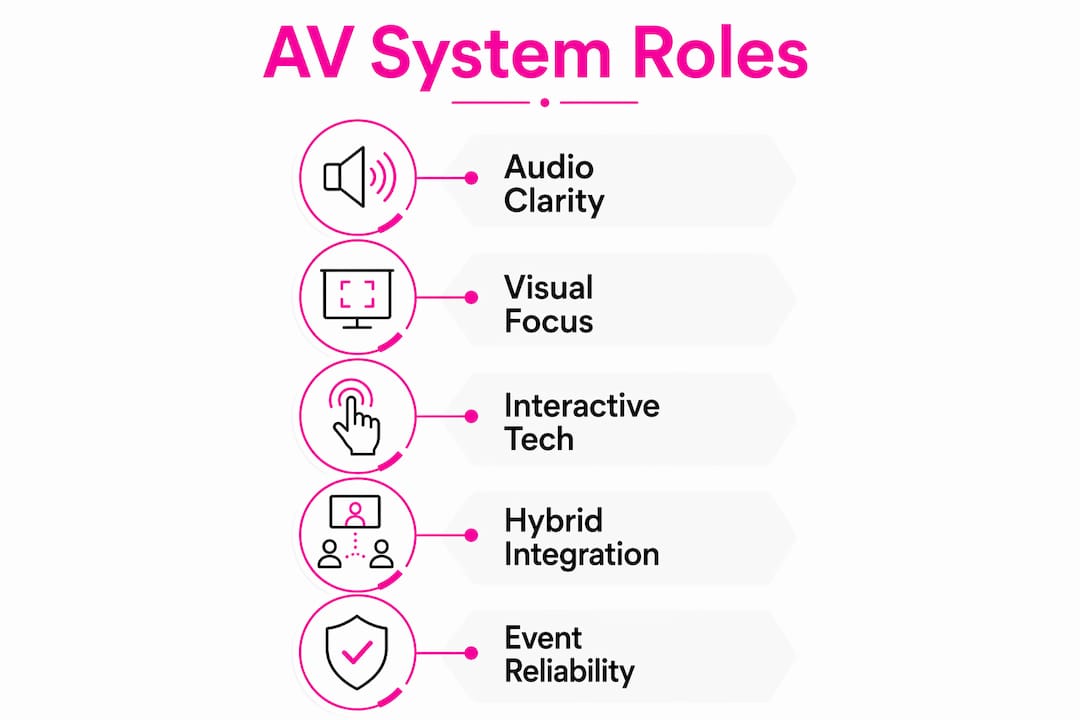
Why do corporate events use AV systems?
AV technology in corporate events is not a luxury add-on. It is the infrastructure that makes communication possible at scale. A speaker addressing 300 delegates in a conference hall cannot rely on unaided voice projection. A product launch streamed to remote offices needs broadcast-quality video. A board meeting with participants across three time zones requires synchronised audio and video that feels natural, not laboured.
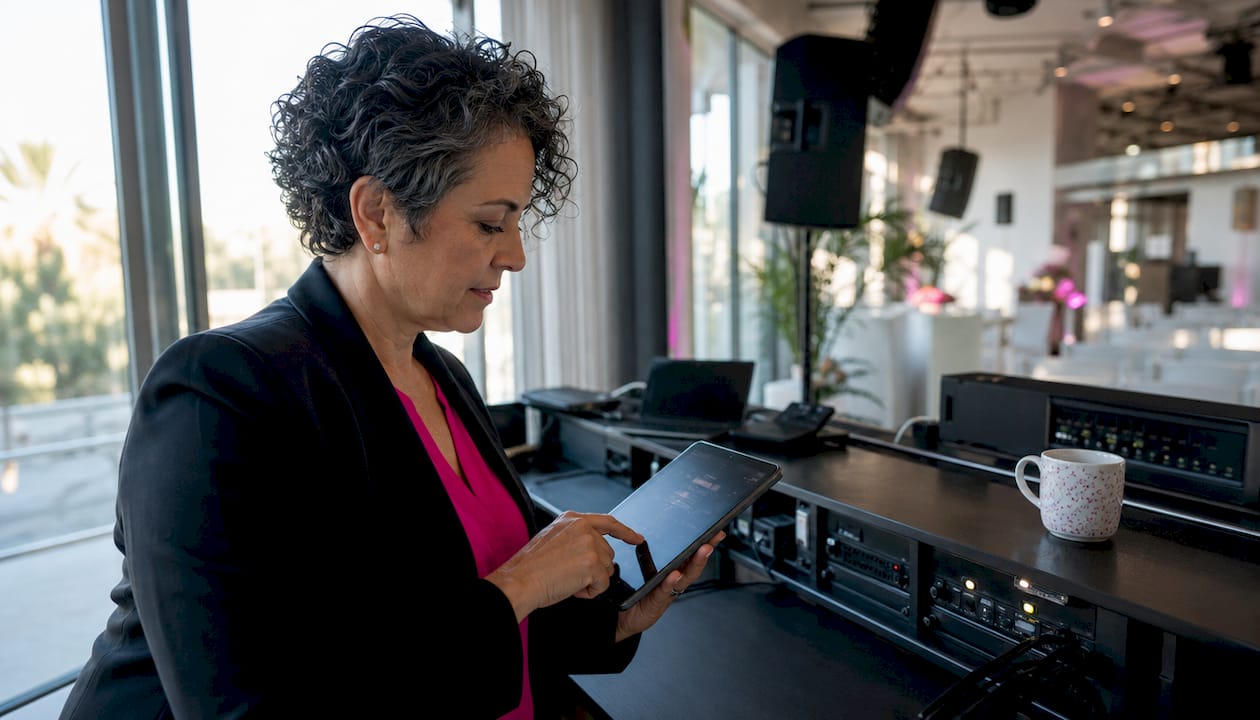
Professional AV services prevent audio feedback, video resolution mismatches, and lighting issues that undermine speaker visibility and attendee experience. Each of those failures is avoidable with the right equipment and technical support. The difference between a polished event and a chaotic one often comes down to whether a qualified AV team was involved from the planning stage.
Poor AV signals disorganisation and damages brand credibility in the eyes of attendees. That is a direct business consequence, not a minor inconvenience. When a keynote speaker’s microphone cuts out or a presentation slide appears blurry on screen, the audience stops focusing on the content and starts questioning the competence of the organiser.
What roles do AV systems play in enhancing corporate event engagement?
AV systems do far more than amplify sound and project images. They shape the entire attendee experience, from the moment someone walks into a venue to the final Q&A session.
Audio clarity across every zone
Clear audio is the single most critical element of any corporate event. Poor audio quality is the top reason attendee disengagement occurs during corporate conferences. That finding matters because disengaged attendees do not absorb your message, do not act on your calls to action, and do not leave with a positive impression of your brand.
Effective microphone placement and speaker coverage are critical to avoiding audio dead zones and feedback during events. A professional AV setup uses distributed speaker arrays, directional microphones, and digital signal processing to deliver consistent audio across every seat in the room. A conference mic system designed for corporate use handles multiple simultaneous speakers without feedback or drop-out, which is particularly important in panel discussions and roundtable formats.
Visuals and lighting that direct attention
Lighting is not simply about making a room look attractive. It directs audience attention, reinforces brand colours, and ensures that speakers appear clearly on camera. A presenter standing in front of a poorly lit backdrop looks unprofessional on screen, regardless of how strong their content is. Intelligent lighting rigs allow event planners to shift focus between a main stage, a secondary presenter, and a screen display without manual intervention.
Video quality follows the same logic. A twin screen conference stage set gives large audiences clear sightlines to presentation content from any angle in the room. High-resolution displays paired with a capable vision mixer mean that slides, live feeds, and pre-recorded content all appear at consistent quality.
Interactive features that raise participation
Modern AV technology supports live polling, audience Q&A platforms, and real-time captioning. These tools transform a passive audience into an active one. When attendees can submit questions digitally, vote on topics, or see their responses reflected on screen, their sense of involvement increases significantly. That involvement translates directly into better knowledge retention and stronger post-event sentiment.
Modern AV systems enable hybrid communication, connecting remote and in-person attendees for collaboration that feels natural rather than forced. Hybrid events are now a standard expectation, not an exception. AV technology for business meetings must account for both the room and the remote audience simultaneously.
Pro Tip: Brief your AV team on the event’s interactive elements at least two weeks in advance. Live polling and Q&A platforms require integration testing with your display and audio systems before the event day.
What risks arise from inadequate AV setups at corporate events?
The risks of poor AV are concrete and measurable. They fall into four categories.
-
Audio failure. Feedback loops, dead zones, and microphone drop-out are the most common complaints at corporate events. They interrupt the flow of presentations and force speakers to pause or repeat themselves, which erodes audience confidence.
-
Video and lighting problems. Mismatched video resolution between a presenter’s laptop and the venue’s display system produces blurry or letterboxed slides. Poor stage lighting makes speakers look washed out or shadowed on camera, which is particularly damaging for events that are recorded or streamed.
-
Streaming failures. A hybrid event that loses its stream mid-session leaves remote attendees with nothing. That audience segment often includes senior stakeholders, international partners, or paying delegates. A streaming failure is not a minor technical glitch. It is a broken commitment to those attendees.
-
Lack of on-site technical support. Equipment fails. The question is whether a qualified technician is present to resolve the issue in seconds or whether the event grinds to a halt while someone searches for a solution. Poor audio and video signals degrade or negate advanced AI collaboration features, which means even the most sophisticated software tools become useless without solid underlying hardware.
The reputational cost of a failed event is difficult to quantify, but the pattern is consistent. Attendees remember technical failures long after they forget the content of the presentations.
How do modern AV technologies transform corporate events?
AV technology has advanced considerably in the past two years. The most significant shift is the integration of artificial intelligence directly into AV hardware.
Agentic AI in conference room hardware
AI embedded at the hardware layer in conference room AV systems can proactively frame cameras and manage audio zones, unlike older reactive AI systems that responded only after a problem occurred. This is a meaningful distinction. Proactive framing means the camera follows the active speaker automatically, without a camera operator. Proactive audio management means the system suppresses background noise and adjusts gain before the audience notices a problem.
Advanced AI features in AV require endpoint hardware with significantly higher compute power to operate autonomously within meetings. That requirement has a practical implication for event planners: AI-enhanced AV is not a software upgrade you apply to ageing equipment. It requires investment in capable hardware from the outset.
Wireless systems and room analytics
Wireless presentation gateways, room scheduling panels, and usage analytics help optimise conference room utilisation and attendee experience. Wireless systems remove the cable clutter that slows down room turnarounds between sessions. Usage analytics tell event planners which rooms were at capacity, which sessions ran over time, and where attendees congregated. That data informs better planning for future events.
AV hardware integration with IT infrastructure is crucial for future-proofing corporate event spaces and enabling smooth hybrid collaboration. An AV system that cannot communicate with your organisation’s video conferencing platform, network, or room booking software creates friction at every event. Choosing AV solutions that integrate cleanly with existing IT systems is not a technical detail. It is a planning priority.
Pro Tip: When evaluating AV equipment for a permanent conference space, ask the supplier for a compatibility matrix showing which platforms the hardware integrates with natively. This prevents costly surprises during installation.
How do you select the right AV solutions and partners?
Choosing AV supplier for corporate events requires a structured approach. The wrong choice costs more than money. It costs credibility.
- Assess your event scale and venue acoustics. A 50-person boardroom requires a very different AV specification than a 500-seat auditorium. Venue acoustics, ceiling height, and room shape all affect microphone placement and speaker coverage decisions.
- Confirm hybrid capability. If any portion of your audience attends remotely, your AV setup must include a reliable streaming solution, a vision mixer for switching between feeds, and a dedicated internet connection for broadcast. A multiformat vision mixer handles multiple video inputs simultaneously, which is standard practice for hybrid events.
- Evaluate equipment quality and supplier expertise. Entry-level equipment may appear cost-effective but frequently underperforms under the sustained load of a full-day conference. Ask suppliers about their equipment specifications, maintenance schedules, and contingency plans for hardware failure.
- Require on-site technical support. A supplier who delivers equipment and leaves is not a partner. A qualified technician present throughout the event resolves issues before they become visible to the audience.
- Plan for integration with your IT stack. Your AV system should connect cleanly with your video conferencing platform, presentation software, and any audience interaction tools you plan to use. Virtual tours support hybrid event planning by giving remote attendees a spatial sense of the venue, which improves their engagement with the live content.
A digital mixing console such as the Allen & Heath Avantis gives your audio engineer precise control over every input channel, which is particularly valuable when managing multiple microphones, playback sources, and hearing loop feeds simultaneously.
Key takeaways
Professional AV technology is the single most controllable factor in whether a corporate event communicates clearly, engages its audience, and reflects well on the organising brand.
| Point | Details |
|---|---|
| Audio quality drives engagement | Poor audio is the top cause of attendee disengagement; invest in distributed speaker coverage and professional microphones. |
| AV reflects brand credibility | A poor AV setup signals disorganisation and damages the organiser’s reputation with attendees. |
| AI AV requires capable hardware | Agentic AI features in modern AV systems only function correctly when the underlying hardware has sufficient compute power. |
| Hybrid events need dedicated AV | Remote attendees require a separate streaming solution, vision mixer, and dedicated connection to receive a consistent experience. |
| Supplier expertise matters as much as equipment | On-site technical support and integration knowledge separate a reliable AV partner from a simple equipment hire. |
The part most planners get wrong
The most common mistake I see corporate event planners make is treating AV as a line item to reduce rather than an investment to protect. A planner will spend months refining the agenda, negotiating catering contracts, and designing branded collateral, then cut the AV budget at the last moment because it feels like an invisible cost. The audience never sees the AV rig. They only notice when it fails.
The second mistake is hiring on price rather than expertise. A supplier who quotes low often does so because they are using older equipment, providing fewer technicians, or skipping the pre-event site survey. That site survey is where microphone placement, speaker coverage, and cable routing get resolved before the event day. Skip it, and you are solving those problems in front of your audience.
The third mistake is underestimating hybrid complexity. Planners who have run successful in-person events sometimes assume that adding a camera and a streaming link is sufficient for hybrid delivery. It is not. Hybrid events require a dedicated AV operator managing the remote feed, a separate audio mix for the stream, and a contingency plan for connection failure. The Blackmagic Design ATEM Mini Pro is a capable entry point for hybrid switching, but it still requires a competent operator to use it effectively.
Experienced AV partners bring something that no equipment catalogue can provide: the knowledge of what goes wrong and how to prevent it. That knowledge is worth more than the cost difference between a professional supplier and a budget alternative.
— Michael
Fireflyav’s AV equipment and support for corporate events
Fireflyav supplies professional AV equipment and technical support to corporate event planners across the UK, covering conferences, product launches, and hybrid events of every scale.
The Fireflyav equipment range includes conference mic systems built for multi-speaker formats, professional digital mixing consoles for precise audio control, and vision mixers for clean hybrid video switching. Every piece of equipment is maintained to broadcast standard and supported by experienced technicians who attend events on-site. Fireflyav’s team works with planners from the initial site survey through to post-event debrief, ensuring that the AV specification matches the event’s scope and the venue’s acoustic properties. To discuss your next event, visit the Fireflyav services page or complete the product enquiry form.
FAQ
What is AV technology in corporate events?
AV technology refers to the integrated audio, video, and lighting systems used to deliver clear communication and professional presentation at corporate events. It includes microphones, mixing consoles, displays, lighting rigs, and streaming equipment.
Why does poor AV damage a corporate event?
Poor audio and video quality causes attendee disengagement and signals disorganisation to the audience. The reputational damage to the organising brand can outlast the event itself.
How does AV support hybrid corporate events?
Modern AV systems connect remote and in-person attendees through synchronised audio, video streaming, and interactive tools. A dedicated vision mixer and streaming encoder are the minimum requirement for a reliable hybrid setup.
What should I look for when choosing an AV supplier?
Prioritise suppliers who conduct a pre-event site survey, provide on-site technical support throughout the event, and can demonstrate compatibility between their equipment and your existing IT and video conferencing platforms.
How does AI improve AV in corporate events?
AI embedded directly in AV hardware can automatically frame cameras on active speakers and manage audio zones without manual intervention. This requires capable endpoint hardware rather than a software upgrade to existing equipment.