AV derig process for UK events: the practitioner’s guide
Date added: 9/07/2026
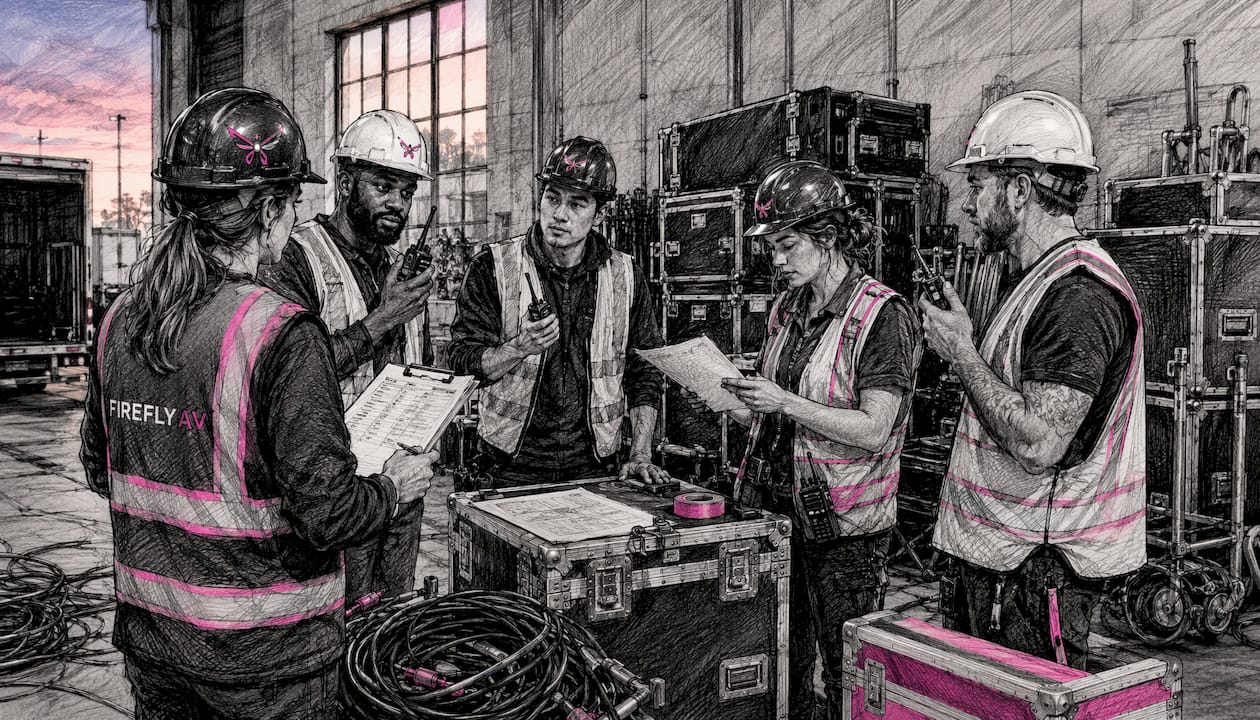
The AV derig process is the planned dismantle, safe lowering and removal, packing, and signed handover of all flown and floor AV elements once an event closes. Before your crew touches a single cable, three things must be confirmed: valid LOLER certificates for all lifting equipment are on site, a written RAMS (Risk Assessment and Method Statement) covering derig activities is available, and the venue rigging supervisor’s sign-off process is agreed.
Immediate priorities at a glance:
- Confirm LOLER inspection certificates are present for every hoist, sling, and shackle before lowering begins
- Verify the RAMS and method statement explicitly cover derig, not just the build
- Establish who holds the venue rigging supervisor sign-off authority and what they need to see
- Check MEWP operator IPAF cards before any platform is moved
- Identify the single point of contact for power isolation so no flown element is lowered live
Who must be present for sign-off: head rigger, venue rigging supervisor, and stage manager. The single most urgent action before lowering any flown element is confirming lift permits and MEWP operator competence are in order.
Table of Contents
- Your one-page derig checklist and role matrix
- How to run a derig step by step: from pre-planning to post-pack
- UK safety checks and the documentation you must have for derig
- How do you coordinate derig with venue staff and rigging supervisors?
- What goes wrong during derig, and how do you prevent it?
- How long does derig take, and how many crew do you need?
- What tools and lifting gear do you need for a safe derig?
- Fireflyav’s operational derig checklist and on-site protocol
- Key takeaways
- The part of derig that most plans get wrong
- Fireflyav: derig planning and crew supply for UK events
- Useful sources for UK derig practice
Your one-page derig checklist and role matrix
A crew brief lives or dies by clarity. Print this, paste it into your production pack, and tick each item as it clears.
Operational checklist (in sequence):
- Secure the stage perimeter and restrict access to authorised crew only
- Execute the power-down sequence: floor equipment first, then flown elements last (never cut power to a live video wall mid-show)
- Isolate all flown elements and confirm secondary suspensions are still intact
- Tag and label every flown point before any load is transferred
- Dismantle flown assemblies from the top down, with a rigger on the load at all times
- Pack and secure flightcases with contents lists attached
- Load vehicles in reverse build order and complete site restoration
Roles, responsibilities and sign-off checkpoints:
| Role | Core derig responsibility | Sign-off checkpoint |
|---|---|---|
| Head rigger | Supervises all lowering operations; confirms LOLER docs | Pre-derig inspection log; final rig completion sign-off |
| Riggers | Execute lowering, dismantle and pack of flown elements | Mid-derig checkpoint after each flown zone clears |
| Stage manager | Coordinates overall sequence and crew timing | Show-end call-down; final venue handover |
| Audio lead | Manages speaker and console dismantle and pack | Audio equipment inventory sign-off |
| Lighting lead | Oversees fixture lowering, cable coiling and pack | Lighting inventory and flightcase seal |
| Video lead | Protects LED panels and encoders until streaming checks complete | Video equipment sign-off post-stream confirmation |
| MEWP operator | Operates platform for access at height; holds valid IPAF card | Pre-use MEWP inspection log |
| Venue rigging supervisor | Reviews loads against structural data; approves secondary suspensions | Formal rig sign-off at trim height and on completion |
Documentation to carry on site:
- RAMS and method statement (derig-specific or explicitly covering derig activities)
- LOLER inspection certificates for every piece of lifting equipment
- PAT test records for electrical equipment being moved
- IPAF cards for all MEWP operators
- Rigging qualification certificates or documented competence records for production riggers
- Crew competence log signed by the head rigger
Event AV operator role descriptions consistently list setup and dismantle coordination as core duties, and senior AV technician job briefs make rigging and derig planning an explicit responsibility at that level.
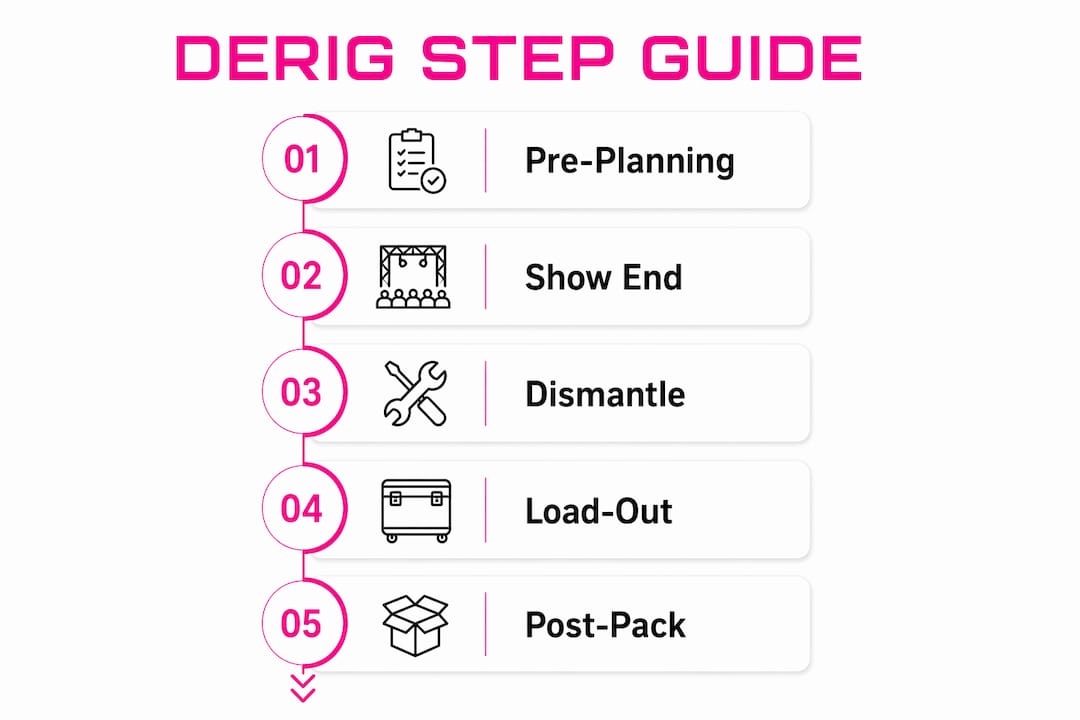
How to run a derig step by step: from pre-planning to post-pack
Pre-planning
Start with a site walk-through at least a week before the event. Walk the load-out route, note access restrictions, confirm vehicle marshalling positions, and mirror the load-in architecture in reverse. Agree the derig access window with the venue in writing. Waste strategy (cable ties, foam offcuts, pallet wrap) and security handover timing both need to be locked before show day.

Professional AV production treats site liaison and documented RAMS as core project management, not optional extras. That framing matters: a derig plan written without a venue walk-through is guesswork.
Show-end sequence
Call a timing countdown 30 minutes before the show closes. Confirm the power-down order with the audio, lighting, and video leads. The sequence runs: streaming encoders and broadcast interfaces stay live until post-event checks are complete; floor equipment powers down next; flown elements are isolated last. Tag every suspended item before any load is transferred to a hoist.
Pro Tip: Never lower a flown video wall until the video lead has confirmed the stream has ended and all recording devices have stopped. Cutting power mid-frame on an LED panel can damage driver cards that cost more to replace than the labour saving is worth.
Dismantle and load-out
Sequence flown equipment before floor equipment wherever access allows. Use secondary suspensions as a safety net during lowering, not as a primary load path. MEWP operators should position the platform to give riggers a clear working zone, with tag lines attached to loads before the hoist releases tension. LED screen handling during derig requires panels to be lowered flat, never tilted, and stacked in the original flightcase foam.
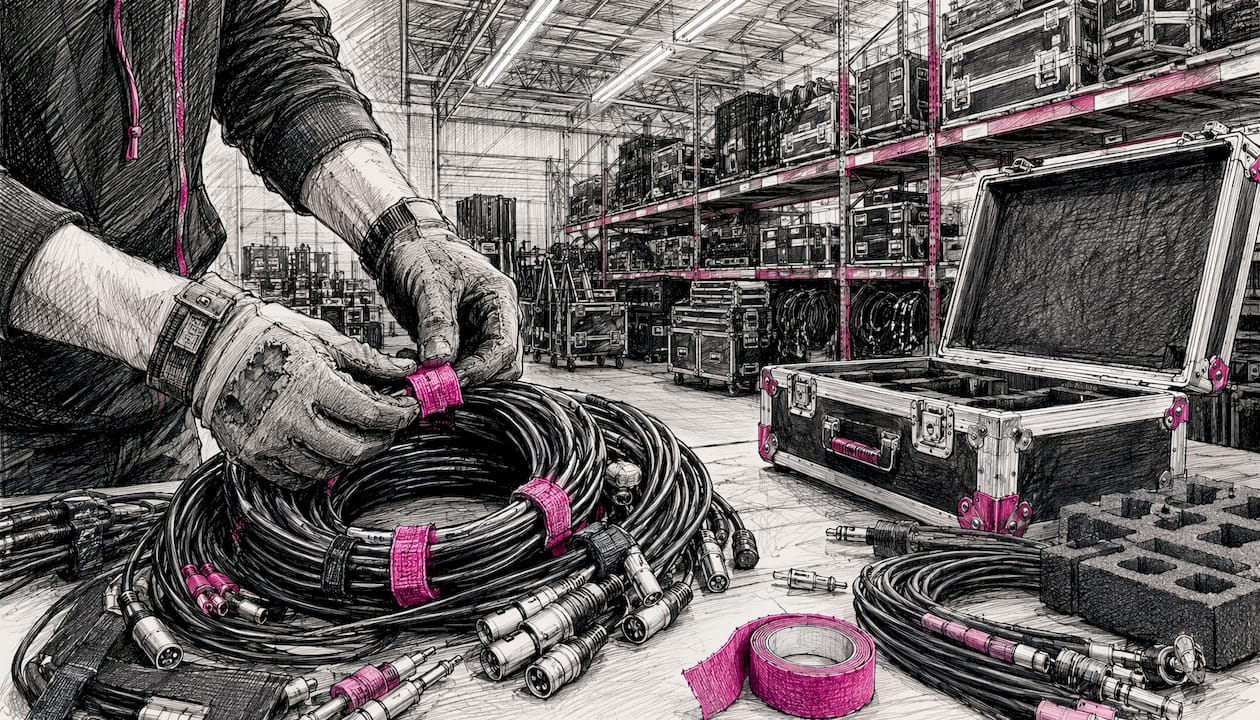
Pack in reverse build order so the first item into the truck is the last item needed at the next venue. Label every flightcase with contents, destination, and fragile warnings before it leaves the stage.
Post-pack sign-off
Complete the post-rig inspection log before any vehicle departs. The head rigger and venue rigging supervisor both sign the completion checklist. The stage manager countersigns the venue handover document. Any damage discovered during dismantle goes into an incident report immediately, not retrospectively. Replenish consumables (cable ties, tape, foam) from the vehicle spares kit so the next build starts complete.
UK safety checks and the documentation you must have for derig
UK event derig sits under several overlapping legal and industry frameworks. Getting the paperwork wrong is not a minor admin issue; it is a liability.
Statutory and industry documentation required on site:
- LOLER (Lifting Operations and Lifting Equipment Regulations 1998) inspection certificates for every hoist, chainblock, sling, shackle, and rated anchor point used during derig
- Written RAMS that explicitly cover derig activities, not just the build phase
- PAT test records for electrical equipment being moved or replugged during derig
- Crew competence records: IPAF cards for MEWP operators, formal rigging qualifications or documented experience for production riggers
- Venue rigging supervisor approval, including secondary suspension decisions and structural load confirmation
Crew competence checks on arrival:
- Verify IPAF cards are current and cover the category of MEWP in use
- Confirm production riggers hold recognised qualifications or have documented, supervised experience
- Check that the head rigger has reviewed the RAMS and signed the pre-derig inspection log
Inspection and sign-off process:
- Complete a pre-derig inspection of all lifting equipment before lowering begins
- Check secondary suspensions are intact and correctly rated before transferring any load
- Obtain the venue rigging supervisor’s signed completion checklist before releasing the venue
The venue rigging supervisor’s role is to review suspended loads against structural calculations and sign off the rig only once trim height and secondary suspension details are confirmed. Their sign-off is not a formality — it is the venue’s formal confirmation that the structure is safe to load and, later, safe to strike. Involve them at the walk-through stage, not at the point of lowering.
How do you coordinate derig with venue staff and rigging supervisors?
The venue rigging supervisor is the technical gatekeeper for everything suspended in the building. Early collaboration prevents late changes to secondary suspensions and secures a clean sign-off. At the site walk-through, exchange trim heights, secondary suspension requirements, roof access procedures, and any access restrictions that affect the derig sequence.
Stakeholder coordination checklist:
- Production manager: confirm derig access window, vehicle marshalling plan, and waste removal
- Stage manager: agree timing call-downs and crew briefing schedule
- Transport contractor: confirm vehicle arrival slots and loading sequence
- Security: agree crew access passes and site clearance procedure
- Venue facilities: confirm power isolation points and any in-house equipment that must stay in place
- In-house audio and lighting staff: agree handover of any venue-owned kit and confirm nothing is packed by mistake
For events with live captioning or accessibility technology that must remain active until all delegates have left, coordinate with the relevant supplier before the power-down sequence begins. Live captioning systems in particular need a confirmed end-of-session signal before their equipment can be struck.
Pro Tip: Build the venue rigging supervisor sign-off into the crew schedule as a named task with a time slot, not a vague “when ready.” If sign-off is on the critical path, it gets done on time. If it is an afterthought, it becomes the reason the truck sits waiting for 45 minutes.
What goes wrong during derig, and how do you prevent it?
Most derig problems are predictable. The ones that cost money are almost always the ones that were not planned for.
Common failure modes:
- Bad weather during outdoor derig: wind makes lowering flown elements dangerous without tag lines; rain damages unprotected electronics left on stage
- Insufficient vehicle access: trucks arriving before the loading bay is clear, or venue access restrictions that were not confirmed in advance
- Kit damage discovered on dismantle: LED panels cracked during lowering, cable connectors bent by rushed packing, flightcase latches broken under load
- Missing documentation: LOLER certificates left at the depot, IPAF cards not carried by operators, RAMS not updated to cover derig
- Uncertified equipment: a sling or shackle with an expired or missing inspection certificate discovered at the point of use
Preventive measures:
- Carry a contingency vehicle for overflow kit or weather-related delays
- Pack packing spares (foam, tape, cable ties) in every truck as standard
- Store flown LED panels in their original flightcases with foam inserts during lowering, never stacked loose
- Confirm vehicle arrival slots with the transport contractor 48 hours before derig
- Run a documentation check at the pre-derig crew brief, not on the morning of the event
On-site risk mitigation:
- Attach tag lines to all flown loads before releasing hoist tension, particularly in outdoor or high-ceiling venues where swing is a risk
- Double-label fragile panels: one label on the flightcase lid, one on the panel itself
- For high-security or complex events, specialist AV decommissioning contracts exist that cover secure handling and site restoration as distinct deliverables
How long does derig take, and how many crew do you need?
Derig time varies significantly by event type. The UK events sector spans conferences, exhibitions, cultural events, and outdoor productions, each with different access constraints and kit complexity.
Typical timeline examples:
Derig time varies by event type, ranging from brief packdowns for small corporate AV setups to extended operations for large theatre or concert loadouts requiring significant crew numbers.
Resourcing rules of thumb:
- Allow one rigger per two flown points as a minimum for safe lowering operations
- Match floor techs to flown techs at roughly 1:1 for mid-size productions; floor-heavy shows can shift to 2:1
- Plan vehicle loading at one 7.5-tonne truck per 40–60 flightcases as a rough guide, adjusted for case size and weight
- For multi-drop routes, add 30–45 minutes per additional drop to the transport schedule
- In peak season (October to December for corporate events), book vehicles and crew at least four weeks in advance
For multi-venue AV logistics, overnight storage between legs needs a confirmed depot location and a vehicle manifest that matches the post-derig inventory exactly.
What tools and lifting gear do you need for a safe derig?
Lifting kit and PPE
Every derig requires rated lifting equipment and appropriate personal protective equipment. The essentials:
- Chainblocks and motor hoists with current LOLER certificates
- Wire rope slings, round slings, and rated shackles, all within inspection date
- Tag lines (minimum 10 metres for high-trim venues) to control load swing during lowering
- MEWP (mobile elevating work platform) with a current pre-use inspection log
- PPE: gloves, safety eyewear, hi-vis vests, and steel-toe boots for all crew on the stage
Packing and consumables
- Flightcases with foam inserts matched to the equipment they carry
- Heavy-duty gaffer tape and PVC tape for cable management and case sealing
- Cable ties (standard and heavy-duty) for bundling and securing
- Bubble wrap and foam sheet for fragile items without dedicated cases
- Pallet wrap for securing stacked cases on pallets
- Wheel chocks and load restraint straps for vehicle loading
Pro Tip: Colour-code your cable ties by department: one colour for audio, one for video, one for lighting. It takes 30 seconds at pack-down and saves 20 minutes at the next build when the video lead is not untangling audio snake from lighting cable.
For a fuller breakdown of AV equipment types and handling requirements, the equipment category matters as much as the quantity when planning packing time.
Fireflyav’s operational derig checklist and on-site protocol
Fireflyav uses a structured checklist approach on every production, designed to be printed and attached to the crew pack. The format below reflects the process the team follows on site.
Fireflyav operational derig checklist:
- Pre-derig: LOLER certificates checked, RAMS signed off, IPAF cards verified, venue rigging supervisor briefed
- Power-down: streaming equipment confirmed offline, floor equipment isolated, flown elements tagged
- Lowering: secondary suspensions checked, tag lines attached, MEWP pre-use inspection complete
- Dismantle: flown elements lowered and packed before floor equipment moves, all panels in foam-lined cases
- Pack: flightcases labelled with contents and destination, inventory list attached to each case
- Load-out: vehicle manifest completed, transport lead signs inventory, head rigger signs completion log
- Venue handover: venue rigging supervisor signs completion checklist, stage manager countersigns handover document
QA and sign-off template:
| Stage | Check | Signed by |
|---|---|---|
| Pre-derig | LOLER docs, RAMS, IPAF cards, secondary suspensions | Head rigger |
| Mid-derig | Flown zone cleared, panels in cases, no loose loads | Head rigger and venue rigging supervisor |
| Final sign-off | All equipment packed, venue restored, incident log complete | Stage manager, venue rigging supervisor, transport lead |
Pro Tip: For hybrid events where a stream is still running post-show, assign a dedicated crew member to the streaming station with a clear instruction: nothing in that zone moves until the video lead gives a verbal “stream confirmed closed.” A Blackmagic Web Presenter or similar interface left live during derig is a common source of post-event client complaints and, occasionally, a broadcast incident.
Fireflyav’s technical support services cover site walk-throughs, RAMS preparation, and certified crew supply for productions across the UK.
Key takeaways
A safe, dispute-free AV derig in the UK depends on three things being in place before the show ends: the right documentation, the right crew competence, and a signed handover process that is built into the schedule, not bolted on at the end.
| Point | Details |
|---|---|
| Verify LOLER and RAMS first | Confirm lifting equipment certificates and a derig-specific RAMS are on site before any lowering begins. |
| Lock in the venue sign-off process | Agree the venue rigging supervisor’s sign-off checkpoint at the walk-through, not on derig day. |
| Plan vehicle marshalling in advance | Confirm arrival slots with the transport contractor 48 hours before derig to avoid loading bay delays. |
| Resource to flown-element complexity | Allow one rigger per two flown points minimum; scale floor crew to match the kit volume, not the room size. |
| Fireflyav for certified derig support | Fireflyav supplies certified crew, RAMS preparation, and site walk-throughs for UK event productions. |
The part of derig that most plans get wrong
The conventional wisdom in event production is that derig is just the build in reverse. It is not, and treating it that way is where most problems start.
A build happens with time to correct mistakes. Derig happens under pressure: the venue wants the space back, the transport contractor is waiting, and the crew has already worked a full show day. That pressure is where documentation shortcuts happen, where a sling with a borderline inspection date gets used anyway, and where the venue rigging supervisor sign-off gets skipped because “we’ve worked here before.”
The fix is not more paperwork. It is embedding the critical checkpoints into the crew schedule as named tasks with owners and times. When the head rigger knows they are signing the pre-derig inspection log at 22:30 and the venue supervisor knows they are doing a mid-derig checkpoint at 23:15, those things happen. When they are listed as “to do when ready,” they get compressed or skipped.
There is also a tendency to treat the post-derig QA log as an admin task for the office. It is not. A signed pre- and post-derig checklist kept in the vehicle manifest reduces disputes over missing items and creates an auditable record for insurance purposes. That record has real value the first time a client queries a damaged panel or a venue charges for something left behind.
The best derig crews are not the fastest. They are the ones who finish with every item accounted for, every certificate in the file, and a venue that will have them back.
Fireflyav: derig planning and crew supply for UK events
When the show ends, the work that protects your kit, your client relationship, and your compliance record begins. Fireflyav provides the full technical picture for UK event productions: site walk-throughs before the build, RAMS preparation that covers derig explicitly, certified riggers and MEWP operators, and transport coordination for load-out.

For planners who need a derig crew that arrives with the right documentation, the right qualifications, and a signed handover process already built into the schedule, Fireflyav’s technical services cover corporate conferences, cultural events, broadcast productions, and live events across the UK. The team handles the compliance detail so you can focus on the client.
Fill out the project enquiry form to discuss your next production’s derig requirements, crew numbers, and access windows.
Useful sources for UK derig practice
Authoritative references for derig compliance, crew standards, and venue coordination:
- UK Rigging: venue rigging supervisor guidance — explains secondary suspensions, structural sign-off, and the formal role of the venue rigging supervisor; the most practical UK-specific reference for the sign-off process
- DWP: Senior AV Technician job listing — confirms industry expectations for rigging and derig planning at senior technician level; useful for writing crew briefs and competence requirements
- RTDNA: Event AV Operator job description — outlines setup, dismantle, and coordination duties; helpful for defining role boundaries in a crew brief
- ABPCO: UK events industry overview — provides context on the breadth of UK event formats and how they affect derig planning and access constraints
- Brightspace Events: AV production services — illustrates how professional AV suppliers approach project management, site liaison, and RAMS as integrated services
- Fireflyav services — Fireflyav’s technical support and crew supply offering for UK productions, including derig planning and certified crew
- Fireflyav: AV equipment explained — practical equipment handling guidance for planners who need to understand what each category requires during pack-down
- Fireflyav: AV logistics for multi-venue events — covers transport, marshalling, and multi-drop logistics for complex productions