Why hiring an AV technical crew protects your event
Date added: 2/08/2026
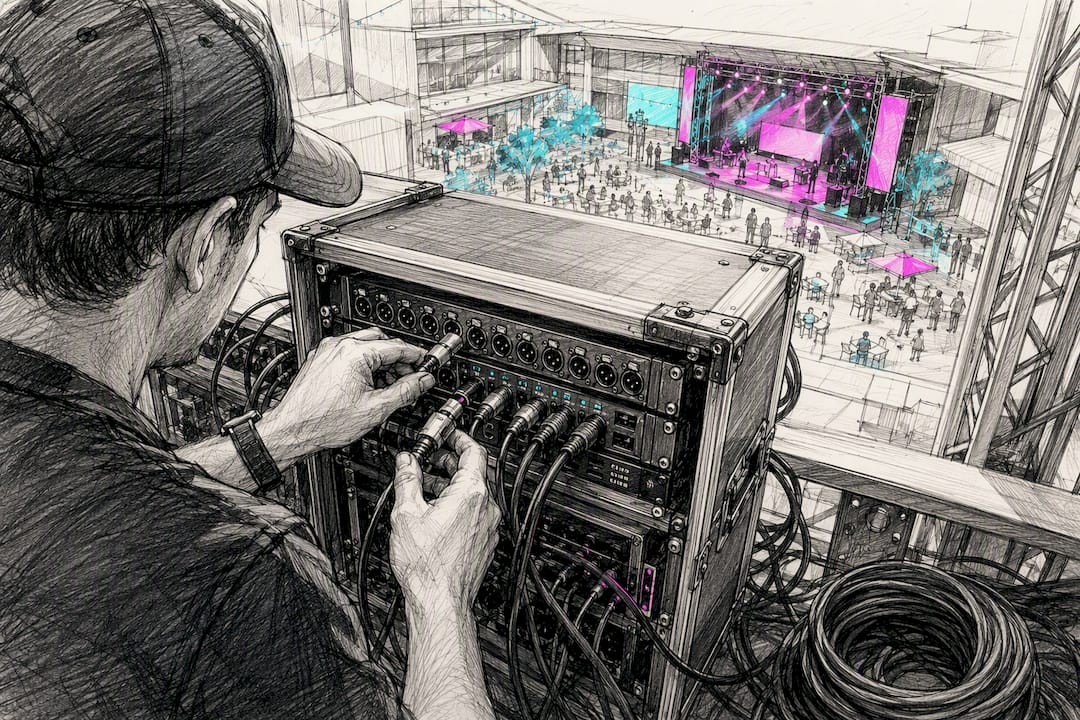
Hiring a professional AV technical crew ensures your event delivers clear sight and sound, runs to time and reduces brand risk. A crew brings redundancy for hybrid livestreams (spare encoders, backup playback), and handles the safety and compliance work, including rigging checks and risk assessments, that venues and insurers expect. Firefly AV is an AV hire and event production company based in Leeds and Preston, working UK-wide across conferences, launches, awards nights and exhibitions.
The benefits of an AV technical crew show up most clearly when something goes wrong. A frozen laptop, a dropped stream, a rigging fault, and the difference between a crew catching it in seconds and a presenter fighting a laptop on stage is the whole reputation of the event.
- Consistent picture and sound quality across the room, not just at the lectern
- Faster load-in and strike, which avoids venue overtime charges
- Trained staff handling PAT testing, rigging checks and risk assessments
- Built-in redundancy for streams, recordings and playback
- One point of contact managing the technical side, freeing organisers to manage the room
Key Takeaways
Hiring an AV technical crew improves audio and visual reliability, reduces safety and compliance risk, and saves organiser time compared with running AV in-house or unstaffed.
| Point | Details |
|---|---|
| Crew roles scale with event size | A breakout room needs one technician; a hybrid general session needs a TD, audio engineer and video technician together. |
| Redundancy prevents visible failure | Backup playback, spare mics and a second encoder catch faults before an audience notices. |
| Day rates vary by role | Technicians typically run £200 to £450 per day; senior TDs £450 to £900 per day. |
| Independent providers can offer better value | Venue AV commissions can reduce the budget actually spent on kit and crew for larger shows. |
| Firefly AV supplies crew and kit UK-wide | Based in Leeds and Preston, stocking Absen LED, Sennheiser, Allen & Heath, DB Technologies and BirdDog equipment. |
Table of Contents
- What does an AV technical crew actually do?
- The practical benefits: 8 ways a technical crew protects your event
- What do AV crew day rates typically cost?
- How do you brief and book an AV technical crew?
- Why choose Firefly AV for your next event?
- What does the crew timeline look like from booking to strike?
- How does AV crew support differ across event types?
- What goes wrong at events without a technical crew?
- What actually matters when you brief a crew
- How Firefly AV can help with your next event
- Sources
- FAQ
What does an AV technical crew actually do?
An AV technical crew covers a set of distinct roles, and which ones you need depends on the event’s scale. A breakout room with a screen and a lapel mic might need one competent technician. A general session with in-room magnification (IMAG), a livestream and multiple presenters needs several specialists working from the same show plan.
- AV producer — owns the overall technical plan, budget and supplier coordination before the event.
- Technical director (TD) — runs the show live, calling cues and coordinating vision, audio and lighting in real time.
- Audio engineer — mixes microphones, monitors and playback, and manages gain before feedback becomes a problem.
- Lighting designer — builds the visual mood and ensures presenters and stage are lit correctly for cameras.
- Video technician — operates cameras, switches sources and manages the LED wall or projection feed.
- Stage riggers — install trussing, LED and speaker arrays safely, and sign off load calculations.
Safety and compliance work sits alongside all of this. The National Careers Service lists pre-event safety checks and equipment testing as core technician duties, while the wider occupational framework for AV professionals covers system design, technical event management and formal risk assessments as standard parts of the job, not extras.
The practical benefits: 8 ways a technical crew protects your event
Most of the value of a crew shows up in what doesn’t happen: the dropout that never reaches the screen, the feedback loop that never hits the PA. Here’s where that value actually comes from.
Consistent quality, with kit that’s built for the job. A crew running Sennheiser microphones, an Allen & Heath console for the mix and DB Technologies speakers for coverage delivers audio that stays clean whether the room holds 50 people or 500. Pair that with an Absen LED wall for vision and you get colour and brightness consistency that a hired-in projector from a generic supplier often can’t match.
Fewer of the failures that damage a brand on the day. Frozen playback, microphone feedback during a CEO’s keynote, LED tiles dropping out mid-presentation — these are the failures a crew is trained to prevent or catch within seconds, not the ones an unstaffed AV rig catches at all.
Real troubleshooting, with a fallback already built in. Technical production leadership reduces the risk of catastrophic failure through redundancy planning, conditioned power and pre-event testing, not luck. A senior TD builds this in as standard: a second encoder standing by, a backup playback device cued, spare handheld mics charged and ready.
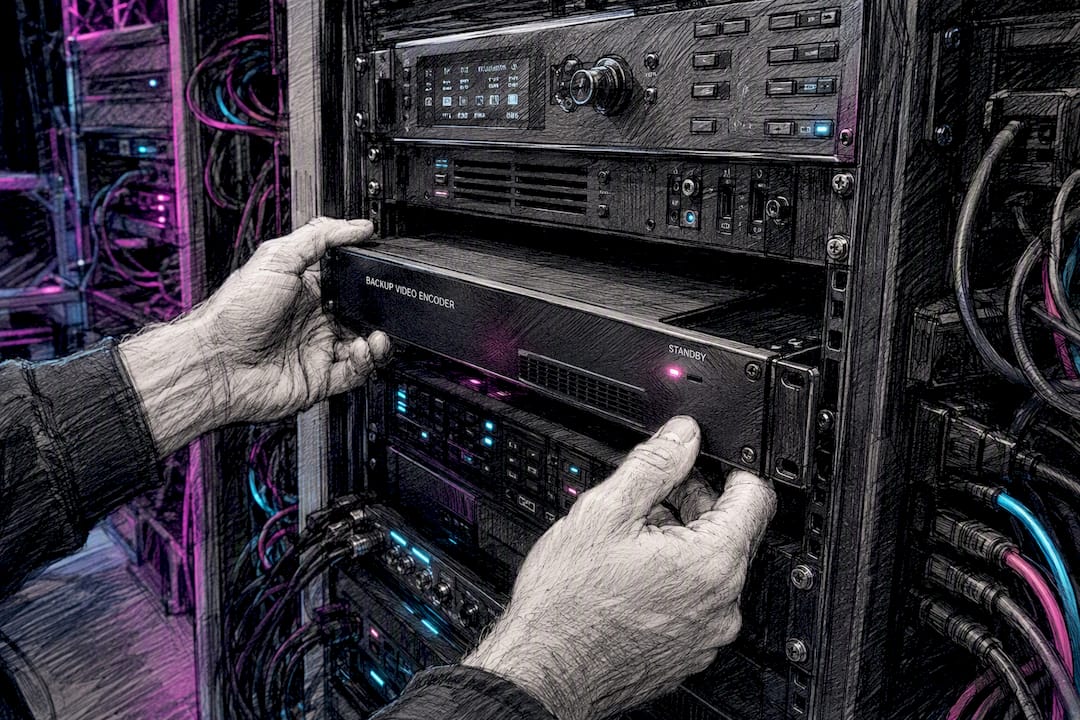
Faster load-in, cleaner strike. A crew that has run the room before knows the loading dock, the power runs and the rigging points, which cuts hours off setup and avoids venue overtime fees that can run into hundreds of pounds per hour at some UK venues.
Safety and compliance handled as part of the job, not an afterthought. Rigging checks, PAT testing, method statements and public liability insurance are standard crew deliverables — hiring trained technicians reduces liability because risk assessments and rigging sign-offs happen before doors open, not after something falls.
Hybrid and livestream competence that a generalist AV hire rarely has. Running BirdDog cameras, managing return audio and switching feeds without introducing lag or EDID handshake issues takes practice most in-house teams don’t get.
Organiser time returned to the parts of the job only you can do. With a TD running cues, you’re managing sponsors and speakers rather than checking HDMI leads.
A visibly sharper event for attendees. Clean IMAG, a properly mixed room and a broadcast-quality recording afterwards are the outputs stakeholders actually judge the event by.
Pro Tip: Ask any crew supplier to describe their redundancy plan in concrete terms, not buzzwords. “We run backup playback and a second encoder” is a real answer; “we’ve got contingencies” is not.
What do AV crew day rates typically cost?
Day rates vary by role, region and how far ahead you book, but the following ranges give a useful starting point for UK events.
- AV technician: roughly £200 to £450 per day
- Senior technical director: roughly £450 to £900 per day
- Full production packages (crew, core kit and a TD for a corporate conference): often starting around £10,000 for a basic larger meeting, scaling with complexity
These figures are typical ranges, not fixed quotes; actual pricing depends on the venue, the kit list and how many crew days the show needs. Total cost usually combines equipment hire, crew day rates, travel, a technical rehearsal day and any standby time built in for live contingencies. Booking with short notice tends to push day rates up, particularly for specialist roles like vision mixing or rigging.
Venue in-house AV often carries a built-in commission, which can leave less of the budget actually spent on equipment and crew. For larger shows, independent AV providers frequently deliver better value because more of the fee goes directly into kit and specialist staff rather than a venue markup.
How do you brief and book an AV technical crew?
A clear brief is the single biggest factor in whether a crew delivers what you actually needed. Suppliers can only plan redundancy, staffing and kit around the information you give them.
- Send the run of show first. Timings, session order and any presenter tech riders let the crew plan crew calls and equipment needs properly.
- Share the floor plan and required outputs. State whether you need IMAG, a livestream, a recording, or all three, and note stage dimensions and power access.
- Ask about redundancy in specific terms. A supplier should describe backup playback, spare radio mics and a second encoder, not vague reassurance.
- Confirm safety paperwork upfront. Ask for current PAT testing records, rigging certifications and public liability insurance before signing.
- Book a technical rehearsal slot. For any event with multiple presenters or a livestream, a rehearsal with the TD, key speakers and the AV producer in the room catches problems while they’re still cheap to fix.
- Agree the crew call time and equipment list in writing. Setup and strike times, the full kit manifest and who’s on site when should all sit in the written brief, not a verbal understanding.
Pro Tip: Splitting the show caller role from the technical director on larger events reduces mistakes, because one person focuses purely on cueing while the other manages the technical picture.
Why choose Firefly AV for your next event?
Firefly AV runs from bases in Leeds and Preston and works UK-wide, supplying the kit lines named throughout this guide: Absen LED walls, Panasonic projectors, Sennheiser microphones, Allen & Heath consoles, DB Technologies speakers, BirdDog cameras and Lite Deck staging.
Clients include the BBC, Leeds City Council and the University of Bradford, spanning broadcast, civic and academic events with very different technical demands.
A typical example: a corporate conference with an Absen LED wall as the main screen, a three-camera BirdDog livestream setup, a technical director calling cues and a dedicated audio engineer on the desk. The outcome is a clean in-room experience for delegates and a broadcast-quality stream for remote attendees, run from a single crew rather than stitched together from separate suppliers.
For equipment specifics before you brief a supplier, the audio visual equipment guide for event planners and the Firefly AV project portfolio are useful starting points.
What does the crew timeline look like from booking to strike?
Crew involvement rarely starts on event day. For anything beyond a single-room meeting, the timeline stretches back weeks.
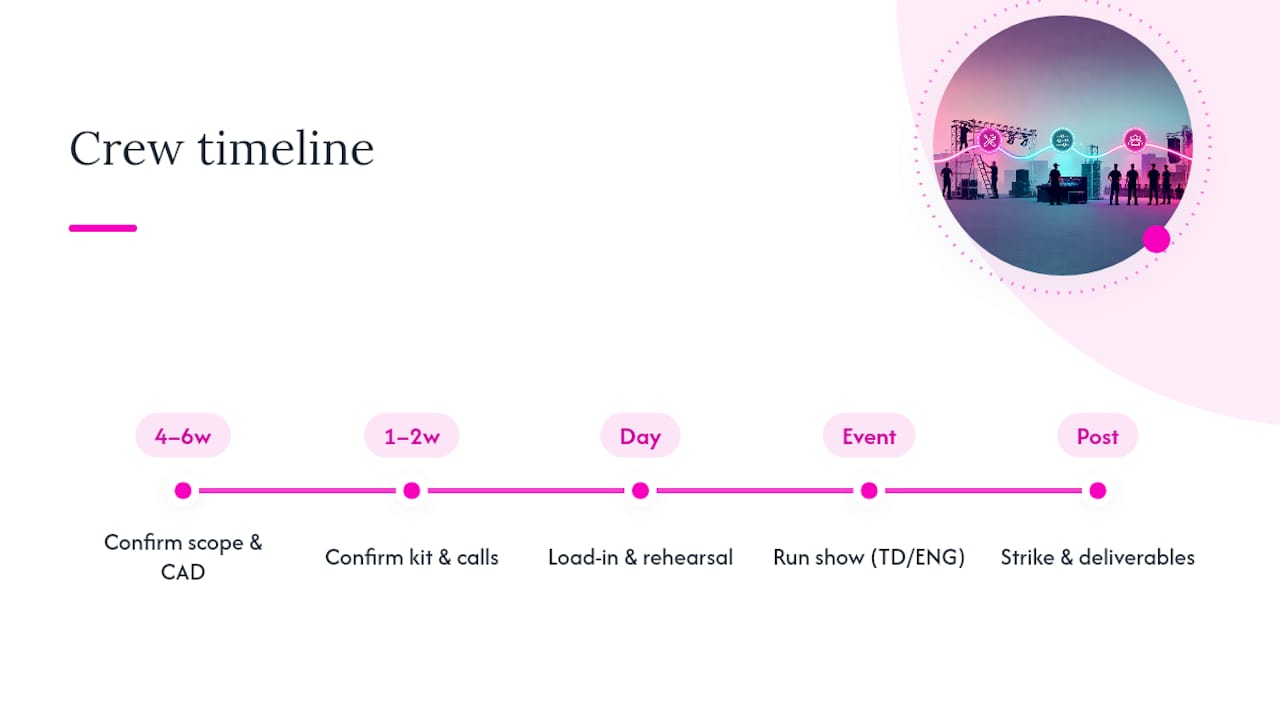
Four to six weeks out, the AV producer and organiser confirm scope: venue site visit, power availability, floor plans and required outputs (stream, recording, IMAG). This is when signal-flow and CAD diagrams get drawn up, which saves organiser time later by catching layout problems before load-in day.
One to two weeks out, kit is confirmed and crew calls are scheduled. Presenter tech riders and run-of-show timings should land with the crew here, not on the morning of the event.
The day before or morning of, load-in happens, followed by a technical rehearsal covering microphone checks, lighting cues, stream tests and any video playback. This is the point where a TD tests redundancy: swapping to backup playback, checking the second encoder, confirming return audio for remote speakers.
During the event, the TD runs the show live while the audio engineer and video technician handle their desks, watching for the faults a crew is trained to catch before an audience notices.
After doors close, strike happens efficiently because the crew that built the rig also knows how to take it down fast, avoiding venue overtime. Recordings and stream archives are usually delivered within a few days.
How does AV crew support differ across event types?
The benefits of hiring a crew look different depending on what you’re running, even though the underlying value, quality, safety and time saved, stays constant.
A conference with hybrid delegates needs technical direction that coordinates in-room IMAG, a livestream and a recording simultaneously. Getting the return audio and frame-rate matching wrong between feeds is a common failure point that dedicated technical direction is built to catch before it reaches remote viewers.
A product launch typically leans harder on lighting and LED vision quality, since the room is judged on visual polish rather than technical complexity. Here, an Absen LED wall run by an experienced video technician does more for brand perception than almost any other single element.
An awards night usually runs a tight, unforgiving schedule: video packages, live audio for acceptance speeches, and a stage that has to look right on camera and in the room at once. A show caller working alongside the technical director keeps the schedule from slipping, since the two roles split cueing from technical oversight.
An exhibition often needs distributed AV across multiple stands or breakout areas rather than one central rig, which puts more weight on the AV producer’s planning and less on a single live technical director.
What goes wrong at events without a technical crew?
Events run without a technical crew tend to fail in predictable, avoidable ways.
The most common issue is audio feedback and inconsistent levels, because nobody is actively managing gain on the console during the show; a volunteer or venue staff member checking levels once at the start won’t catch a lapel mic drifting out of range an hour later.
Load-in and strike take longer, because nobody has run this exact combination of venue and kit before, and problems get solved by trial and error rather than experience. That often tips into venue overtime charges that a crew with a tested setup routine would have avoided.
Safety and compliance gaps are the least visible risk until they matter. Rigging without a proper risk assessment, or running kit with no current PAT testing record, creates liability that most venues and insurers won’t accept once questioned.
Hybrid streams are the most fragile point. Without someone dedicated to monitoring the feed, a dropped stream or lagging return audio can go unnoticed for minutes, which is exactly the kind of failure remote attendees remember. And without a single point of technical ownership, small issues, a cable fault, a level creeping too hot, a slide clicker losing connection, get discovered by the audience instead of caught beforehand.
What actually matters when you brief a crew
Most guides to hiring AV support focus on kit specs. That’s the wrong starting point. The kit list matters far less than whether the crew has run this exact combination of event type and venue before, and whether they can describe their redundancy plan in specifics rather than reassurance.
The conventional advice, “get quotes from three suppliers and compare price”, misses the real variable: day rates cluster fairly tightly for a given role and region, so price differences usually reflect experience and redundancy planning rather than corner cutting. A quote £100 cheaper per day that skips a backup encoder is not a saving.
What should come first in any brief is the run of show and the required outputs, stream, recording, IMAG, because everything else, staffing, kit list, rehearsal time, follows from that. Organisers who send a vague brief and expect the crew to fill in the gaps are the ones who end up surprised on the day. Get specific early, and the rest of the planning gets considerably easier.
— Michael
How Firefly AV can help with your next event
If you’ve read this far weighing up whether to staff your event properly, the practical next step is straightforward. Firefly AV delivers crewed production, hybrid stream support and dry-hire equipment from bases in Leeds and Preston, working UK-wide, so you’re not stitching together separate suppliers for kit, crew and stream management.
Lead times vary by scale: smaller conferences and launches can often be confirmed within two to three weeks, while larger multi-day productions benefit from more advanced notice to lock in kit and specialist crew. If you want to see what’s available before committing, browse AV equipment hire in Leeds for stock including Absen LED walls, Sennheiser microphones and BirdDog camera systems, or get in touch to request a site visit and a quote tailored to your run of show.
Sources
- Audio visual technician — National Careers Service
- AV occupation duties — Skills England
- AV production for corporate events — Visual i Solutions
- How strong technical production leadership guarantees seamless execution — LivePros
FAQ
What does an AV technical crew include?
A crew typically includes some combination of an AV producer, technical director, audio engineer, lighting designer, video technician and stage riggers, depending on the event’s scale and outputs required.
How much does it cost to hire an AV technical crew?
Individual technicians typically run £200 to £450 per day, senior technical directors £450 to £900 per day, and full production packages for larger conferences often start around £10,000, with final cost depending on kit, venue and lead time.
Why is a technical rehearsal important?
A technical rehearsal lets the crew test redundancy, microphone levels, lighting cues and stream connections before an audience is in the room, catching problems while they’re still cheap and quiet to fix.
Does Firefly AV provide crew for hybrid and livestream events?
Yes, Firefly AV supplies technical directors, audio engineers and BirdDog camera crews for hybrid events from its Leeds and Preston bases, working across the UK.
What should I ask an AV supplier before booking?
Ask for specifics on redundancy planning, current safety paperwork including PAT testing and rigging certification, comms plans for the live show, and whether a technical rehearsal slot is included in the quote.