What is a noise pollution licence? The real legal picture
Date added: 2/08/2026
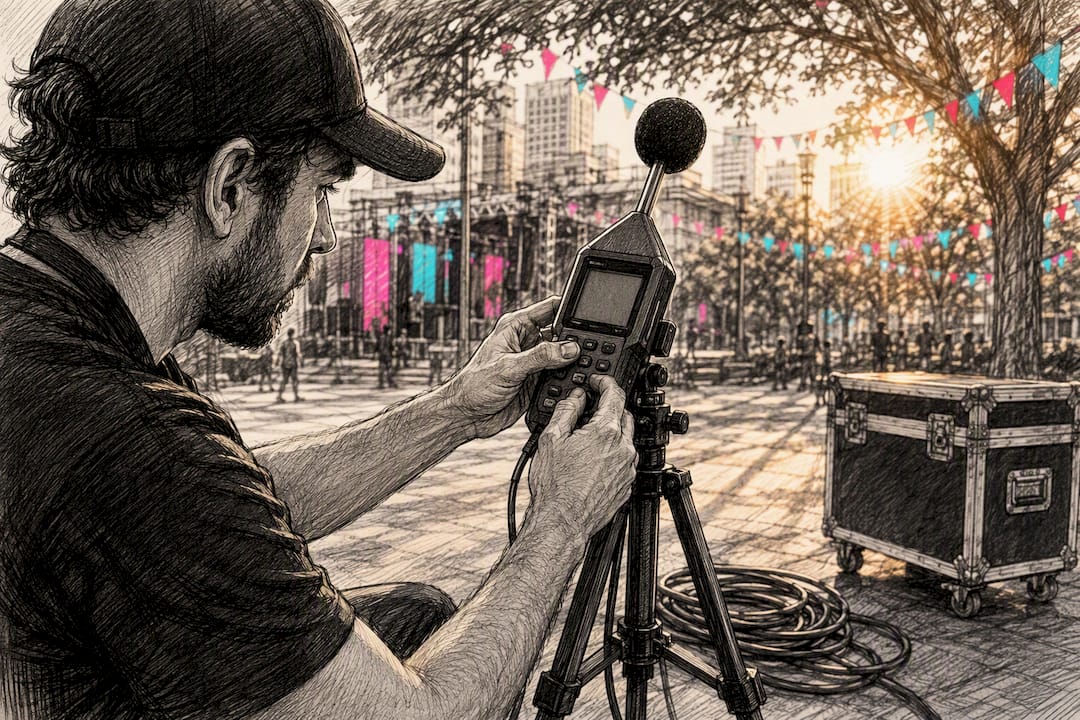
There is no such thing as a “noise pollution licence” in the UK. Noise is controlled instead through a mix of instruments: premises licences and Temporary Event Notices under the Licensing Act 2003, statutory nuisance abatement notices under the Environmental Protection Act 1990, and, for a smaller category of fixed-site operations, environmental permits. Whichever applies to your event, the mechanism is the same: conditions are attached, and breaching them has consequences.
Firefly AV is an audio visual hire and event production company based in Leeds and Preston, working across the UK and Europe, and we deal with these instruments on a practical level every time we rig sound for a conference, festival stage, or product launch near residential neighbours.
Get the wrong licence, or ignore a condition buried in the small print, and you’re looking at:
- A licence review that can add restrictive conditions or suspend your licence
- An abatement notice requiring you to stop or limit noise immediately
- Fines that have run as high as £20,000 in some prosecutions
- Reputational damage with a venue or local authority that affects future bookings
Key Takeaways
Noise compliance for UK events depends less on which licence you hold and more on whether you can evidence what happened on the night.
| Point | Details |
|---|---|
| No standalone licence exists | Noise is controlled via premises licences, TENs, abatement notices, and environmental permits, not a dedicated “noise licence.” |
| TENs run up to 96 hours | Temporary Event Notices cover short-run events but still carry enforceable noise conditions under the Licensing Act 2003. |
| Abatement notices carry criminal penalties | Non-compliance under the Environmental Protection Act 1990 can lead to prosecution, not just a warning. |
| NIAs and NMPs apply to fixed-site operations | Large permanent infrastructure or industrial sites may need a Noise Impact Assessment referencing BS 4142 methodology. |
| Calibrated logs resolve disputes | SPL monitoring records and a named responsible person on site are what typically prevent escalation to licence review. |
Table of Contents
- What is a noise pollution licence, and why doesn’t it exist?
- How does statutory nuisance law affect events?
- When do you need an environmental permit instead?
- What technical measures actually reduce noise risk on site?
- What happens after a noise complaint is made?
- When should you bring in a specialist AV supplier?
- Editorial take: what organisers get wrong about noise compliance
- Sources
- FAQ
What is a noise pollution licence, and why doesn’t it exist?
Searching for “noise pollution licence” usually means one of four things is actually needed, depending on what you’re running and where.
A premises licence is the standing authorisation a venue holds under the Licensing Act 2003 to sell alcohol, provide late-night refreshment, or put on regulated entertainment. It’s permanent, tied to the building, and typically carries a full set of conditions covering noise, hours, and capacity.
A Temporary Event Notice (TEN) is the lighter-touch route for one-off or short-run events at a venue without a premises licence, or at a licensed venue doing something outside its usual permission. A TEN covers licensable activities for up to 96 hours, and there’s a cap on how many any one premises can run per year.
- Check what your event actually is. A wedding reception with amplified music in a marquee needs different cover to a corporate product launch inside an already-licensed conference centre.
- Identify the licensing authority. That’s your local council, and they administer both premises licences and TENs.
- Read the S182 guidance. The revised guidance issued under section 182 (Feb 2026) tells licensing authorities to focus on preventing public nuisance rather than imposing blanket rules, which is why conditions vary so much between venues.
- Submit early. TENs need advance notice, and premises licence variations can take some time if there are representations.
Pro Tip: A TEN doesn’t automatically mean lighter noise conditions. Councils frequently attach the same restrictions they’d put on a premises licence, particularly for events near housing, so don’t assume a short notice period equals a quiet form-filling exercise.
How does statutory nuisance law affect events?
If your event isn’t covered by a licence breach but neighbours still complain, the council can act under the Environmental Protection Act 1990 instead. Statutory nuisance doesn’t require a specific decibel figure. It’s assessed on whether noise “materially interferes” with someone’s use of their property, judged against timing, duration, and character as much as loudness.
Environmental health officers typically follow a set pattern once a complaint lands:
- Log the complaint and ask for diary sheets recording times and impact
- Visit or monitor remotely, sometimes overnight, to witness the noise directly
- Assess against statutory nuisance tests, not just subjective annoyance
- Decide whether to serve an abatement notice
An abatement notice requires the person responsible to stop the noise or reduce it within a stated timescale, and it can specify how. You can appeal to the magistrates’ court in England and Wales, or the sheriff court in Scotland, but the notice usually stands while an appeal is pending unless the court says otherwise.
Non-compliance is a criminal offence. Fines follow, and repeat breaches escalate quickly toward prosecution. There’s a recognised defence of “best practicable means,” meaning you took every reasonable step available given the cost and technology involved, but it only works if you can prove it with contemporaneous records, not a verbal assurance after the fact.
When do you need an environmental permit instead?
Most events never touch this regime. It applies mainly to fixed-site industrial processes, and occasionally to very large festivals with permanent or semi-permanent infrastructure that falls under regulated activities.
Where it does apply, the Environment Agency’s guidance on environmental permits sets expectations that go well beyond a standard licensing application:
- A Noise Impact Assessment (NIA) modelling likely noise levels against nearby receptors, usually referencing BS 4142 methodology for rating industrial and commercial sound
- A Noise Management Plan (NMP) setting out how noise will be controlled operationally, not just predicted on paper
- Evidence that mitigation has actually been considered, not just described
The Noise Advisory Tool (NAT) helps applicants work out whether an NIA and NMP are likely to be required, but it’s a screening aid, not a decision-maker.
The Environment Agency will not grant a permit if significant noise pollution is expected. That single line is why an NIA needs to be genuinely rigorous rather than a box-ticking summary, because a weak assessment can sink an application outright.
If your event sits anywhere near this threshold, get specialist input before you submit, not after a refusal.
What technical measures actually reduce noise risk on site?
This is where most of the real compliance work happens, and it’s also where an AV supplier earns its keep.
- Get the system design right first. Speaker orientation and directional arrays keep sound aimed at the audience rather than spilling toward a neighbouring street or residential block. Line-of-sight planning between the stage and the nearest sensitive receptor matters more than most organisers expect.
- Control low frequency separately. Bass carries further and through more structures than mid and high frequencies, so subwoofer placement and cardioid arrays need their own plan, not an afterthought bolted onto the main hang.
- Monitor in real time. Calibrated SPL meters at front of house and at the noise-sensitive boundary let your technician adjust before a complaint arrives, not after.
- Log everything. Timestamped SPL readings, limiter settings, and any adjustments made during the show are the evidence that turns “we think it was fine” into a defensible record.
- Build in operational controls. Restricted hours for outdoor stages, managed egress to avoid crowd noise late at night, acoustic shielding where practical, and clear door and window policies for indoor venues all reduce risk cheaply.
Noise limiters split opinion for good reason. They’re effective, but the S182 guidance explicitly warns against imposing them as a blanket condition on small venues, where they can strangle a mix unnecessarily. For a 200-capacity venue night, a well-briefed technician with a calibrated meter often achieves the same result more flexibly than a fixed limiter. For a multi-stage outdoor festival, limiters paired with continuous monitoring become close to essential.
Budget-wise, expect a monitoring technician on a day rate somewhere in the £250 to £450 range depending on event scale and location, with calibrated SPL kit hire adding a modest daily cost on top. Larger festival rigs with multiple monitoring points and a dedicated noise management lead push toward the higher end of that range across a multi-day build.
Pro Tip: Keep your Noise Management Plan under two pages. Licensing and environmental health officers see plenty of NMPs, and a document that clearly states your monitoring points, response thresholds, and named responsible person carries more weight than one padded with generic risk-assessment language.
A concise NMP should cover:
- Named responsible person on site with contact details
- Monitoring points and SPL thresholds for each
- Response procedure if a threshold is breached
- Hours of operation and any curfew arrangements agreed with the licensing authority
Firefly AV builds this into system design as standard, running conference mic systems and PA rigs from DB Technologies speakers through Allen & Heath consoles, with Sennheiser mics for spoken-word elements where gain structure and feedback control also affect perceived loudness. Absen LED walls and staging come from the same crew, so noise control sits inside the wider production plan rather than as a separate bolt-on.
What happens after a noise complaint is made?
The pathway is fairly consistent across councils, even if the pace varies.
- Initial contact: An officer may call the venue directly during the event, particularly for a first-time or minor complaint.
- Investigation: Diary sheets, monitoring visits, or objective SPL data get requested, sometimes within days.
- Outcome: Ranges from informal advice, through an abatement notice, to a licence review, and in serious or repeat cases, prosecution or a closure order.
- Coordination: Councils and the Environment Agency coordinate so an operator isn’t prosecuted twice under different regimes for the same incident.
If a complaint arrives mid-event, the immediate priority is evidence, not panic. Pull your SPL log, note the exact time and reading, reduce levels if the reading is trending toward your agreed threshold, and get the named responsible contact on the phone to the council’s out-of-hours line if one exists. A prompt, documented response is consistently what separates a written warning from a formal notice.
When should you bring in a specialist AV supplier?
Certain situations tip past what an in-house events team can safely manage alone: a large outdoor event with multiple stages, a licence application that’s attracted representations from residents, or a venue with a documented history of noise complaints. In each case, the technical evidence you can produce afterwards matters as much as the mitigation you put in place beforehand.
Calibrated logs and a named technician’s testimony routinely turn a subjective complaint into an objective record, which is often what actually resolves a licence review in the operator’s favour.
Firefly AV supports organisers across this whole chain: system design that accounts for directional control from the outset, calibrated SPL monitoring throughout the event, on-site technicians who can adjust in real time, and support drafting a Noise Management Plan that a licensing officer will recognise as substantive. Day rates for a dedicated monitoring technician typically sit in the £250 to £450 bracket, scaling with event size and the number of monitoring points required. For anyone weighing up what audio visual equipment actually contributes to a compliant event, the answer is usually less about the kit list and more about who’s operating it and what they’re logging while they do.
If you’re planning an event where noise risk is a genuine factor, whether that’s a city-centre conference venue or an outdoor festival site, book AV support that builds monitoring and documentation into the production plan from day one rather than treating it as an afterthought once a complaint has already landed.
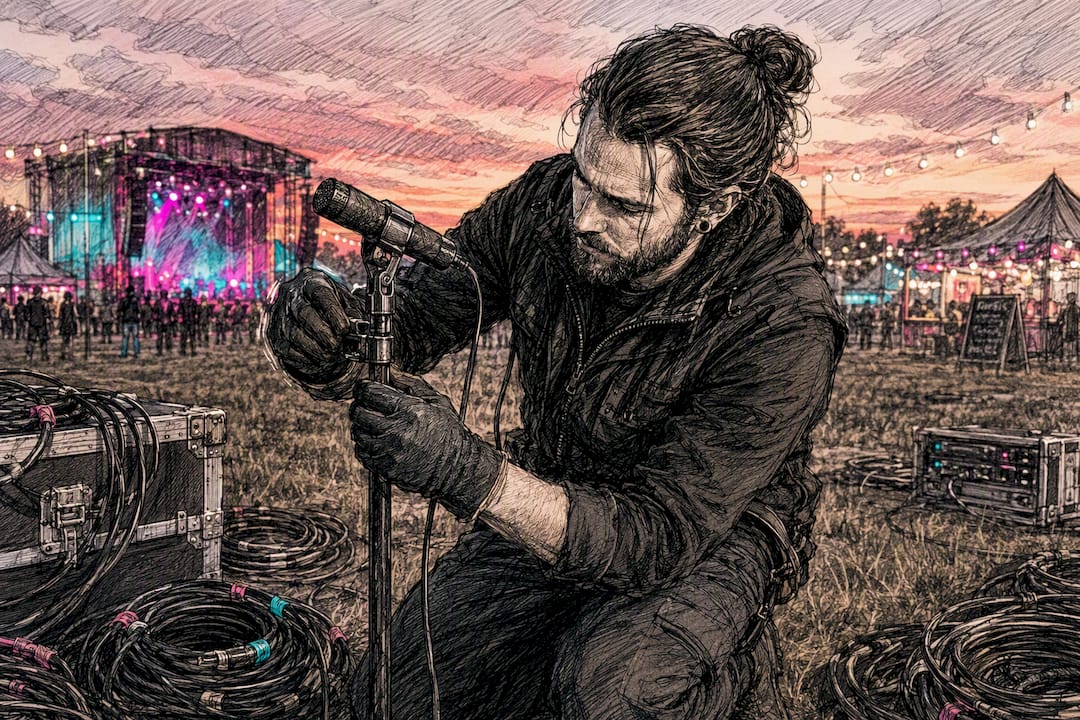
Editorial take: what organisers get wrong about noise compliance
Most guidance on this topic treats noise control as a paperwork exercise: get the right licence, tick the right box, move on. That’s backwards. The licence is the least interesting part. What actually determines whether an event survives a complaint is whether anyone can produce a calibrated record of what happened on the night.
Councils and licensing authorities aren’t looking for perfection. The S182 guidance is explicit that conditions should be proportionate, which tells you enforcement bodies expect reasonable effort, not silence. The organisers who get burned aren’t usually the loudest ones. They’re the ones who had no SPL log, no named responsible person, and no answer when an officer asked what happened at 11:40pm.
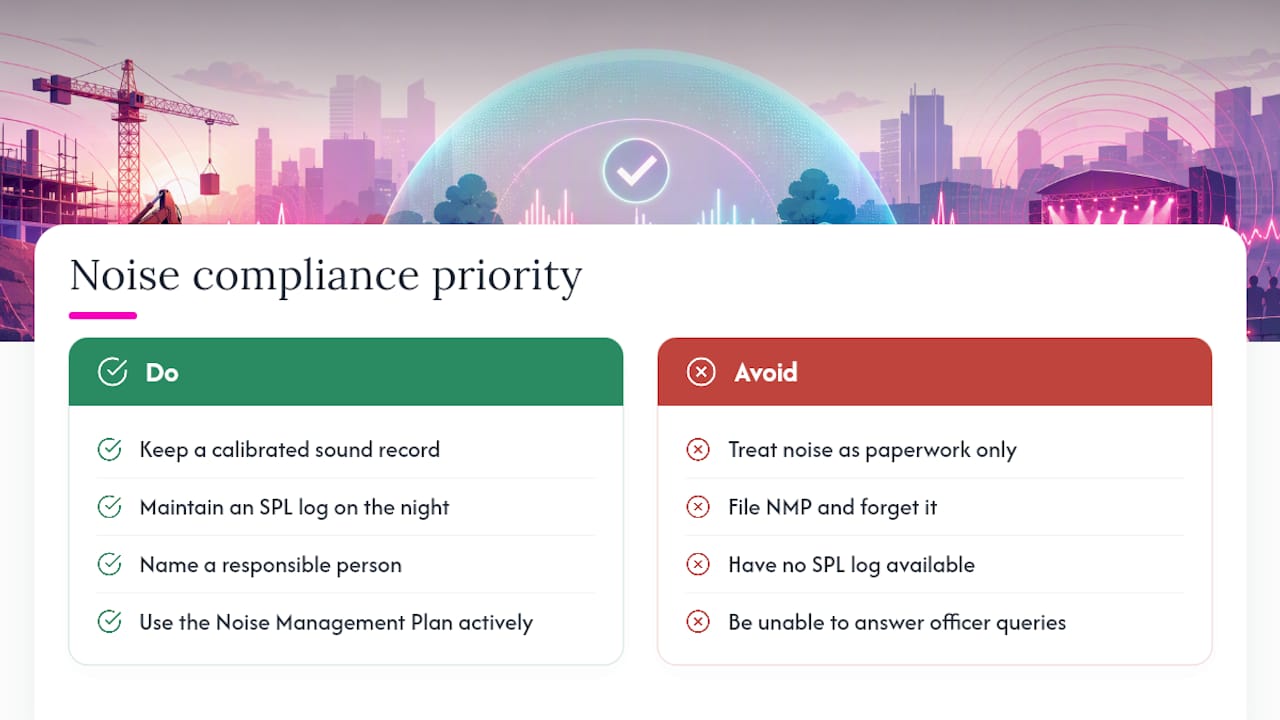
If there’s one priority to take from this, it’s treat your Noise Management Plan as a working document your technician actually uses on the night, not a compliance form filed and forgotten. That single habit resolves more disputes than any amount of licence paperwork ever will.
Sources
FAQ
What time do you legally have to be quiet?
There’s no single national cutoff time. Licensing conditions and TEN terms set specific hours per venue or event, and statutory nuisance assessments give extra weight to noise during night-time hours regardless of any stated curfew.
What are acceptable noise levels from neighbours?
There’s no fixed decibel threshold in statutory nuisance law. Officers assess whether noise materially interferes with normal use of a property, weighing timing, duration, and character rather than a single number.
How do you prove noise is a statutory nuisance?
Councils typically ask complainants to keep diary sheets logging times, duration, and impact, then may carry out their own monitoring visits before deciding whether the statutory nuisance test is met.
My neighbour plays music all day long. What should I do?
Report it to your local council’s environmental health team, who will investigate and can serve an abatement notice if they’re satisfied it meets the statutory nuisance threshold under the Environmental Protection Act 1990.
Do I need a permit for an outdoor festival?
Most festivals operate under a premises licence or TEN rather than an environmental permit. Permits typically only apply to fixed-site operations with permanent infrastructure that falls under regulated environmental activities.
What’s the difference between a premises licence and a TEN?
A premises licence is a permanent authorisation tied to a venue, while a Temporary Event Notice covers a specific event for up to 96 hours at a venue without a standing licence or outside its usual terms.