What is an event lighting rig? A planner’s guide
Date added: 8/08/2026
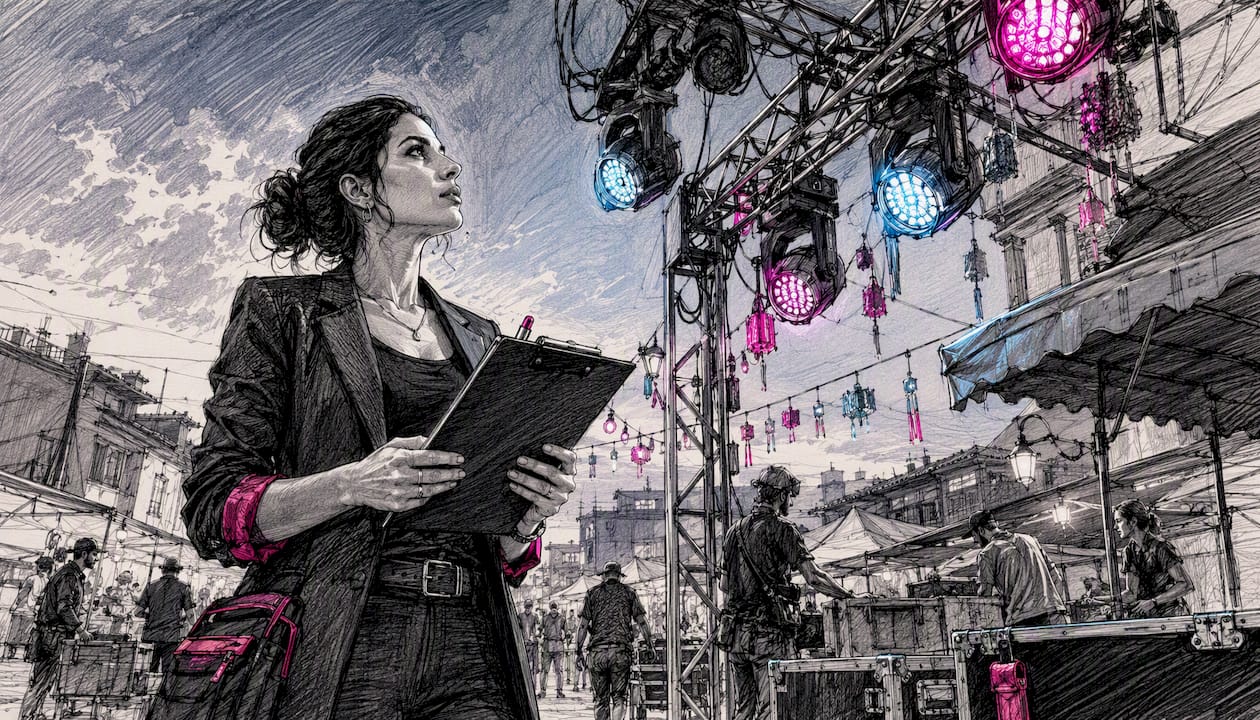
An event lighting rig is an engineered assembly of fixtures, support structure, control systems, and power distribution, built to shape atmosphere, direct focus, and ensure visibility across a live or staged event. At a concert, that means a flown truss loaded with moving heads and wash lights above the stage. At a corporate conference, it is a simpler overhead bar with profiles and a colour wash tied to a DMX console. In theatre, it is a precisely plotted system of bars, booms, and followspots. The core principle is the same in every case: a lighting rig is not a collection of lights placed roughly in the right direction. It is a designed, tested, and safety-checked system.
The term “lighting rig” is the standard industry shorthand. You will also hear “lighting setup” or “lighting system” used interchangeably, but in professional AV and event production, “rig” specifically implies the structural and control infrastructure, not just the fixtures. DMX512 is the universal control protocol that runs almost every professional rig, and truss types such as F33 and F34 box truss are the structural backbone for most overhead lighting runs in the UK.
Table of Contents
- What does a lighting rig consist of?
- Where do you position lights on a rig?
- How do truss types and load capacity affect your rig?
- How does power and control work on a lighting rig?
- How do you plan and brief a lighting rig?
- What UK safety and inspection requirements apply?
- Pre-event testing and maintenance checks
- How professionals specify a rig: terminology and rules of thumb
- Key takeaways
- The thing most planners underestimate about lighting rigs
- Fireflyav: lighting rigs and technical support for UK events
- Useful sources and further reading
What does a lighting rig consist of?
Professional event lighting is a comprehensive, engineered assembly, and every component has a specific job. Miss one and the rig either fails to perform or becomes a safety risk.
Fixtures
The lights themselves fall into a few clear categories:
- Wash fixtures flood a broad area with even colour, ideal for stage coverage or audience illumination.
- Profile/ellipsoidal fixtures produce a hard-edged, focusable beam, used for key lighting speakers or highlighting specific set pieces.
- Moving heads combine pan, tilt, colour, and gobo functions in one unit, giving operators dynamic control for concerts and live shows.
- Beam fixtures produce a tight, parallel shaft of light, primarily used for aerial effects and crowd-facing looks.
- PAR cans and LED PARs are the workhorses for simple colour washes and uplighting.
Truss and mounting hardware
Truss is the structural spine of any flown rig. Box truss (F33/F34) handles the heavy loads of a full concert rig; lighter tube or flat truss suits smaller DJ setups or decorative stands. Clamps, spigots, and coupler plates connect fixtures and truss sections.

Control systems
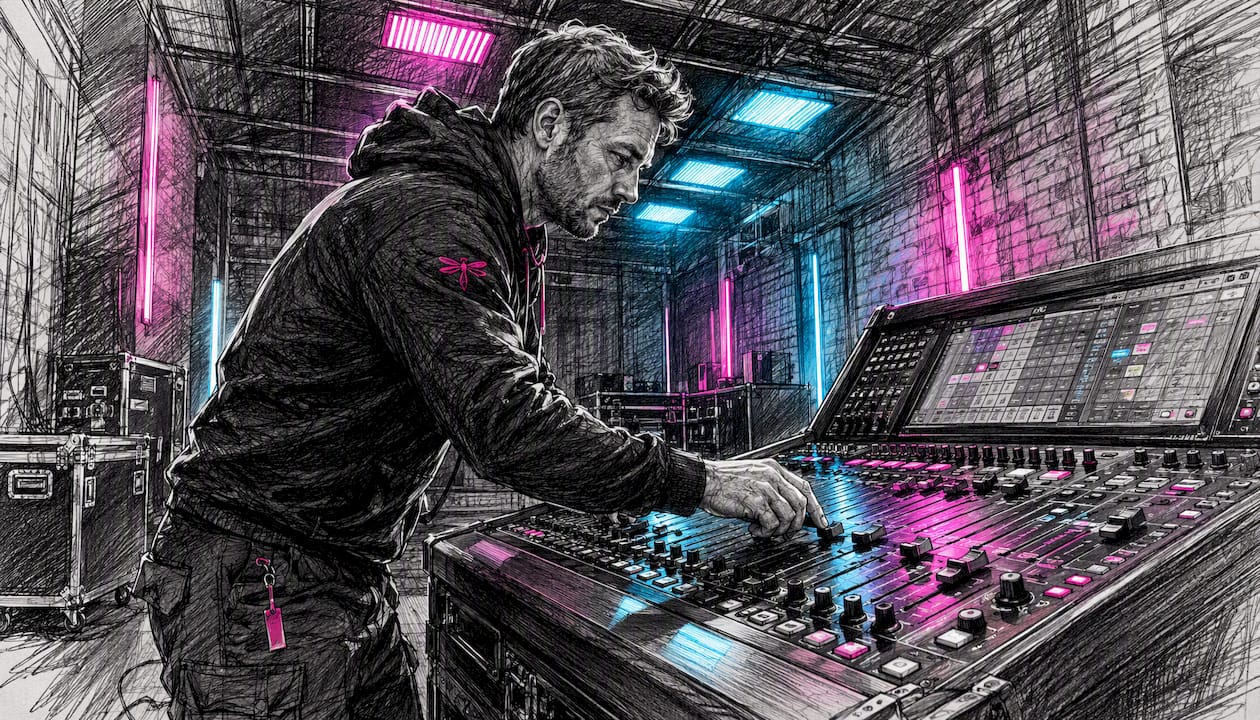
A lighting console (from a compact wing such as the ChamSys MagicQ PC Wing to a full-size desk) sends DMX512 data down the signal chain. DMX splitters distribute that signal across multiple universes. Where cable runs are impractical, a W-DMX wireless transceiver replaces the physical link.
Power distribution
A power distro unit (PDU) takes the incoming supply and breaks it into protected circuits for each rig zone. Dimmers control intensity for tungsten sources; LED fixtures typically run on direct power with their own drivers. Multicore (Socapex) cables bundle multiple circuits into a single run, keeping the stage floor tidy.
Rigging hardware
Chain motors (hoists) lift and trim flown truss to the correct height. Shackles, slings, and safety bonds connect the motor to the truss and the truss to the venue’s structural points. Every piece of rigging hardware carries a Safe Working Load (SWL) rating that must not be exceeded.
Safety equipment
Safety bonds (also called safety cables or safeties) are secondary retention devices attached to every fixture on a flown rig. They are not optional.
Pro Tip: Label every fixture, cable, and circuit with a consistent naming convention before the rig goes up. A simple scheme such as “LX1-A” (bar 1, fixture A) matched to a printed patch document cuts troubleshooting time dramatically when a fixture drops out mid-show.
Where do you position lights on a rig?
Rigging position determines angle, coverage, and the quality of light the audience and performers experience. Standard positions are named by their relationship to the stage and audience.
Overstage / flown truss
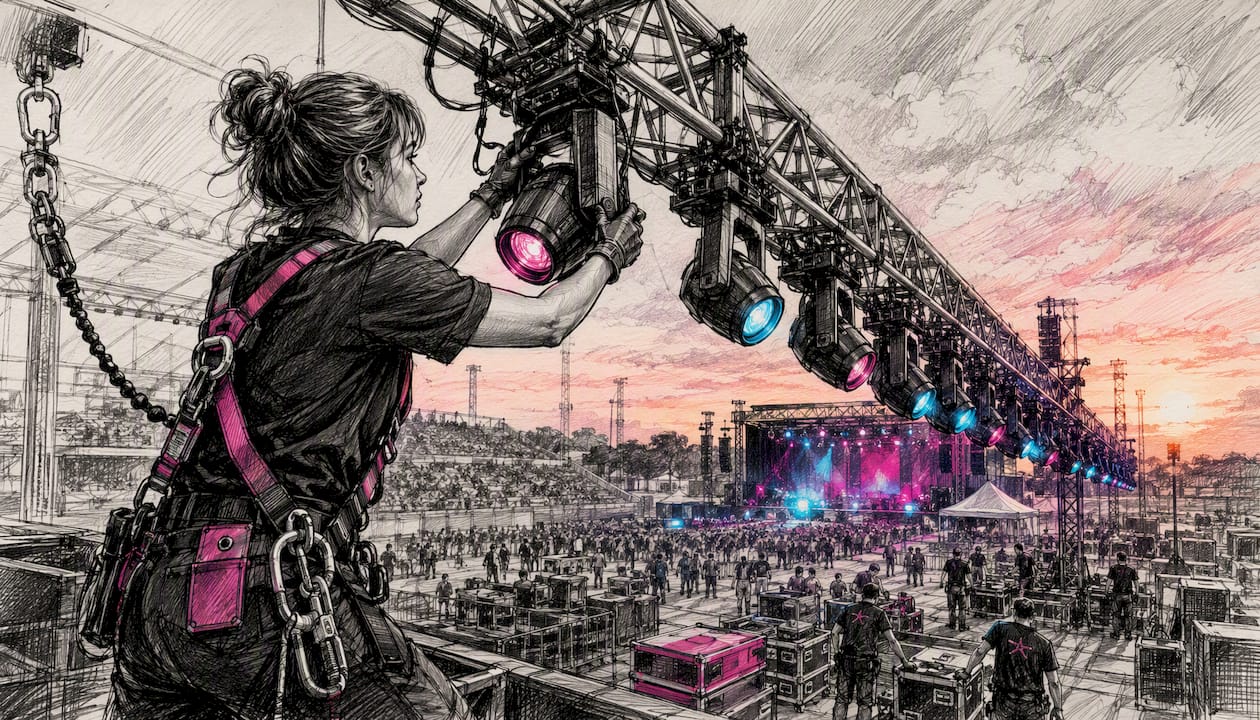
Bars or truss runs flown directly above the performance area. Numbered from the proscenium upstage (LX1, LX2, and so on in theatrical convention). These are the primary positions for downlighting, gobo work, and moving-head effects at concerts and theatre productions.
Front of house (FOH)
Positions in the auditorium or at the back of the room, facing the stage. FOH bars or trusses carry profile fixtures for key lighting faces and followspots for touring shows. At a corporate conference, a single FOH bar above the audience provides the front fill that makes a speaker’s face readable on camera.
Side-stage booms
Vertically mounted bars in the wings, carrying fixtures angled across the stage. Booms provide side light that gives performers depth and separates them from the background. They are standard in theatre and dance, and useful at concerts for dramatic cross-lighting.
Floor and totem positions
Ground-supported options include floor stands, totems, and ground-supported truss towers. These are used when flying is not possible (low ceilings, no structural points) or when upward-facing fixtures are needed for scenic uplighting. Totems are common at corporate dinners and product launches.
Ladders and lighting bars
Ladder frames hung in the wings offer multiple vertical fixture positions in a compact footprint, useful in smaller venues or where boom space is restricted. Horizontal lighting bars at balcony fronts or on floor stands extend coverage into the room without requiring overhead rigging.
For concerts, the typical combination is flown overstage truss plus FOH plus booms. Corporate conferences usually rely on FOH and a single overhead bar. Theatre uses the full range, with booms and ladders doing much of the character work.
How do truss types and load capacity affect your rig?
Choosing the wrong truss is one of the most common and costly mistakes in event lighting setup. Truss comes in five main shapes: tube, flat, triangular, box, and five-chord, each suited to different loads and applications.
| Truss shape | Typical use | Load capacity |
|---|---|---|
| Tube (single) | Decorative, DJ stands, small rigs | Low |
| Flat (ladder) | Lightweight bars, small venues | Low to medium |
| Triangular | Medium rigs, portable touring | Medium |
| Box (F33/F34) | Concert and corporate overhead runs | High |
| Five-chord | Heavy-duty arena and broadcast rigs | Very high |
Most professional overhead lighting runs use F33 or F34 box truss. Lighter tube or flat truss is appropriate for small DJ rigs or decorative lighting stands where the fixture count is low. Specifying truss by F-series designation simplifies conversations with rental suppliers and makes load planning straightforward.
Material matters too. Stage truss is most commonly fabricated from 6082-T6 aluminium, which gives a high strength-to-weight ratio and is practical for touring and temporary events. Steel truss is heavier and better suited to permanent roof installations than to events that need to be built and struck in hours.
Venue structural information to collect before you design
- Posted roof or grid load (in kg/m² or per point)
- Number, location, and rated capacity of dead-hang points
- Structural material (steel I-beam, timber, concrete)
- Clearance from floor to the lowest structural point
- Fire escape routes and access restrictions
- Any existing permanent rigging infrastructure
Safety callout: Never exceed a venue’s posted load limits. If the rig design approaches or exceeds those limits, or if the venue cannot provide certified load data, commission a structural engineer’s assessment before the rig goes up. A lift plan and method statement are required for any motorised flying in the UK. The Vectorworks introduction to entertainment rigging is a useful primer on the difference between temporary event rigging and permanent theatrical fly systems, and why venue assessment is non-negotiable for the former.
Example specification note: A single 6 m bay of F34 box truss spanning between two motor points, carrying eight moving heads at approximately 25 kg each, plus clamps, cables, and safety bonds, represents a significant point load. Dynamic loads from moving fixtures add to the static figure. Always apply the appropriate safety factor (commonly 7:1 for chain motors in entertainment rigging) and confirm the total against the venue’s structural data.
How does power and control work on a lighting rig?
Power and control are two separate flows that must be planned in parallel. Getting either wrong produces the same result: a rig that fails on show day.
The control chain
DMX512 is the standard digital protocol for lighting control. A console outputs DMX data, which travels via a splitter (to maintain signal integrity across multiple runs) to each fixture. Each fixture is assigned a unique DMX start address, and the console addresses it within a universe of 512 channels. A large rig with many fixtures will span multiple universes, each requiring its own data run or splitter output. Where cable runs are impractical, W-DMX wireless transceivers replace the physical link, though a wired backup is always worth having.
Proper signal routing follows a clear path: console → splitter → fixtures. Avoid daisy-chaining more fixtures than the protocol supports without a splitter, and test signal integrity during the pre-rig check rather than discovering a dead universe at the start of the show.
The power chain
In the UK, event power typically arrives via 16 A or 32 A commando (CEE) connectors from the venue’s distribution board or a generator. A power distro unit breaks that supply into individual circuits, each protected by a breaker. Socapex (multicore) cables then carry multiple circuits in a single run to rig zones, where breakout boxes distribute to individual fixtures.
LED fixtures draw far less current than tungsten sources and do not require dimmers. Tungsten and halogen sources need dimmer racks. Mixing both on the same circuit without understanding the load is a common cause of tripped breakers mid-show.
Pro Tip: Maintain a patch document that maps every fixture’s DMX universe and start address alongside its circuit and breaker number. Keep printed and digital copies with the crew. A simple spreadsheet shared before the build prevents the “which universe is that moving head on?” conversation at 11 PM.
For a detailed breakdown of event power distribution and load calculations, Fireflyav’s dedicated guide covers the specifics for UK venues.
How do you plan and brief a lighting rig?
A clear brief is the single biggest factor in getting a rig that performs. Suppliers cannot design to your needs if they do not know what those needs are.
Briefing checklist
- Event type and creative intent (concert, conference, awards, theatre)
- Venue name, address, and ceiling/grid height
- Audience sightlines and any camera positions
- Available rigging points and posted load data
- Power supply: incoming capacity, location of distribution board, generator availability
- Content running on the day: presentations, live band, AV playback, video walls
- Estimated fixture count or desired lighting zones
- Budget range (fixture hire, labour, transport, permits)
- Crew access times and load-in/load-out schedule
- Any venue restrictions (no drilling, noise curfew, union crew requirements)
Questions to ask your supplier
- Are all flying equipment and rigging hardware covered by current LOLER inspection certificates?
- Can you provide PAT test records for all electrical equipment?
- What public liability insurance do you carry, and to what value?
- Who is the appointed rigger, and what are their competency credentials?
- What is your pre-event test procedure, and how long does it take?
- Is the quote dry hire or does it include a technician?
- What are the transport, access, and parking requirements?
Timeline by event scale
| Event scale | Design sign-off | Pre-rig test | On-site build | Tech rehearsal |
|---|---|---|---|---|
| Small (low fixture count) | 1 week out | 2 days out | Same day | 2–4 hours before doors |
| Medium (moderate fixture count) | a few weeks out | a few days out | 1 day before | a few hours before doors |
| Large (high fixture count) | several weeks out | about a week out | a few days before | day before doors |
Cost factors to flag early
Fixture count and type drive the largest share of cost. Moving heads cost significantly more to hire than static wash fixtures. Motorised flying (chain motors, controllers) adds both hire cost and labour. Transport, access equipment (cherry pickers, tallescopes), and any permit requirements for outdoor rigs add further. Labour is typically quoted per build day and per derig day, with programming time separate.
For a broader view of how lighting integrates with sound, staging, and LED screen setup across a full event production, Fireflyav’s resources cover the complete picture.
What UK safety and inspection requirements apply?
Safety on a lighting rig is not a box-ticking exercise. In the UK, several pieces of legislation and guidance apply directly to event rigging, and organisers have a duty to verify compliance before the rig goes live.
Documents to request from every supplier
- LOLER (Lifting Operations and Lifting Equipment Regulations 1998) inspection certificates for all chain motors, shackles, slings, and rigging hardware used in lifting operations
- PAT (Portable Appliance Testing) records or equivalent electrical inspection evidence for dimmers, distro units, and any portable electrical equipment
- Public liability insurance certificate at a level appropriate for the event and venue.
- Method statement and risk assessment for the rigging operation
- Lift plan for any motorised flying
- Competency evidence for the appointed rigger (PLASA, IOSH, or equivalent)
On-site safety checklist during the build
- Establish exclusion zones beneath any flown equipment before lifting begins
- Confirm all rigging hardware SWL ratings against the actual load
- Attach safety bonds to every fixture on a flown bar or truss
- Check tag lines are in place on any truss being flown
- For outdoor rigs, have a weather monitoring plan and defined wind-speed thresholds for de-rigging
- Conduct a visual inspection of all truss connections before trim height is set
Entertainment rigging covers both temporary event work and permanent theatrical fly systems. The key distinction for event planners is that temporary rigs cannot assume permanent grid points are rated for the load you intend to apply. Always verify.
The Health and Safety Executive (HSE) publishes guidance on Working at Height Regulations 2005, which apply to anyone working on a lighting rig above ground level. The HSE’s Entertainment Information Sheet No. 6 covers rigging in the entertainment industry specifically. When in doubt, escalate to a structural engineer.
Roles and responsibilities
- Appointed person / head rigger: responsible for the overall rigging operation, lift plan, and crew safety.
- Riggers: execute the lift plan under the appointed person’s direction.
- Lighting designer: specifies the rig, fixture positions, and DMX patch.
- Lighting operator: programmes and operates the console during the show.
- Production manager / stage manager: coordinates between departments and holds the overall safety sign-off.
Pre-event testing and maintenance checks
A rig that has not been tested is a rig that will fail at the worst possible moment. Build testing time into every schedule.
Pre-event test list
- Power sanity check: confirm all circuits are live, breakers are correctly rated, and no earth faults are present
- DMX signal flow: address each fixture from the console and confirm it responds correctly
- Full fixture function test: cycle through all channels (colour, gobo, pan, tilt, dimmer, strobe) on every unit
- Movement test for motorised fixtures: run full pan and tilt range and check for mechanical noise or binding
- Motor trim check: confirm all flown truss is at the correct height and level
- Safety bond inspection: visually confirm every bond is attached and correctly rated
- Cue run: walk through the show’s lighting cues with the operator and stage manager before the audience arrives
Derig checklist
- Power down all circuits before any fixture is removed from a flown position
- Secure all cables before lowering truss
- Inspect truss sections for damage (bent chords, cracked welds, damaged spigots) before packing
- Tag and return all consumables (gels, gobos, tape) with an inventory count
- Log any incidents, equipment faults, or maintenance items in writing
Pro Tip: Photograph every flown point before the rig goes up and again after it comes down. A signed handover sheet recording the condition of all hired equipment at the end of the event protects both the organiser and the supplier if a damage dispute arises later.
How professionals specify a rig: terminology and rules of thumb
Understanding the language professionals use lets you read a supplier’s quote critically and spot gaps before you sign.
Example specification snippet
A typical overhead lighting run for a medium-scale corporate event might read:
- 2 × 6 m runs of F34 box truss, flown on four 500 kg chain motors
- 12 × LED wash fixtures (approx. 8 kg each), 4 × profile fixtures (approx. 6 kg each), plus clamps and safety bonds
- Total estimated flown load per motor point: a moderate load well within a typical 500 kg motor’s rated capacity, with safety factor applied
- DMX: 1 universe, addressed from a single splitter output
- Power: 1 × 32 A commando feed, split via distro to two 16 A circuits
Key terms every planner should know
- Dead-hang: a fixed, non-motorised suspension point; the truss is set at one height and stays there.
- Bridle: a two-leg sling arrangement used to spread a load between two structural points.
- Chain motor: an electric hoist used to fly and trim truss to the correct height.
- SWL (Safe Working Load): the maximum load a piece of rigging hardware is rated to carry in normal use.
- Headroom: the clearance between the top of the truss and the venue’s structural ceiling or roof.
- Trim height: the finished height of the underside of the flown truss above the stage floor.
- Universe: a single DMX512 data run carrying up to 512 channels of control data.
- Patch: the mapping of DMX addresses to physical fixtures and circuits.
Practical rules of thumb
Fixture spacing on an overhead bar typically runs at standard centres for wash coverage, with closer spacing for profile work. A substantial safety factor is commonly applied to chain motors in entertainment rigging in the UK. Labour for a medium rig build commonly runs to a full day for two riggers and a lighting technician, with derig taking roughly half that time. These are illustrative figures; actual costs vary by rig complexity, venue access, and location.
For AV equipment explained in broader context, Fireflyav’s planner resource covers how lighting integrates with sound and video across a full event.
Key takeaways
A well-specified event lighting rig requires structural assessment, a clear DMX patch, verified LOLER compliance, and a tested pre-show procedure before a single fixture is switched on.
| Point | Details |
|---|---|
| Define the rig early | Specify fixture types, rigging positions, and power needs before approaching suppliers. |
| Verify structural capacity | Always collect posted load data from the venue and commission a structural engineer if capacity is uncertain. |
| Demand LOLER and PAT evidence | Request current inspection certificates for all flying equipment and electrical items before contracting. |
| Test before doors open | Run a full DMX, power, and function test with the operator and stage manager in the schedule. |
| Fireflyav for full-service support | Fireflyav supplies lighting rigs, rigging hardware, control systems, and onsite technical management for UK events. |
The thing most planners underestimate about lighting rigs
The coordination piece is where rigs go wrong far more often than the technical spec does. A lighting rig does not exist in isolation. It shares the ceiling with audio speaker arrays, shares the floor with staging and set, and shares the schedule with every other department trying to load in at the same time.
The most common problem is not a failed fixture or a tripped breaker. It is a lighting truss that cannot be flown to trim height because a speaker array is in the way, or a DMX run that has to be re-routed at the last minute because the stage manager moved a set piece. These are coordination failures, not technical ones.
The fix is straightforward in principle: get the lighting designer, sound engineer, and production manager in the same conversation before the design is finalised. A shared venue drawing with all departments’ equipment plotted on it takes an hour to produce and saves three hours of on-site argument. Stage management needs to know the exclusion zones and the build sequence. Sound needs to know where the truss is flying so they can route their speaker hangs accordingly.
The other thing planners consistently underestimate is the value of a proper tech rehearsal. Not a “let’s check the lights are on” walk-through, but a cue-to-cue with the operator running every state, the stage manager calling every cue, and someone watching from the audience position. Problems found in a tech rehearsal cost ten minutes to fix. The same problem found during the event costs the entire show.
Fireflyav: lighting rigs and technical support for UK events
When you need a lighting rig that is specified correctly, built safely, and operated by people who know what they are doing, the difference between a smooth show and a stressful one usually comes down to who is handling the technical side.
Fireflyav supplies lighting equipment hire, rigging hardware, control systems, and onsite technical management for corporate events, conferences, eSports, cultural productions, and broadcast work across the UK. The offer is not just dry hire. You get equipment that arrives tested, a crew that knows the rig, and technical support from load-in through to derig.
When requesting a quote, include your venue’s structural data, ceiling height, power supply details, fixture preferences, and access times. The more specific your brief, the faster Fireflyav can turn around a costed proposal. For onsite technical support and production services, visit the technical support page, or fill in the project enquiry form to start the conversation.
Useful sources and further reading
The following authoritative sources are worth bookmarking if you are preparing paperwork, deepening your technical knowledge, or verifying UK regulatory requirements.
| Source | What it covers |
|---|---|
| HSE Working at Height Regulations 2005 | UK legal framework for all work at height, including rig builds |
| HSE Entertainment Information Sheet No. 6 | Specific HSE guidance on rigging in the entertainment industry |
| LOLER 1998 — HSE guidance | Lifting Operations and Lifting Equipment Regulations: inspection and certification requirements |
| Entertainment rigging — Wikipedia | Overview of entertainment rigging types, techniques, and terminology |
| Vectorworks: introduction to entertainment rigging | Practical primer on temporary vs permanent rigging and venue assessment |
| AVGear stage truss buying guide | Truss types, materials, load considerations, and F-series sizing |
| Theatrecrafts: lighting rigging positions | Standard rigging position names and their theatrical conventions |
Document checklist for a supplier contract
- Current LOLER inspection certificate for all lifting equipment
- PAT test records or electrical inspection evidence for all portable electrical items
- Public liability insurance certificate
- Method statement and risk assessment for the rigging operation
- Lift plan (required for any motorised flying)
- Competency evidence for the appointed rigger
- Equipment inventory and hire agreement with condition notes