IP video production explained: a guide for professionals
Date added: 12/08/2026
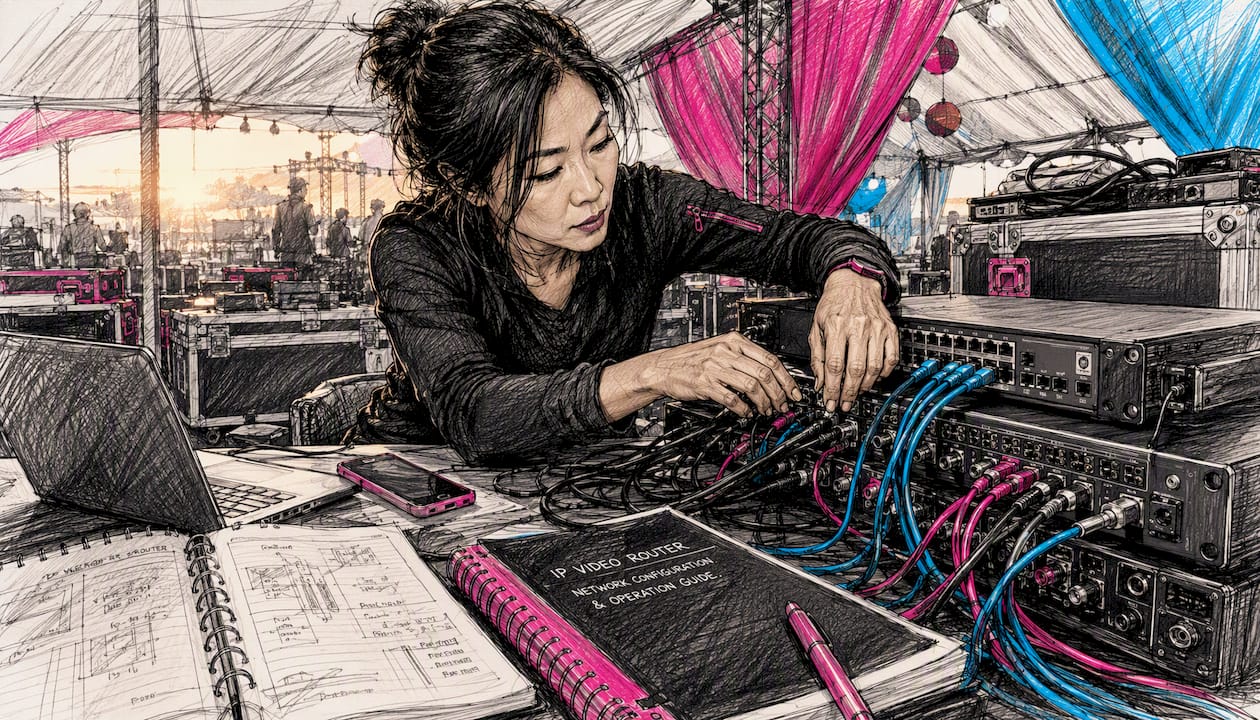
IP video production is the practice of carrying video, audio and control signals as discrete digital packets over standard IP networks — a LAN, WAN or the public internet — rather than routing them through point-to-point SDI or HDMI cabling. The ‘IP’ stands for Internet Protocol, the same packet-based transport layer that underpins the web. Instead of a dedicated wire per signal, each media stream is broken into packets, addressed, transmitted and reassembled at the destination.
Production teams reach for IP workflows in four broad situations:
- Remote/REMI production — centralised crews controlling cameras and switchers at distant venues
- Studio IP cores — replacing traditional SDI routers with software-defined media networks
- Corporate and hybrid events — distributing feeds to multiple screens and remote presenters without running long cable runs
- Contribution and backhaul — moving compressed streams between sites, to cloud playout or to broadcast partners
If any of those scenarios describes your next project, the rest of this guide covers how the technology works, which protocols to choose, and what a sensible deployment actually looks like.
Table of Contents
- How IP video production works: packetisation, timing and transport
- Which protocols and standards should you use?
- What are the real operational benefits of IP video?
- What are the trade-offs and failure modes to plan for?
- What does a typical IP production architecture look like?
- How to plan a migration or deploy IP video for an event
- Where does IP video add most value in UK production?
- How Fireflyav supports IP video production deployments
- UK regulatory and compliance considerations for IP video deployments
- Security in IP video production: encryption, access control and network hardening
- Key takeaways
- The learning curve is steeper than the marketing suggests
- Fireflyav: IP video equipment hire and technical support for UK events
- Useful sources and further reading
How IP video production works: packetisation, timing and transport
The journey from camera sensor to playout screen follows a consistent chain, regardless of which protocol you use.
Capture and encode. A camera or capture device digitises the signal. Depending on the workflow, the media is either kept uncompressed (as in SMPTE ST 2110) or lightly to heavily compressed before transmission (NDI, SRT). Encoding typically happens at the endpoint device, a dedicated hardware encoder, or a software encoder running on a server.
Packetisation. The media data is wrapped into IP packets, each carrying a payload, a sequence number and a timestamp. Those sequence numbers matter: they let the receiver detect dropped or reordered packets and request retransmission where the protocol supports it.

Transport. Packets travel across the network fabric — switches, routers, and in WAN scenarios, the public internet. This is where jitter (variation in packet arrival time) and packet loss become production concerns. A well-engineered LAN with Quality of Service (QoS) policies keeps both under control; a congested WAN link does not.
Synchronisation. For live switching, frames and audio must be aligned across every source. SMPTE 2059 and IEEE 1588 Precision Time Protocol (PTP) distribute a common clock across the network so every device timestamps its packets against the same reference. Without PTP lock, you get glitches at the cut point — the kind of artefact that ends careers in live broadcast.
Reassembly and playout. The receiver buffers incoming packets, reorders them if necessary, decodes the media and passes it to the downstream device — a monitor, switcher, graphics engine or encoder.
Latency in an IP video chain is the sum of encode time, network transit, jitter buffer depth and decode time. Uncompressed ST 2110 workflows can achieve sub-millisecond network latency on a local fabric; SRT over a WAN typically adds 120–500 ms depending on the buffer setting and link quality. Know your latency budget before you choose a protocol.
Pro Tip: Before any live event, run a dedicated one-way latency and jitter test on the actual network path you plan to use — not a similar one. Tools such as iPerf3 and Wireshark give you packet-loss figures and jitter histograms that reveal problems a ping test will miss entirely.
Which protocols and standards should you use?
IP video production has fragmented into several protocols, each optimised for a different part of the production chain. Choosing the wrong one for your network or use case is the single most common planning mistake.
The main protocols at a glance
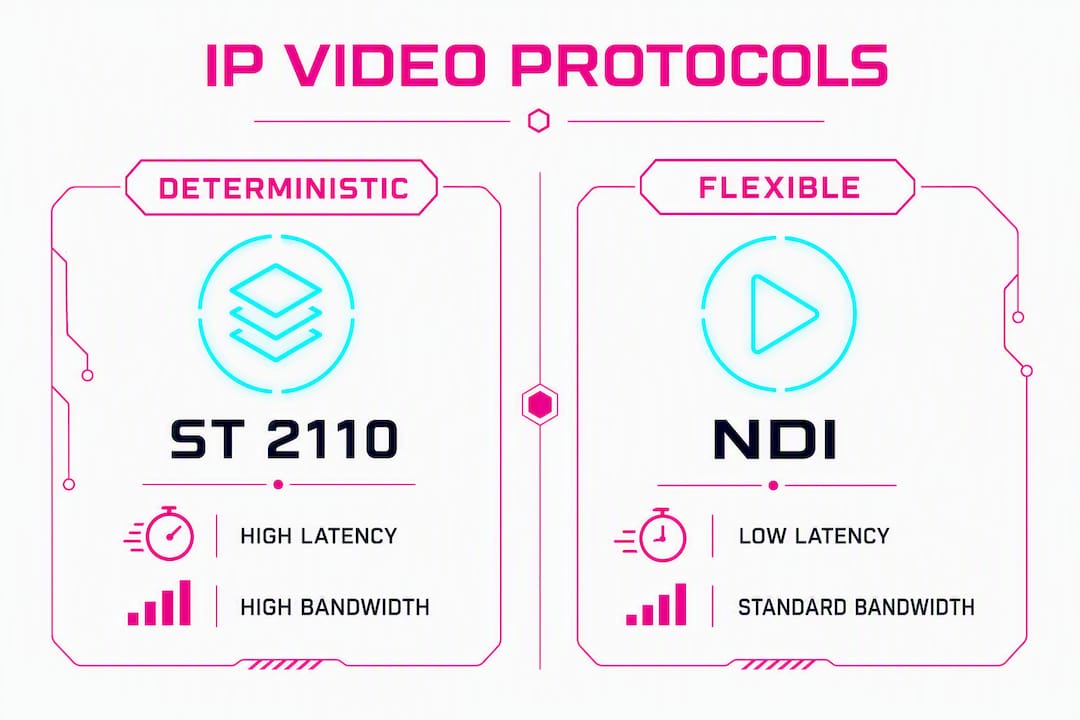
- SMPTE ST 2110 carries uncompressed video, audio and ancillary data as separate time-aligned essences (video on 2110-20, audio on 2110-30, ancillary on 2110-40). It demands PTP timing and an engineered fabric. The payoff is deterministic, frame-accurate switching — the standard for broadcast studios and large mobile units.
- NDI is a software-centric, lightly compressed LAN protocol that runs comfortably on 1 GigE. It is popular for graphics-heavy workflows, small studios and any environment where fast, flexible routing between PCs and software tools matters more than uncompressed quality.
- SRT (Secure Reliable Transport) is built for WAN contribution. It provides reliability and encryption over imperfect links by retransmitting lost packets within a configurable latency window. Use it for remote feeds, cloud contribution and backhaul between sites.
- RIST (Reliable Internet Stream Transport) solves a similar problem to SRT but is an open IETF standard, which matters when you need multi-vendor interoperability on contribution paths.
- RTP/RTSP are the underlying transport and control protocols that many higher-level systems build on. You will encounter them in IP cameras, streaming encoders and IPTV systems.
- IPMX adapts the ST 2110 essence model for Pro AV environments, adding compression options suited to 1 GigE and 10 GigE networks where full uncompressed bandwidth is impractical.
- Dante AV extends Audinate’s audio-over-IP platform into video, useful when a facility already runs Dante audio and wants a unified AV-over-IP fabric without a full ST 2110 deployment.
Protocol comparison
| Protocol | Latency | Bandwidth requirement | Interoperability | Best use case | Complexity | TCO implication |
|---|---|---|---|---|---|---|
| SMPTE ST 2110 | Sub-millisecond (LAN) | Very high (uncompressed, 10 GigE+) | Broad broadcast vendor support; NMOS for discovery | Broadcast studio, large mobile unit | High — requires engineered fabric and PTP | High upfront; lower long-term routing cost |
| NDI | Low (LAN, ~1 frame) | Moderate (lightly compressed, 1 GigE) | Wide software support; hardware gateways available | Small studio, LAN graphics/replay nodes | Low — plug-and-play on existing LAN | Low; runs on commodity hardware |
| SRT | Configurable (120–500 ms typical) | Low (compressed stream) | Growing; open source | WAN contribution, cloud delivery | Medium — buffer tuning required | Low; open source, no licence fee |
| RIST | Configurable | Low (compressed stream) | Open IETF standard; multi-vendor | WAN contribution, broadcast backhaul | Medium | Low |
| IPMX | Low (LAN) | Moderate (compressed, 1/10 GigE) | Growing Pro AV support | Corporate AV, hybrid events | Medium | Moderate |
Interoperability and gateways. Most real deployments mix protocols. An SDI camera feeds an IP gateway; the gateway outputs ST 2110 into the studio core; an NDI node handles graphics on the same LAN; SRT carries the finished programme to a remote site. NMOS (Networked Media Open Specifications) handles discovery and connection management across ST 2110 devices, reducing the manual configuration that used to make IP cores painful to operate.
Practical deployments tend to settle on a small, repeatable stack: ST 2110 for the deterministic core, NDI for flexible LAN nodes, SRT for WAN contribution. Adopting every format at once is a reliable way to create a support nightmare.
What are the real operational benefits of IP video?
The commercial case for IP video is straightforward, though the details matter.
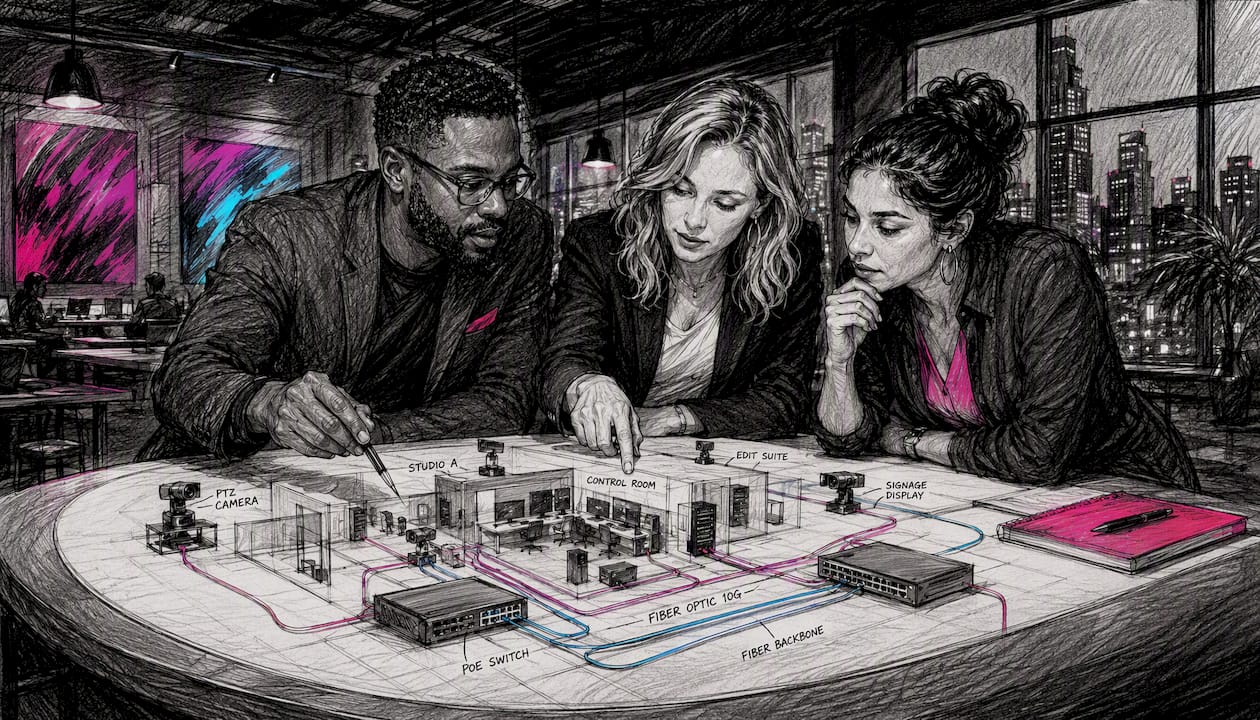
Scalability without hardware sprawl. Adding a new source to an SDI router means a physical input card and a cable run. Adding a source to an IP fabric means connecting to the network. Scalability and remote production are among the most cited operational benefits, and the network-attachment model is the reason: you can spin up a new camera, replay server or graphics node without touching the core infrastructure.
Remote and REMI production. Centralising production crews at a hub facility while cameras stay at the venue reduces travel costs, allows specialist operators to work across multiple events in a day, and makes flexible resource allocation genuinely practical. AV over IP enables remote access, device control and centralised production in ways that SDI point-to-point simply cannot match across distances.
Reduced cabling and PoE convenience. A single Cat6 or fibre run replaces multiple SDI cables. Power over Ethernet (PoE) switches — such as the Swissonic Stage Switch PoE — can power IP cameras and endpoints directly from the network port, eliminating separate power runs to remote positions.
TCO and infrastructure reuse. Falling IP bandwidth and storage costs have driven adoption across video markets. Beyond hardware, IP workflows integrate naturally with compute and cloud services — a production can share infrastructure with IT, use cloud rendering for graphics, or spin up a remote contribution path without commissioning new physical plant.
Pro Tip: When calculating TCO for an IP migration, include the cost of network engineering time and training alongside hardware. The kit is often cheaper than SDI equivalents; the expertise to run it correctly is where budgets get surprised.
What are the trade-offs and failure modes to plan for?
IP video is not a free upgrade from SDI. The failure modes are different, and some are harder to diagnose under pressure.
Bandwidth demands. Uncompressed ST 2110 video at 1080i/59.94 requires roughly 1.5 Gbps per stream. UHD/HDR multiplies that by four. A 64-source studio core needs a 100 GigE spine. Compressed workflows (NDI, SRT) reduce those numbers significantly but introduce encode/decode latency and quality trade-offs.
Latency and determinism. For live switching, the latency of every source must be consistent. A mix of compressed and uncompressed sources with different buffer depths creates alignment problems at the switcher. Some workflows — particularly those requiring frame-accurate switching with no perceptible delay — still benefit from SDI at the critical path.
Network complexity. IP production networks are not standard IT networks. Key design requirements include:
- Multicast routing with IGMP snooping (to avoid flooding every switch port with every stream)
- QoS policies that prioritise media traffic over control and data
- PTP/clocking infrastructure with a grandmaster clock and boundary clocks at each switch tier
- Managed switches with sufficient buffer depth and low-latency forwarding
Operational risks. A misconfigured VLAN or a rogue multicast flood can take down an entire production simultaneously — something that rarely happens with SDI, where failures tend to be per-cable. Monitoring tools (stream analysers, PTP monitors) are not optional extras; they are part of the production infrastructure.
Redundancy. SMPTE 2022-7 carries duplicate IP paths so receivers can switch cleanly if the primary path drops packets. Implementing it doubles the bandwidth requirement but is standard practice for broadcast-grade reliability.
Skills gap. Production engineers who are expert in SDI routing often need significant upskilling to manage IP fabrics. Network engineers who understand IP often lack production workflow knowledge. The overlap between those two skill sets is where IP deployments succeed or fail.
Suggested mitigations:
- Start with a hybrid SDI/IP approach — keep SDI at the critical path and add IP where it adds clear value.
- Build a test rig that mirrors the production network before committing to a live event.
- Implement SMPTE 2022-7 redundancy on any path where a dropout is unacceptable.
- Hire or contract a network engineer with media networking experience for the first several deployments.
- Define fallback procedures in writing before the event, not during it.
What does a typical IP production architecture look like?
The components of an IP video system fall into a few clear categories. How they connect depends on the scale and use case.
Core components
- IP cameras — cameras with native IP outputs (NDI, ST 2110, or RTSP) or traditional cameras feeding IP gateways
- Encoders and decoders — hardware or software devices that compress media for transport and decompress at the destination
- Capture and media servers — ingest, replay and playout servers connected directly to the IP fabric
- Network switches — the backbone of the system; choice of 1 GigE, 10 GigE or 25 GigE depends on stream count and codec
- PTP grandmaster clock — distributes the common timing reference across all ST 2110 devices
- SDI/IP gateways — convert between SDI and IP to integrate legacy cameras, routers and monitors; the Blackmagic Smart Videohub Cleanswitch 12x12 is one example of routing hardware that bridges traditional and IP signal paths
- NMOS controller — handles discovery, registration and connection management for ST 2110 devices
- Monitoring and multiview — stream analysers, PTP monitors and software multiviewers that give operators visibility of the fabric
Typical architecture patterns
Three patterns cover most deployments:
Small LAN NDI studio. A handful of NDI cameras, a software switcher (such as the Blackmagic Design ATEM Mini Pro used alongside NDI sources), graphics PCs and a replay node, all on a single managed 1 GigE switch. Low cost, fast to deploy, adequate for corporate content and small live productions.
Engineered ST 2110 broadcast core. A spine-leaf switch fabric at 10 GigE or 25 GigE, PTP grandmaster, NMOS controller, hardware gateways for SDI integration, and a software-defined router. This is the architecture for a broadcast facility or large mobile production unit where deterministic switching and large multiview environments are non-negotiable.
WAN contribution with SRT/RIST. A compressed feed from a venue encoder travels over a bonded 4G/5G or dedicated WAN link to a hub facility using SRT or RIST. The hub decodes, integrates with the studio core and distributes the finished programme. Monitoring at both ends is critical.
On any architecture, monitoring and redundancy are not afterthoughts — they are load-bearing elements. A production that cannot see its own network in real time is flying blind, and a production without a redundant path for its critical feeds is one packet storm away from dead air.
| Network tier | Typical use | Recommended switch speed | Notes |
|---|---|---|---|
| NDI LAN studio | Small studio, corporate events | 1 GigE | Managed switch with IGMP snooping |
| ST 2110 / IPMX core | Broadcast facility, large mobile unit | 10 GigE+ | PTP-capable, low-latency forwarding |
| WAN contribution | Remote/REMI, cloud delivery | Varies (WAN link dependent) | SRT/RIST with buffer tuning; monitor packet loss |
| UHD/HDR ST 2110 | High-end broadcast, OB truck | 25 GigE / 100 GigE spine | Redundant paths, SMPTE 2022-7 |
Exact bandwidth requirements depend on channel count, resolution and codec. These tiers are starting points, not fixed rules.
How to plan a migration or deploy IP video for an event
A staged approach prevents the most common failures. Hybrid environments are the practical reality: most facilities keep SDI where determinism matters and add IP where routing flexibility and remote production add value.
Pre-project scoping
- Define quality and latency requirements — uncompressed or compressed, and what is the maximum acceptable end-to-end delay?
- Count your channels: sources, destinations, multiview feeds, monitoring paths and redundant streams.
- Determine whether the event is LAN-only or requires WAN contribution, and whether cloud services are in scope.
- Identify which existing equipment can be retained with gateways and what must be replaced.
Network design essentials
- Segment media traffic onto dedicated VLANs, separate from IT and control traffic
- Enable IGMP snooping on all switches to contain multicast traffic
- Apply QoS policies that prioritise RTP/media packets over best-effort data
- Deploy a PTP grandmaster and configure boundary clocks at each switch tier for ST 2110 workflows
- Choose managed switches with sufficient buffer depth; unmanaged switches are not suitable for production IP
- Plan redundant physical paths and implement SMPTE 2022-7 on critical feeds
Pre-event checklist
- Lab-test the full signal chain end-to-end before arriving on site.
- Run iPerf3 or equivalent to measure one-way latency, jitter and packet loss on every network path.
- Verify PTP lock on all ST 2110 devices and confirm grandmaster priority settings.
- Test codec and buffer settings under load — not just with a single stream.
- Confirm multiview and monitoring feeds are operational.
- Verify redundancy paths by deliberately failing the primary link and confirming clean switchover.
- Document and rehearse the fallback procedure with the full production team.
For a hybrid event AV setup, add a test of the remote presenter path under realistic WAN conditions — not a local loopback.
Where does IP video add most value in UK production?
UK production teams are deploying IP workflows across a wide range of project types. The technology fits differently in each.
Broadcast facilities. ST 2110 cores are now standard in new-build and refurbished UK broadcast facilities. The deterministic switching and large multiview environments they support are difficult to replicate with SDI at scale. NMOS-based discovery and connection management reduces the manual patching that used to make large SDI routers slow to reconfigure.
Remote and REMI sport and live events. SRT and RIST carry compressed contribution feeds from venues to hub facilities, while NDI or lightly compressed IP handles replay and graphics on the local LAN at the venue. The result is a smaller on-site crew and specialist operators working from a central location — a model that has become standard for UK sports rights holders managing multiple simultaneous fixtures. For live event setups that feed large LED walls, IP distribution simplifies the signal routing considerably.
Corporate and hybrid events. Low-latency NDI or managed AV-over-IP handles flexible stage setups, distributed presenter feeds and multi-room distribution without the cable infrastructure that traditional SDI requires. AV over IP is already widely used in corporate AV environments, and the flexibility it offers for last-minute layout changes is a genuine operational advantage on event day.
eSports and live streaming. eSports productions typically combine low-latency LAN feeds from gaming PCs with cloud contribution for global audiences. NDI handles the local capture and replay; SRT carries the programme feed to cloud encoders for distribution. The hybrid approach keeps latency low for the in-venue experience while reaching global streaming platforms simultaneously. Fireflyav has specific expertise in eSports production, making this a well-understood workflow for the team.
How Fireflyav supports IP video production deployments
Fireflyav supplies equipment and technical support for IP video deployments across corporate, broadcast, live event and eSports productions in the UK. The services relevant to an IP workflow include:
- IP-capable camera hire and SDI/IP gateway equipment
- Managed network switches (including PoE models for camera power)
- Encoder and decoder hardware for contribution and distribution
- Onsite technical support from engineers with IP production experience
- System design consultation for hybrid SDI/IP architectures
- Managed REMI services for remote production setups
Before a live event, Fireflyav’s technical team runs a structured pre-event verification process:
- PTP lock checks across all ST 2110 devices
- One-way latency and jitter measurement on all network paths
- Codec and buffer verification under realistic load
- Multiview and monitoring feed confirmation
- Redundancy path testing with deliberate primary-link failure
- Fallback procedure rehearsal with the production team
For teams new to IP workflows, Fireflyav can also advise on broadcast AV equipment types and help scope the right architecture for the project scale and budget. The team’s experience across event production setups means the advice is grounded in what actually works on UK event sites, not just what looks good in a white paper.
UK regulatory and compliance considerations for IP video deployments
IP video production in the UK sits within several overlapping regulatory frameworks that production teams should understand before deploying.
Ofcom and broadcast licensing. Any IP video workflow used to originate or distribute licensed broadcast content must comply with Ofcom’s technical standards for programme contribution and distribution. The ITU-R BT.2137-0 recommendation covers technologies applicable to IP interfaces for programme production and is the relevant international reference for broadcasters operating IP contribution chains.
Data protection. IP video systems that capture or transmit footage of identifiable individuals — including audience members at live events — are subject to the UK GDPR and the Data Protection Act 2018. This applies to both live streams and any recorded content stored on network-attached servers. Production teams should confirm that their IP infrastructure does not inadvertently retain footage beyond the agreed retention period.
Network and spectrum. Where IP video is carried over licensed wireless links (bonded 4G/5G for REMI contribution, for example), Ofcom spectrum licensing requirements apply. Temporary spectrum licences for outside broadcast use are available through Ofcom’s licensing portal and should be secured well in advance of the event date.
Venue and building regulations. Temporary IP network installations at UK venues must comply with BS 7671 (IET Wiring Regulations) for any mains-powered equipment. PoE-powered devices fed from a compliant switch are generally straightforward, but any generator-fed temporary power distribution requires a competent person sign-off.
Cyber Essentials and public sector contracts. UK public sector clients and some large corporate clients increasingly require suppliers to hold Cyber Essentials or Cyber Essentials Plus certification. If your IP video infrastructure handles content for a public sector event, check whether the contract requires certification of the network and connected devices.
This section provides general information about the regulatory context for IP video production in the UK. Confirm current requirements with Ofcom, the ICO, or a qualified legal adviser before deploying.
Security in IP video production: encryption, access control and network hardening
IP video networks are computer networks, and they carry the same attack surface as any other networked system. The difference is that a security incident during a live production has immediate, visible consequences.
Network segmentation. Media VLANs should be isolated from corporate IT networks and from the public internet. A production network that shares a flat network with office Wi-Fi is an unnecessary risk. Firewall rules should permit only the specific ports and protocols required by the production system.
Encryption. SRT includes built-in AES-128 or AES-256 encryption for WAN contribution paths. For NDI on a LAN, the network boundary (firewall, VLAN isolation) provides the primary protection; NDI does not encrypt by default. ST 2110 streams are similarly unencrypted at the transport layer, making physical and logical network isolation the primary security control.
Access control. All management interfaces — switches, encoders, NMOS controllers, media servers — should use strong, unique credentials. Default passwords on network equipment are a well-documented attack vector. Where possible, use RADIUS or LDAP-based authentication for management access rather than local accounts.
Monitoring and intrusion detection. A production network should have baseline traffic monitoring so that unexpected multicast floods, new devices appearing on the fabric, or unusual bandwidth spikes are visible to the engineering team. Tools such as PRTG Network Monitor or open-source alternatives like Zabbix can provide this visibility without significant additional cost.
Physical security. On event sites, network switch ports that are not in use should be disabled. Unattended network equipment in public areas should be physically secured. A rogue device plugged into a production switch can disrupt the entire fabric.
Firmware and patching. Network equipment used in production environments should run current firmware. This is frequently overlooked in event AV, where equipment is hired, deployed and returned without a patching cycle. Confirm firmware versions during the pre-event check.
Key takeaways
IP video production routes media as IP packets over standard networks, making it the foundation of modern remote production, scalable studio cores and flexible event AV.
| Point | Details |
|---|---|
| Packet-based transport | Video, audio and control travel as IP packets over LAN, WAN or internet rather than dedicated SDI cables. |
| Protocol choice drives design | ST 2110 suits deterministic broadcast cores; NDI fits LAN/graphics nodes; SRT handles WAN contribution reliably. |
| Timing is non-negotiable | PTP (IEEE 1588 / SMPTE 2059) synchronises all sources; without it, live switching produces glitches. |
| Hybrid is the pragmatic path | Most UK facilities keep SDI at the critical path and add IP where routing flexibility or remote production adds value. |
| Fireflyav for UK deployments | Fireflyav supplies IP-capable equipment hire and onsite technical support, including pre-event network verification for live events. |
The learning curve is steeper than the marketing suggests
The production industry has spent two decades being told that IP is the future, and it is — but the transition is harder than the white papers make it sound. The skills gap is real and it cuts both ways: experienced broadcast engineers who can read a waveform monitor in their sleep often struggle with IGMP configuration, and IT network engineers who can design a spine-leaf fabric have no instinct for why a two-frame jitter buffer is too much for a live cut.
What actually works, based on the evidence from facilities that have made the transition successfully, is starting smaller than you think you need to. A single NDI node in an otherwise SDI studio teaches the team more about IP production behaviour than any training course. From there, a pilot REMI event over SRT, then a hybrid ST 2110 core for one studio, then a full migration. Each step validates the network design and builds the team’s confidence before the stakes get higher.
The other thing the marketing undersells is the monitoring requirement. SDI fails one cable at a time. IP fails in ways that can take down every signal simultaneously, and the failure mode is often invisible without the right tools watching the network. Budget for stream analysers and PTP monitors from day one, not as an afterthought when something goes wrong.
Hybrid operation is not a compromise or a transitional state. For most UK production teams, it is the permanent, pragmatic answer — SDI where determinism is non-negotiable, IP where flexibility and remote production add genuine value.
Fireflyav: IP video equipment hire and technical support for UK events
For UK production teams ready to deploy IP video workflows, Fireflyav provides the equipment and the engineering expertise to make it work on the day. The difference from sourcing kit independently is the pre-event verification: Fireflyav’s technical team tests PTP lock, latency, jitter and redundancy paths before the event goes live, not during it.
The hire inventory covers IP-capable cameras, encoders, managed PoE switches, SDI/IP gateways and the supporting infrastructure for LAN studio setups through to WAN contribution rigs. For corporate conferences, hybrid events and eSports productions, Fireflyav can provide a fully managed technical support package that includes system design, onsite engineering and post-event debrief. Browse the AV equipment options for event planners or go straight to the technical support service page to discuss your next project. To get a quote for specific equipment or a managed production package, fill in the project enquiry form and the team will respond with a scoped proposal.
Useful sources and further reading
- Recommendation ITU-R BT.2137-0: Technologies applicable to IP interfaces for programme production — the ITU’s primary reference for IP programme production interfaces
- IP Video Production Fundamentals (Chapter 7) — Remote Production — practical overview of IP video production concepts and REMI workflows
- How video over IP works — Telestream — explanation of PTP synchronisation and SMPTE 2022-7 redundancy
- SDVoE Alliance — industry body for AV-over-IP standards and interoperability resources
- AVnu Alliance FAQs — reference for AVB/TSN timing and synchronisation standards relevant to Pro AV
- Fireflyav broadcast AV equipment guide — Fireflyav’s guide to broadcast kit types for UK production teams