Rear projection screens: what they are and how they work
Date added: 3/08/2026
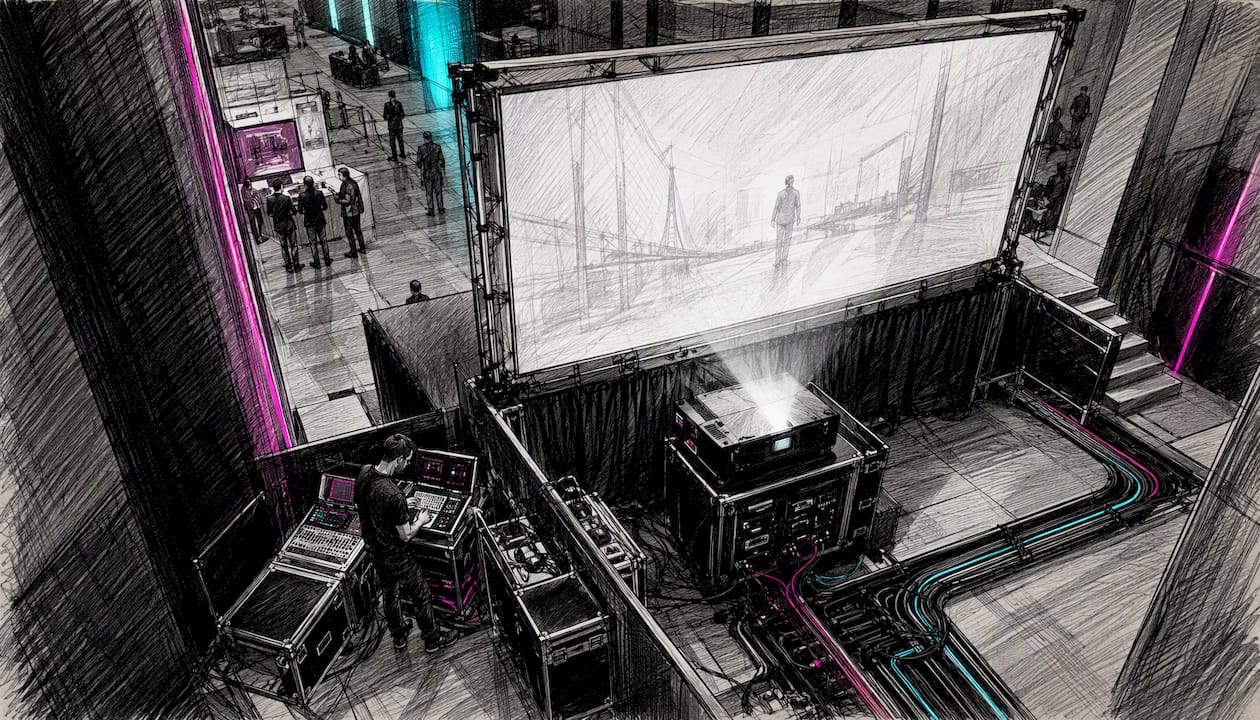
A rear projection screen is a semi-translucent surface that shows an image projected from behind it, so the audience views transmitted light rather than reflected light. Planners choose it when they want a clean stage with no shadows cast by presenters walking in front of the image and no projector visible in the room. Firefly AV is an AV hire and event production company based in Leeds and Preston, working across the UK. We install and hire the kit behind these setups: Panasonic projectors, Absen LED wall, Sennheiser mics, Allen & Heath consoles, DB Technologies speakers, Birddog cameras and Lite Deck staging.
A rear projection screen transmits light through a diffusion material instead of bouncing it off a reflective surface, which is why the projector sits behind the screen rather than in front of it.
- Ideal for stages where you need a shadow-free image and concealed hardware
- Common in awards ceremonies, museum exhibits and broadcast studios
- Requires more depth behind the screen than most venues assume
The sections below cover how the technology works, the space and lumen checks you need to run, typical UK hire costs, and how to decide between rear projection, front projection and LED.
Key Takeaways
Rear projection works by transmitting light through a diffusion screen rather than reflecting it, trading extra rear space and higher lumen requirements for a shadow-free, gear-concealed stage.
| Point | Details |
|---|---|
| Core definition | A rear projection screen transmits light from a projector behind it, unlike front projection, which reflects light off the surface. |
| Space is the deciding factor | You need enough depth behind the screen for your lens’s throw distance, or a mirror relay system to compress it. |
| Brightness needs rise | Rear-projection setups typically need higher-lumen projectors than equivalent front-projection rigs to offset light lost in transmittance. |
| Viewing angle limits seating | Higher-gain materials brighten the image but narrow the viewing cone, so check your seating plan against it. |
| Firefly AV supports the full build | Firefly AV, based in Leeds and Preston, runs site surveys, supplies Panasonic projectors and screen packages, and provides technicians for test installs across the UK. |
Table of Contents
- How rear projection works
- What types of rear-projection screen material are there?
- Is rear projection better than front projection?
- What should you check before specifying rear projection?
- What does rear projection cost to hire in the UK?
- Maintenance and specs: gain, transmittance and viewing angles
- Choosing rear projection for your specific venue
- Which projectors and brightness levels suit UK events?
- Sources
- FAQ
How rear projection works
Rear projection transmits light through a diffusion material rather than reflecting it off a coated surface, which is the entire reason the audience sees a clean image with no shadows. The technique is often called back projection, and it depends on a handful of components working together correctly:
- A projector positioned behind the screen, usually on a short or long-throw lens
- A rear-projection screen material with a known gain and transmittance rating
- A mounting frame or cabinet that holds the material taut and flat
- Power, cabling and ventilation for the enclosed space behind the screen
In simple terms: the projector fires light through the material, the material diffuses it, and the audience on the front side reads the transmitted image within a defined viewing cone. Picture it as audience, then screen, then projector, all on a single axis, with the projector’s throw distance determining how much depth you need behind the screen.
- Confirm throw distance and throw ratio for the lens you plan to use
- Match projector lumens to the screen’s transmittance rating
- Check the viewing cone covers your seating plan without hotspotting
You will hear terms like ALR (ambient light rejecting), hotspotting and diffusion used interchangeably by suppliers, so it is worth asking exactly which spec they mean before booking.
What types of rear-projection screen material are there?
Screen material choice depends on your content, your projector’s brightness and how much control you have over ambient light. Grey rear-projection vinyl is common where you need higher contrast under some ambient light, while white diffusion screens suit darker rooms and give a brighter, more neutral image. Dual-surface exchangeable screens let you switch between front and rear projection panels on the same frame, and switchable or translucent film can turn a glass panel transparent or opaque on demand, which retail and exhibition designers use for reveal effects.
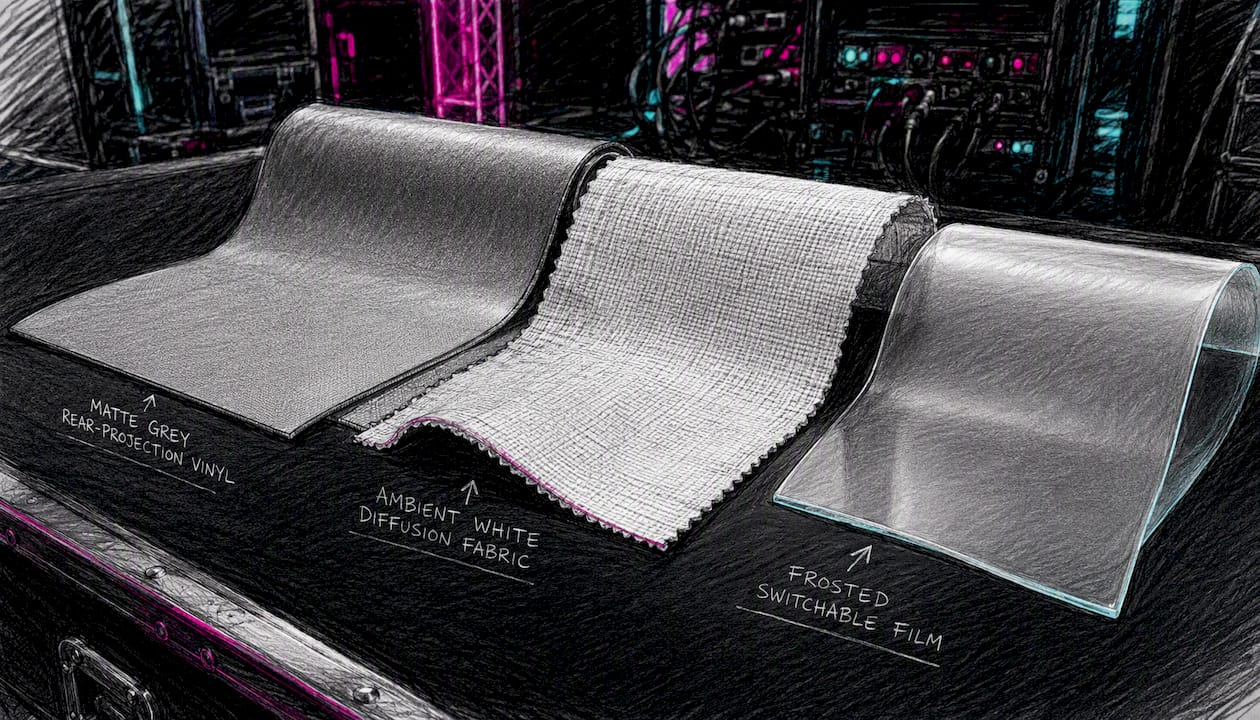
UK suppliers worth knowing as examples include the Stage Depot grey rear projection screen and Pro Display’s rear-projection materials, both cited regularly in UK AV specification documents. Neither is an endorsement, simply a marker of what is commonly available in this market. Standard front-projection surfaces will not work for rear use; the material has to be built specifically for transmission.
Builds range from framed permanent screens to fast-fold portable frames and fully cabinetled rear-projection enclosures for touring shows.
Pro Tip: Match screen gain to your content type. Video and motion graphics tolerate lower-gain, wider-viewing-angle material, but dense text or fine graphics benefit from a higher-gain surface and a brighter projector to keep edges crisp.
Is rear projection better than front projection?
Neither wins outright. It depends on your venue, your budget and how much you value a shadow-free stage against how much depth you actually have behind the screen.
| Factor | Rear projection | Front projection |
|---|---|---|
| Space/throw distance | Needs depth behind the screen | Needs clear sightline in front |
| Brightness (lumens) | Higher lumens usually needed, light lost through diffusion | Lower lumens often sufficient |
| Viewing angle | Narrower viewing cone | Wider audience spread possible |
| Cost (hire vs buy) | Higher, especially with mirror relays | Generally lower for standard setups |
| Aesthetics | No shadows, gear concealed | Presenter shadows possible, rig visible |
Rear projection removes on-stage shadows, keeps rigging and cabling out of sight, and gives technicians a working back-of-house zone, reflecting conference room technology trends that prioritise clean stage appearances. The trade-offs are real: brightness loss through the diffusion material, the need for rear space you might not have, and a narrower viewing cone than front projection allows.
If your venue has the depth and you want a polished, gear-free look, rear projection tends to win. If space is tight or your audience spreads wide, front projection or an LED wall usually makes more sense.
What should you check before specifying rear projection?
Run these checks before you commit a venue to a rear-projection build, because the wrong answer on any one of them can force a redesign on-site.
- Measure the depth behind the screen. You need enough throw distance for your lens, plus access space for technicians.
- Check access routes. Can you get a projector, cabling and a technician behind the screen without disrupting the room during the event?
- Assess ventilation and noise. Enclosed rear-projection cabinets trap heat and projector fan noise; plan cooling accordingly.
- Confirm sightlines and seating rake. Every seat needs to sit inside the screen’s viewing cone, or the image will look dim or discoloured from the sides.
- Estimate lumens for ambient light. As a rule of thumb, budget for more lumens than an equivalent front-projection setup to compensate for light lost through the material, and scale up further for a brightly lit conference hall versus a blacked-out theatre.
A worked example: a 3.7m by 2.7m screen in a mid-sized conference hall, similar in scale to a 12 foot by 9 foot FastFold projector screen, typically needs a short-throw lens if your rear space is limited, paired with a projector in the higher-lumen band to punch through ambient room lighting and screen transmittance loss together.
Pro Tip: If your rear space is too shallow for the throw distance you need, ask about a mirror relay system. It folds the light path using a mirror, which shortens the physical depth required, but it adds cost, alignment complexity and usually justifies a technical site visit before you book anything.
Where does rear projection actually get used?
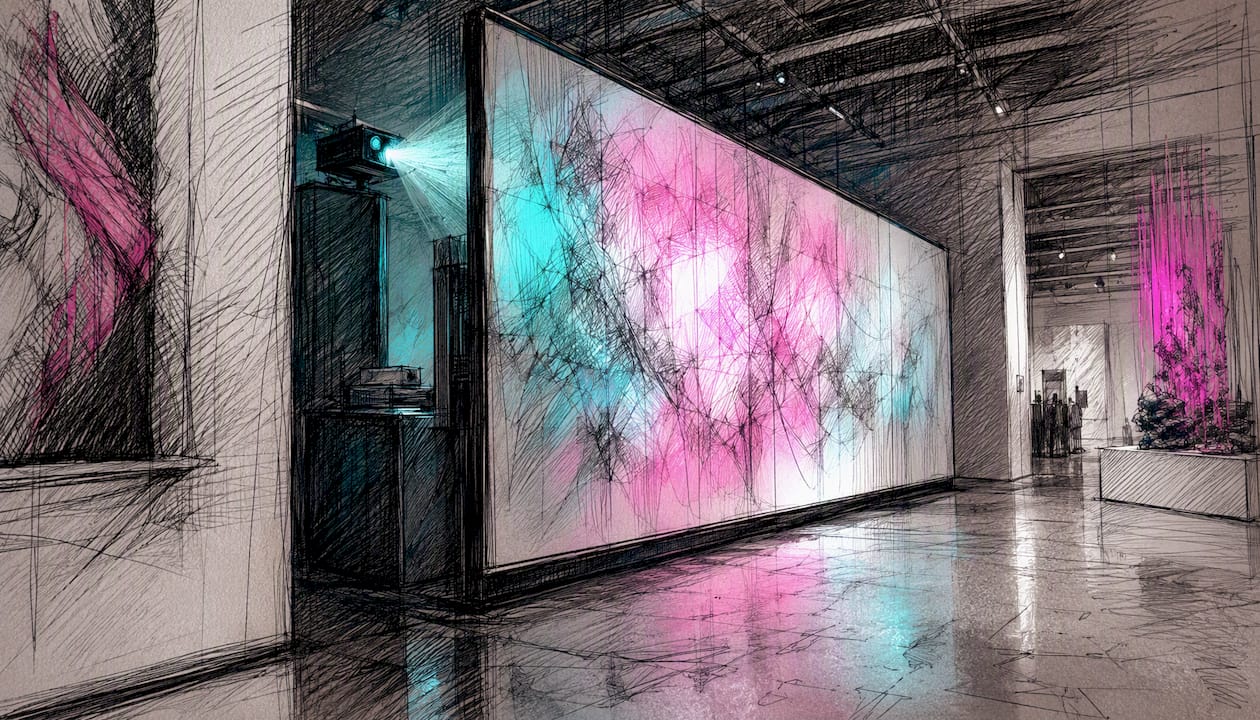
Rear projection suits awards nights, theatre backdrops, museum exhibits, retail window displays, broadcast studios and immersive exhibition spaces, anywhere a clean, shadow-free image matters more than raw viewing angle. It is a poor fit for small rooms with no rear access and for wide, shallow rooms where the audience spreads beyond the viewing cone. Noise-sensitive spaces, such as broadcast sets or recording sessions, also benefit from having the projector’s fan noise sealed away behind the screen.
What does rear projection cost to hire in the UK?
Hiring a rear-projection package makes sense for a single event; buying only pays off if you are running the same setup repeatedly, because a permanent installation carries ongoing maintenance and storage costs a one-off hire avoids.
A typical UK hire package bundling a rear-projection screen, short-throw projector, lens, cabling and a technician for setup and breakdown usually sits in the low hundreds of pounds per day for a standard conference-sized screen, rising well beyond that for bespoke materials, mirror relay systems or high-lumen projectors on larger stages. Costs climb further with permanent framing, site works, or where a supplier has to run a full technical survey before quoting.
Ask your AV supplier for:
- A site survey to confirm throw distance and rear-space depth
- A lens test against your actual screen size, not a generic spec sheet
- Confirmation of blackout or ambient-light requirements for the room
How does Firefly AV handle rear-projection installs?
Firefly AV is based in Leeds and Preston and works UK-wide, supplying Panasonic projectors, Absen LED wall, Sennheiser mics, Allen & Heath consoles, DB Technologies speakers, Birddog cameras and Lite Deck staging for events that need rear projection alongside full production support.
Our process runs through a site survey, throw-distance calculation, lens selection, screen material selection, a test install and final tuning before doors open, catching hotspotting and lumen mismatches before your event, not during it.
Getting the lumen band and lens right on paper means nothing until you have tested it against the actual screen material in the actual room.
Maintenance and specs: gain, transmittance and viewing angles
Three specs decide how a rear-projection screen will actually perform: gain, transmittance and viewing angle. Gain measures how much a screen amplifies or diffuses incoming light relative to a standard reference surface. A higher-gain rear-projection material throws a brighter image but usually narrows the viewing cone, so people seated at sharp angles see a dimmer or discoloured picture. Transmittance describes what percentage of the projector’s light actually passes through the material to reach the audience; the rest is absorbed or scattered within the screen itself, which is why rear-projection setups generally need brighter projectors than an equivalent front-projection rig.
Viewing angle, sometimes called the viewing cone, defines the horizontal and vertical range within which the image looks correctly lit and coloured. A narrow viewing angle is fine for a lectern-facing conference room but wrong for a wide banqueting layout where guests sit far to either side of centre.
On maintenance, rear-projection material is generally low-upkeep: keep the surface free of dust and fingerprints, avoid folding fast-fold fabric screens tightly during storage, and check tensioning on framed screens periodically, since a slack surface introduces visible ripples that distort the image. Cabinets and enclosures need occasional checks on ventilation fans, since trapped heat shortens projector lamp life and can trigger thermal shutdowns mid-event.
Choosing rear projection for your specific venue
Three factors decide the call more than any spec sheet: space, ambient light and audience size. Space is the hard constraint. If you cannot find the depth for your lens’s throw distance, rear projection is off the table unless you introduce a mirror relay system, which adds cost and complexity. Ambient light matters because rear-projection screens generally need more lumens to punch through a lit room than front-projection ALR (ambient light rejecting) surfaces designed for exactly that problem.
Audience size and layout decide whether the viewing cone works for you. A lectern-style room with a narrow, forward-facing seating block suits rear projection well. A wide banqueting layout with tables spread far to either side will push viewers outside the viewing angle, producing a dim or washed-out image for anyone sitting off-axis.
As a working rule: choose rear projection when you have the rear depth, a controllable ambient light level, and a seating plan concentrated within a reasonable viewing angle. Choose front projection or an LED video wall when floor space is tight, the room stays bright throughout, or your audience spreads wider than a rear screen’s viewing cone comfortably covers.
Which projectors and brightness levels suit UK events?
Short-throw and ultra-short-throw projectors dominate rear-projection setups in UK venues because they minimise the depth needed behind the screen, a genuine constraint in most conference hotels, hired halls and temporary exhibition stands. Standard-throw lenses still have a place in permanent installations, such as museum displays and broadcast sets, where the rear space is built into the room from the start.
Brightness requirements scale with room size and ambient light. A small meeting room with blackout curtains can run comfortably on a mid-range lumen projector, while a daylight-lit exhibition hall or a large conference plenary needs a projector well up the lumen scale to compensate for both ambient light and the light lost through the screen’s transmittance. Products such as the Panasonic PT-VMZ50 sit in the brightness band commonly specified for mid-to-large UK conference and event spaces.
The practical takeaway for planners: never specify a projector purely on the screen size. Always factor in ambient light, screen transmittance and viewing distance together, and get your supplier to confirm the lumen figure against your actual room, not a generic recommendation.
When we would actually recommend it
We lean towards rear projection for high-end events where concealed gear and a quiet, shadow-free stage matter, museum displays, and any room where you genuinely have the depth to spare. For tight spaces, wide audiences or tighter budgets, front projection or an LED wall usually wins on cost and flexibility. It always comes down to trading space against aesthetics against budget, in that order.
Book a survey with Firefly AV
If a rear-projection build looks right for your event but you are not sure your venue has the depth for it, that is exactly what a site survey is for. Firefly AV runs site surveys, supplies hire packages either as kit alone or kit plus technicians, and handles test installs and on-event technical support so the lens and lumen figures are confirmed before your event day, not during it.
We work UK-wide from our Leeds and Preston offices, covering conferences, awards nights, exhibitions and broadcast events. Start with our guide to audio visual equipment for event planners if you want the wider context, or head straight to our AV equipment hire page to check availability and get a quote for your dates.
Sources
- Front vs Rear Projection — ProjectorCentral
- Rear projection screen — Wikipedia
- Rear projection screen guide: materials & setup tips — AWOL Vision
FAQ
Do you need a special screen for rear projection?
Yes. A standard front-projection screen reflects light and will not work for rear use; you need material built specifically for transmission, such as rear-projection vinyl or dedicated diffusion film.
What are the disadvantages of rear projection screens?
The main drawbacks are light loss through the diffusion material, a narrower viewing cone than front projection, the risk of hotspotting with short-throw lenses, and the need for enough depth behind the screen to fit the projector’s throw distance.
Is rear or front projection better for events?
Neither is universally better. Rear projection gives a shadow-free stage and conceals gear, which suits awards nights and broadcast sets, while front projection needs less rear space and suits wider audiences, so the right choice depends on your venue and seating plan.
When did rear projection televisions stop being made?
Rear projection television sets were largely phased out of consumer manufacturing as flat-panel LCD and plasma TVs became cheaper to produce, though the rear projection technique itself remains standard in professional AV, events and exhibition design.
How much does it cost to hire a rear projection screen in the UK?
A standard conference-sized rear-projection package, including screen, short-throw projector, lens and a technician, typically runs in the low hundreds of pounds per day, rising with bespoke materials, mirror relay systems or high-lumen projectors for larger stages.