Robotic camera system: what it is and how it works
Date added: 3/08/2026
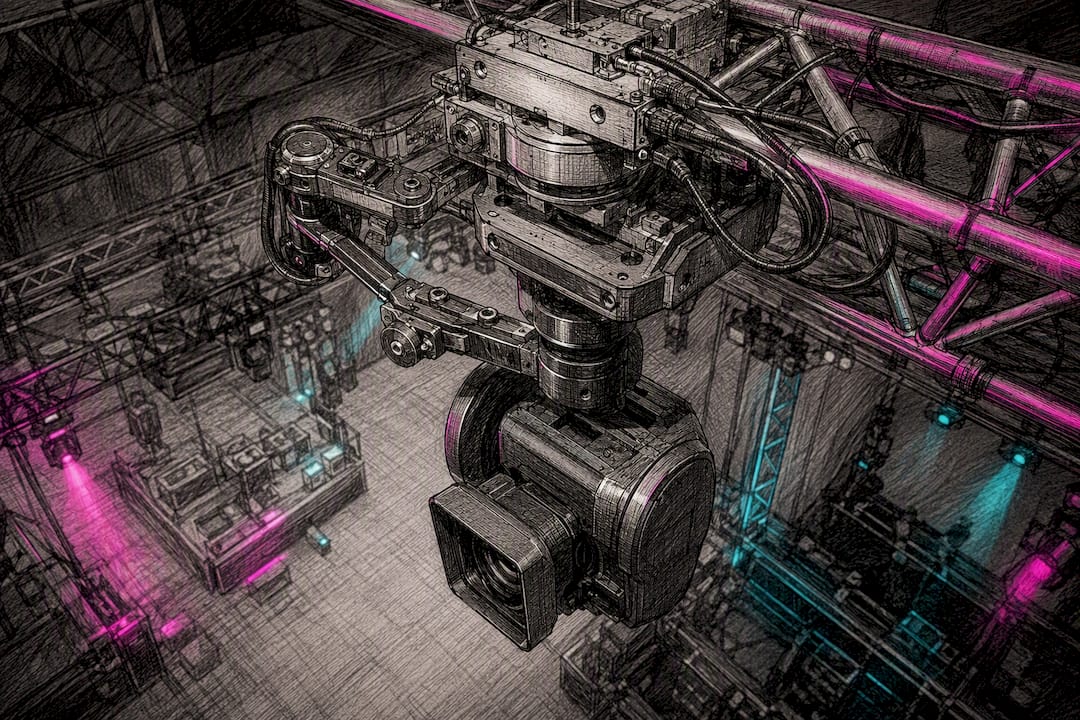
A robotic camera system is a motorised, computer controlled camera rig that moves, pans, tilts, and zooms on programmed or remotely operated paths, letting one operator run several cameras at once instead of a full crew running one each. It covers everything from studio-mounted pan and tilt heads to rail-based cinebots that repeat an identical move frame for frame, and it’s now standard kit in television galleries, outside broadcast trucks, and virtual production stages.
- Automation and repeatability: moves can be programmed once and replayed exactly, which matters for compositing and multi-take product shoots.
- Remote multi-camera control: robotic systems allow a single operator to run several devices from one control panel, cutting crew numbers on studio floors.
- Graphics and AR integration: positional data feeds virtual sets and on-screen graphics so overlays track the camera in real time.
Firefly AV is an AV hire and event production company based in Leeds and Preston, working across the UK, and this guide reflects how we brief, hire, and integrate robotic camera kit for broadcast and live production clients.
Key Takeaways
Robotic camera systems succeed when payload, control software, and positional data are matched to the production, and when rigging and calibration time are budgeted realistically.
| Point | Details |
|---|---|
| Match payload to camera weight | Confirm rig payload rating leaves a safety margin above your heaviest lens and body combination. |
| Budget calibration time separately | Allow a half day to a full day for rigging and encoder calibration before any live rehearsal. |
| Hire usually beats buying | PTZ hire runs roughly £80 to £200 per day; robotic arms run £600 to £1,500+ per day with an operator. |
| Positional data drives AR and graphics | Confirm the control software outputs live position feeds before relying on it for virtual sets. |
| Firefly AV supplies hire and integration | Firefly AV, based in Leeds and Preston, offers PTZ and robotic camera hire with technician and switcher integration UK-wide. |
Table of Contents
- What are the main types of robotic camera systems?
- How do control software and integration actually work?
- Where do robotic cameras earn their keep in broadcast and live events?
- How do you choose the right robotic camera system?
- How much does a robotic camera system cost to hire or buy?
- What safety and operator standards should you expect?
- How does Firefly AV integrate robotic cameras into a live gallery?
- How long does installation and setup usually take?
- What maintenance does a robotic camera system need?
- How do robotic cameras fit existing broadcast workflows?
- When should you choose robotics over a conventional camera crew?
- Get robotic camera systems hired and integrated with Firefly AV
- Sources
- FAQ
What are the main types of robotic camera systems?
Four families cover most broadcast and event needs, and picking the wrong one is the most common (and expensive) mistake production teams make at the briefing stage.
- Robotic arms and cinebots: multi-axis arms capable of sweeping, high-speed moves; typically rated for box cameras and large-sensor cinema bodies, with payloads suitable for typical studio-grade rigs.
- PTZ heads: motorised pan, tilt, and zoom units carrying a fixed lens camera, popular for lecture capture, panel discussions, and multi-camera studio work where a compact footprint matters.
- Motorised dollies and rail systems: linear or curved track that moves a camera smoothly along a fixed path, common on product shoots, awards stages, and set-piece studio sequences.
- Pedestal and column systems: vertical lift units combined with pan and tilt heads, used where a camera needs to rise and fall as well as pivot, such as news studios and panel shows.
Panasonic’s product range spans robotic arms, motorised dollies, columns, elevation units, and pan and tilt mechanisms built to work with PTZ, 4K box, and large-sensor cameras. As a rough matrix: studio news and panel shows lean on pedestals and PTZs; outside broadcast and sport favour compact PTZ heads on fixed rigging points; concerts and awards use arms and rails for sweeping hero shots; product shoots and virtual production rely on cinebots for exact repeatability. Footprint and cable runs matter as much as payload. A rail system needs clear floor space and a straight or gently curved run, while a column unit needs headroom and a stable fixing point, so venue surveys should always precede the spec sheet.
How do control software and integration actually work?
Robotic camera systems work by combining a motorised head or rail with encoders that report exact position, fed into a controller that talks to production software over a network. Every axis, pan, tilt, zoom, focus, dolly travel, carries its own encoder, so the system always knows precisely where the camera is and can return to that exact point on command.
- Motion head or rail: the physical hardware moving the camera along programmed axes.
- Controller and control panel: hardware or software interface where an operator drives the rig or triggers saved shots.
- Vision switcher integration: the robotic system feeds a clean signal into the same switcher handling manual cameras, so cuts between robotic and human-operated shots are seamless.
- Automation and orchestration software: sequences multiple cameras, ties moves to a rundown, and can trigger shots on a timecode.
Industry guidance is consistent on one point: hardware without a proper integration layer is not much use on its own, since production teams need control software that talks to lighting consoles and vision switchers for the whole rig to behave as one system rather than isolated gadgets. Positional data also feeds graphics engines and AR overlays, which is why encoded axes and modular rails matter so much in virtual production. Glossary in brief: DOF means degrees of freedom (how many axes a rig moves on), API is the software interface other systems use to talk to the rig, and positional data is the live coordinate feed the camera sends out.
Where do robotic cameras earn their keep in broadcast and live events?
Robotic systems earn their place wherever repeatability, reduced headcount, or precise positional data matter more than a human operator’s improvisation.
- Live studio shows: fixed PTZ and pedestal rigs cut the floor crew while keeping shot quality consistent across a series run.
- Outside broadcast for sport: compact PTZ heads on gantries or barriers capture angles a full crew can’t reach safely.
- Concerts and awards nights: robotic arms deliver sweeping hero shots that would be nearly impossible to repeat by hand, night after night.
- Product shoots and virtual production: cinebots handle high-speed, identical passes for VFX compositing and green screen work.
A UK broadcast gallery running robotics typically has one operator managing four or five cameras from a single desk, freeing the rest of the crew for graphics, sound, and direction.
How do you choose the right robotic camera system?
Match the rig to camera payload and axes first, because underspecifying either forces a costly mid-project swap. Everything else, control software, footprint, cost, follows from getting that match right.
| Type / best for | Payload / camera compatibility | Axes / motion range | Control & integration | Footprint / install complexity | Typical cost / hire day rate | Operator skill required |
|---|---|---|---|---|---|---|
| Entry PTZ head (studio, panels) | fixed-lens cameras | Pan, tilt, zoom | Basic panel or software, switcher integration | Small, quick to rig | £80 to £200 per day | Low, minimal training |
| Pedestal/column (news, panel shows) | box cameras | Pan, tilt, elevation | Panel control, timecode triggers | Medium, needs fixed floor point | £250+ per day | Moderate, short briefing |
| Motorised dolly/rail (product, stage) | mirrorless to cinema bodies | Linear/curved travel, some pan/tilt | Software programmed moves | Medium to large, needs clear run | £300+ per day | Moderate to high |
| Robotic arm/cinebot (VFX, hero shots) | cinema cameras | Full multi-axis, high speed | API driven, AR/graphics feed | Large, significant rigging | £600 to £1,500+ per day | High, specialist operator |
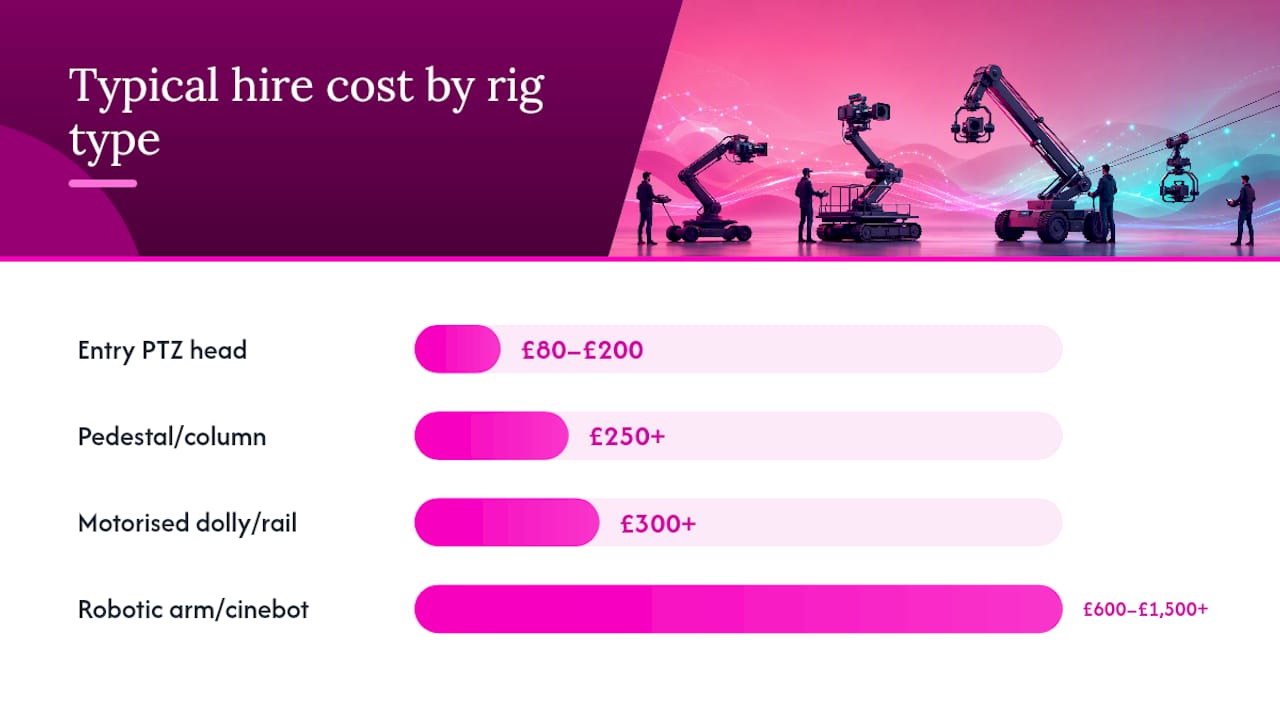
Before signing off, ask suppliers: what payload margin does the rig have above your heaviest lens and camera combination? What control protocol does it use, and does it output live positional data for graphics? What’s the minimum rigging lead time? Red flags include a vendor who can’t confirm a control API, a rig with no positional data output for AR or graphics work, or a payload rating with no safety margin above your actual camera weight.
How much does a robotic camera system cost to hire or buy?
Hiring beats buying for most one-off events and short series, while owning a rig only pays off for broadcasters running daily or weekly studio output over several years. A single PTZ head can be bought outright for a few thousand pounds, but a broadcast-grade robotic arm or cinebot runs into five or six figures, so most UK production companies hire rather than tie up capital.
- PTZ head day hire: at a cost depending on lens and control panel.
- Robotic arm or cinebot hire: at a cost including a trained operator.
- Motorised dolly or rail package: at a cost for hardware and rigging.
Pro Tip: Budget for at least a half-day rigging and calibration slot on top of the show day itself, robotic heads need encoder calibration on site before they’ll return to a saved position reliably.
Firefly AV runs stock across PTZ cameras for dry hire or technician-operated packages, on a two-day hire week structure for short and long-term bookings across the UK.
What safety and operator standards should you expect?
Robotic camera rigs carry real risk around moving mass, overhead rigging, and live cabling, so competent operators and proper documentation are not optional extras.
- Defined exclusion zones around moving arms and rails during rehearsal and live operation.
- Load limits confirmed against certified rigging points, never estimated on site.
- Emergency stop procedures every operator and floor manager understands before doors open.
- Current insurance, method statements, and risk assessments requested from any hire supplier in advance.
Ask for the operator’s training record and the rig’s last inspection certificate before it arrives on site.
How does Firefly AV integrate robotic cameras into a live gallery?
A site survey comes first: cable runs, network capacity, power drops, and rigging points all need confirming before a robotic head goes anywhere near a truss. From there, the sequence is network and IP addressing plan, power distribution check, physical rigging, then interoperability testing with the vision switcher and graphics system before the crew ever touches a live rehearsal.
- Site survey covering rigging points, power, and network capacity.
- IP addressing plan agreed with the venue or OB truck engineer ahead of build day.
- Switcher and graphics interoperability tested during rig, not left until rehearsal.
Pro Tip: Allow a full rigging and test day before any multi-camera robotic shoot, same-day rig and shoot is the most common cause of on-air glitches we see.
Firefly AV, based in Leeds and Preston, also stocks the wider kit that surrounds a robotic camera setup: Absen LED walls, Panasonic projectors, Sennheiser mics, Allen & Heath consoles, DB Technologies speakers, and Lite Deck staging.
How long does installation and setup usually take?
A single PTZ head on a fixed bracket can be rigged, cabled, and calibrated inside two to three hours by an experienced technician, provided power and network points already exist at the mounting position. Add a rail or dolly system and that timeframe stretches to a half day, since track alignment and encoder calibration both need checking before the rig will hit a saved position reliably.
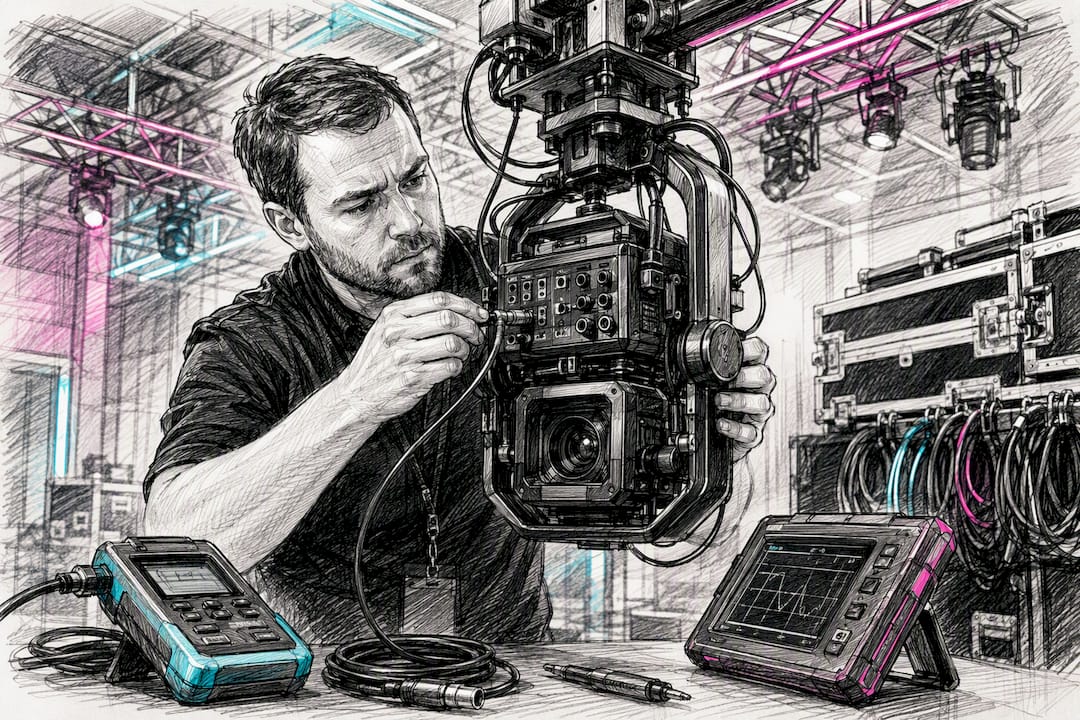
Full robotic arm or cinebot installs, especially where AR or virtual production integration is involved, typically need a full rigging day followed by a separate calibration and interoperability test day. That second day matters more than production schedules usually allow for: positional data feeding a graphics engine has to be checked against every planned camera position, not just a couple of test points, or the AR overlay will drift once the shoot starts moving through a real rundown.
Multi-camera studio installs with several robotic heads plus pedestals commonly run three to five days from first cable pull to signed-off rehearsal, including switcher and lighting console integration. OB trucks compress this timeline because much of the control infrastructure is pre-built into the vehicle, but venue rigging, especially in older UK theatres or town halls with limited truss access, can add a day or more versus a purpose-built studio. Booking a realistic install window, rather than assuming a robotic rig behaves like a tripod you can drop in an hour before doors, is one of the most common planning gaps production managers hit on their first robotics-equipped shoot.
What maintenance does a robotic camera system need?
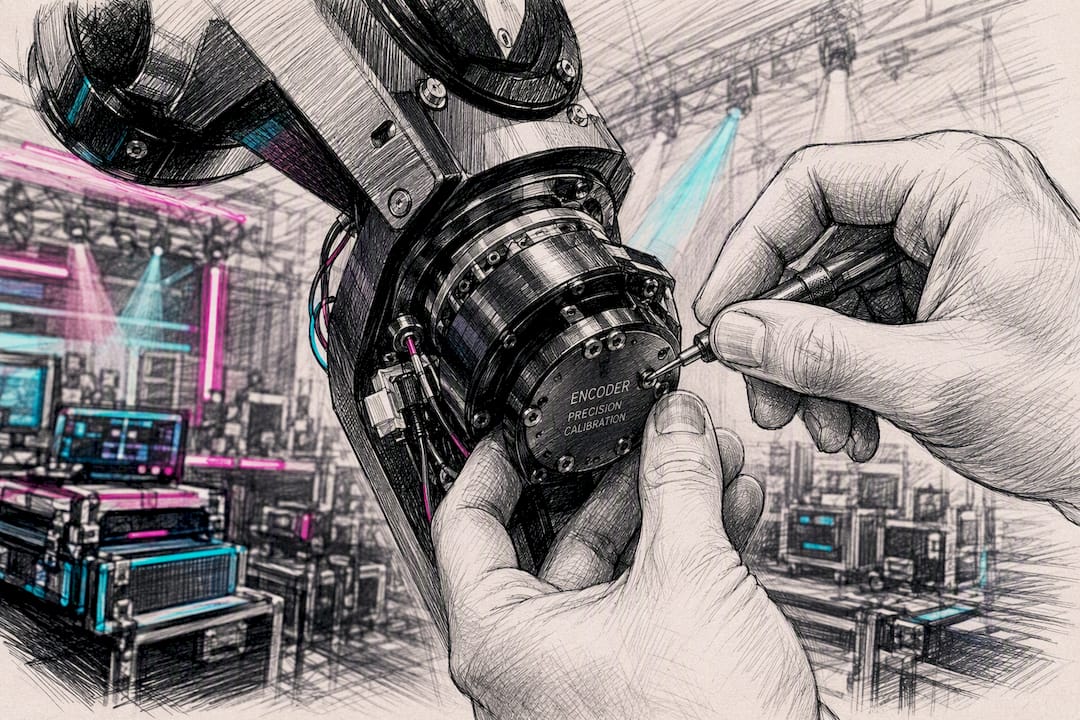
Encoders drift over time, and a rig that hasn’t been recalibrated in months will start missing its saved positions by a noticeable margin, usually before anyone notices until a shot lands wrong on air. Regular calibration checks, ideally before every major shoot rather than on a fixed monthly schedule, catch this before it becomes a live problem.
Cabling and connectors take more physical wear on a moving rig than on a static camera, since every move flexes the same cable run repeatedly. Hire suppliers and in-house engineering teams should inspect cable strain relief and connector wear on a rolling basis, particularly on rail and dolly systems where the cable travels the full length of the track on every pass.
Software updates matter just as much as physical maintenance. Control software and firmware on robotic heads get periodic updates from manufacturers addressing everything from encoder accuracy to new integration protocols, and a rig running outdated firmware can lose compatibility with a newer switcher or graphics package mid-project. Reliability, in practice, comes down to three habits: calibrate before every serious shoot, inspect cabling on a fixed schedule rather than waiting for a fault, and keep firmware current rather than treating an update prompt as something to defer.
How do robotic cameras fit existing broadcast workflows?
Robotic camera systems only add value once they’re speaking the same language as the rest of the gallery, which means the vision switcher, lighting console, and graphics engine all need to see the robotic rig as just another input, not a separate system running in parallel. Most modern robotic controllers support standard broadcast integration protocols specifically so they can sit alongside manually operated cameras on the same switcher bank without special workarounds.
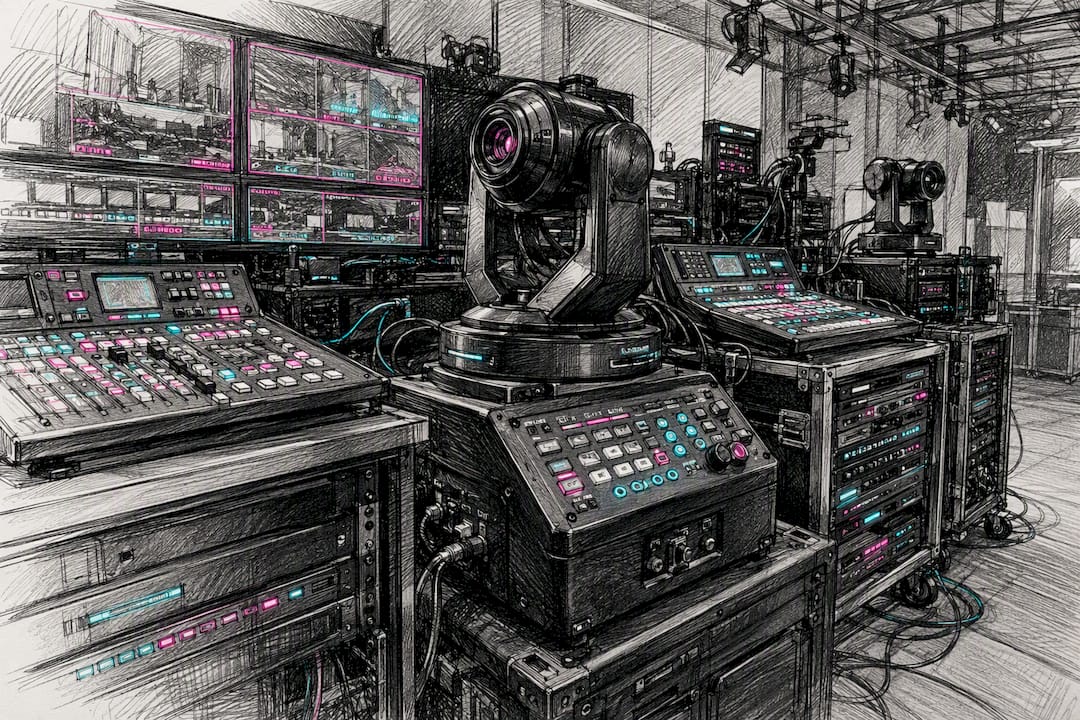
The practical test is whether an operator can cut between a robotic shot and a human-operated camera without the audience noticing a difference in framing quality or timing. That depends on the robotic system’s control software talking cleanly to the switcher’s tally and preview system, something worth confirming during a technical rehearsal rather than assuming from a spec sheet. A multiview and SDI setup that already handles several manual camera feeds should be able to add a robotic feed with minimal reconfiguration, provided the robotic controller outputs a standard SDI or IP signal.
Positional data integration is where workflows most often break down. Graphics and AR systems need a continuous, accurate feed of the camera’s exact position, and if that data path isn’t tested against the actual graphics engine in use, on-screen elements will drift out of alignment the moment the camera moves off its calibrated start point. This is precisely why modular robotics and encoded positional data are treated as the enabling technology behind virtual production, not the robotic arm itself.
When should you choose robotics over a conventional camera crew?
Choose robotics when a shot needs to repeat exactly, compositing, product passes, multi-camera studio work with a lean crew, and keep a human operator when the shot depends on reading a live, unscripted moment.
- Robotics wins: repeatable moves, reduced headcount, positional data for graphics or AR.
- Human crew wins: fast-breaking live events, improvised framing, unpredictable subjects.
- Most well-run productions blend both: robotics on fixed, repeatable angles, operators on anything that needs a human eye reading the room in real time.
Get robotic camera systems hired and integrated with Firefly AV
Firefly AV supplies robotic and PTZ camera hire, technician support, and full integration into your gallery or OB setup, from our Leeds and Preston bases, UK-wide.
A typical package pairs a robotic head or PTZ camera with an operator, control panel, and cabling on a standard two-day hire week, so you’re not paying for kit sitting idle either side of the shoot. We also supply the switchers, multiview screens, and staging that sit around the camera system, meaning one point of contact rather than three separate suppliers to coordinate on show day.
Browse our current AV equipment hire range or read our primer on audio visual equipment for event planners if you’re briefing a supplier for the first time. To get a quote or arrange a site survey for your venue, get in touch and tell us your camera count, venue type, and show dates.
Sources
- Robotic Systems | Panasonic Connect
- Complete Guide to Studio Robotics | Mark Roberts Motion Control
- Camera Robotics | Definition
FAQ
What are robotic cameras?
A robotic camera is a motorised camera or camera head controlled remotely or by programmed moves, letting one operator run several cameras at once rather than needing a dedicated crew member per camera.
How much does a robotic camera system cost?
Day hire for a PTZ head typically runs £80 to £200, while a robotic arm or cinebot with an operator runs roughly £600 to £1,500 or more per day; buying a broadcast-grade system usually costs five to six figures outright.
What are some examples of robotic camera systems?
Examples include Panasonic robotic arms, dollies, and pedestal systems, Ross Video camera motion systems, XD-Motion and ARCAM rail systems, and PTZ units like BirdDog cameras, all commonly stocked or specified by AV suppliers such as Firefly AV for broadcast and event work.
Is robotic surgery good or bad? Does that relate to camera robotics?
Robotic surgery is a separate medical field and isn’t connected to broadcast robotic camera systems; the “robotic” term simply describes automated, precision controlled hardware in both fields, but the applications, risks, and standards are entirely different.
Do I need a specialist operator for a robotic camera rig?
Basic PTZ heads need only short operator briefing, but robotic arms and cinebots feeding AR or graphics systems need a specialist trained on that specific control software and rigging setup.
Can Firefly AV supply an operator alongside the camera hire?
Yes, Firefly AV offers both dry hire and technician-operated robotic and PTZ camera packages from its Leeds and Preston bases, alongside switcher, staging, and lighting kit for the same event.